Turkish geology and seismology experts have reacted with harsh criticism to a controversial analysis published by The New York Times (NYT), which cites a study published in the journal Science that argues that seismic activity in the Marmara Sea region has progressively shifted from west to east over the past 15 years, increasing tectonic stress near Istanbul, which could trigger a major earthquake with devastating consequences.
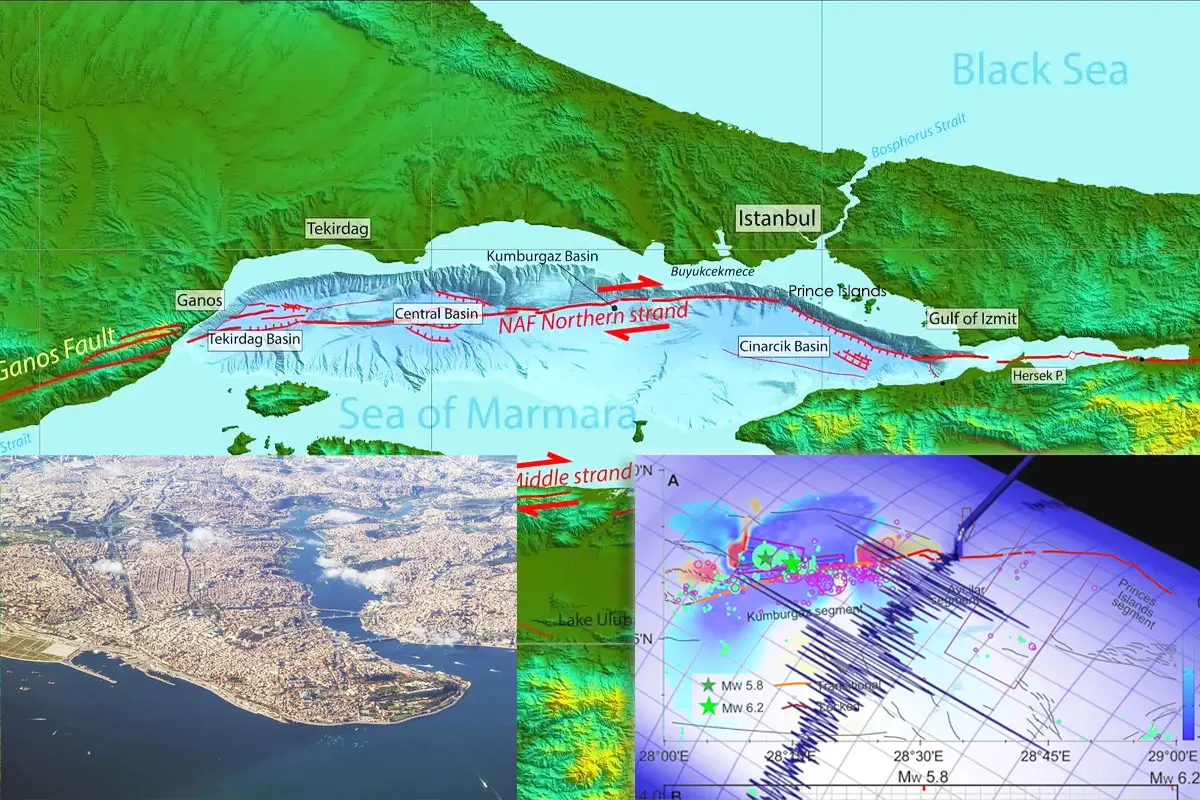
The NYT article warns that “A very large earthquake striking near Istanbul will likely cause one of the worst humanitarian disasters in recent history“. The information is supported by a study led by scientists at the GFZ Helmholtz Centre for Geosciences, according to which the smaller, slow-slip western sections of the Marmara fault would be pushing stress build-up towards the eastern segments of the tectonic fault, closer to Istanbul, raising the probability of a major rupture that would unleash a large earthquake in the Turkish metropolis.
Although earthquakes are usually followed by a phase of energy release along the fault line, the researchers of this study say the 6.2 magnitude earthquake on 23 April in Istanbul, a city of some 16 million people, did not reduce the danger. On the contrary, it would have increased pressure on eastern segments of the fault south of Istanbul that remain locked and accumulating energy, raising stress levels unusually high.
The authors of the study describe this phenomenon as a domino effect occurring from west to east along the entire fault line: while the western sections slowly slip eastward, the eastern sections remain locked, storing up stress that could be released in a powerful earthquake. The area near the Princes’ Islands segment appears to be the most likely candidate for a strong rupture of the tectonic fault.
Turkish geologists call the study “alarmist“
However, several Turkish experts consulted by various media in Turkey argue that the study is not new and do not hesitate to describe it as “alarmist“, presenting as new findings data and conclusions that are well known to the scientific community.
“We have already spoken clearly about this in articles in 2004, 2021 and 2025, and published it in detail in preliminary work. But in the news it is presented as if it is the first time it is mentioned,” said Professor Tuncay Taymaz, from the Department of Engineering Geophysics and the Institute of Disaster Management at Istanbul Technical University, in statements to the daily Milliyet.
In the same vein, seismologist Bülent Kaypak stressed that, despite being a detailed study published in a high-impact journal such as Science, “what is presented is ultimately only a hypothesis“, and called for the debate to focus on preventive measures.
Professor Şükrü Ersoy said after reading the article that it “does not say anything new“: “It compiles well what is already known, and presents it in a simpler way using some geophysical methods”, says Ersoy, although he agrees with the rest of the Turkish scientific community that the seismic risk in the Marmara persists and that there is a possibility of a future magnitude 7 earthquake in Istanbul.
A study “without any basis” and that tries to “instil fear“
The harshest criticism, however, came from the renowned professor Şener Üşümezsoy, famous for having predicted weeks in advance the wave of earthquakes that left hundreds of people injured in Istanbul last April. Speaking to CNN Türk and reported by the daily Hürriyet, Üşümezsoy described the NYT article as “speculative” and “without any basis“, accusing the US newspaper of “trying to instil fear in society”.
“Previously they published analyses suggesting that the fault was moving from east to west, heading towards the Princes Island fault, and that Istanbul was going to be destroyed. At that time, we said that the fault was moving towards the Düzce province (east of Istanbul). After the Düzce earthquake, they kept silent. Then they said that a 110 km section of the fault, from Yeşilköy to Gaziköy (from Istanbul to Tekirdağ), would rupture, causing a 7.5 magnitude earthquake; but the analysis carried out with submarines concluded that only 60 km of this fault had ruptured, and that there is no accumulated stress on the (Princes’) Islands fault,” Üşümezsoy said indignantly on TV.
“The new study published in the NYT now says that fault activity is shifting from west to east, towards Istanbul… However, these faults do not accumulate stresses progressively, as they say. The analysis mixes apples and oranges. There is no stress accumulation between Büyükçekmece and Küçükçekmece (west of Istanbul). There is no tension either on the Islands’ fault or on this fault. They have come out with a totally wrong logic: they speak as if there is only one fault, when there are two separate faults. There is no accumulated stress on the Avcılar fault (west of Istanbul) either. Therefore, this article lacks any basis whatsoever. It is the story of the boy who cried ‘wolf’, to instil fear in society,” the Turkish expert concluded.
VOTE

EDITORIAL TEAM
🧿 About us
.
Edited and reviewed by:

Pablo Gómez is a specialist in Turkey and has been editor-in-chief of Hispanatolia since 2011. He has been analysing current affairs and geopolitics in Turkey and the surrounding region since 2006.
…
📣 Your ADVERTISING on Hispanatolia
.
🤗 HELP US WITH A DONATION:
💗 Paypal