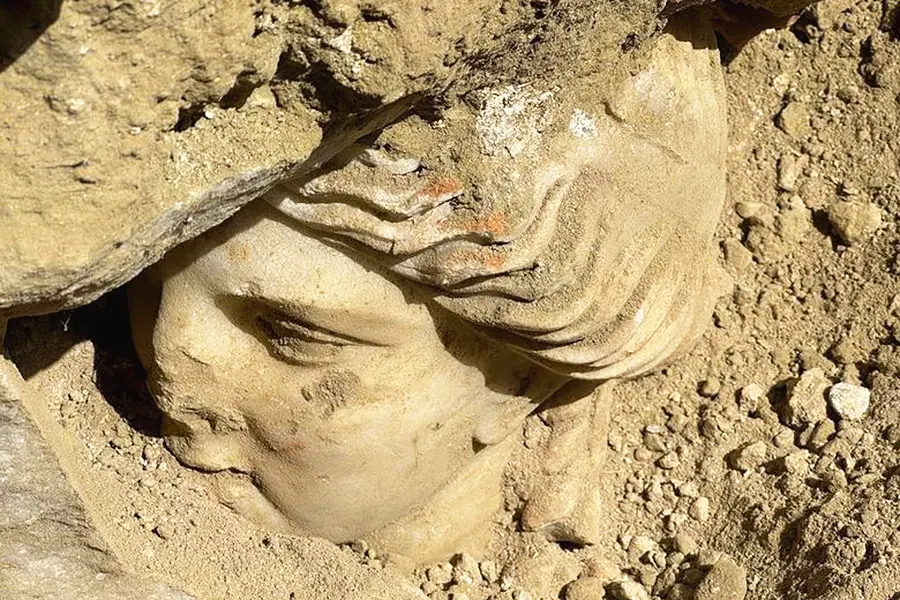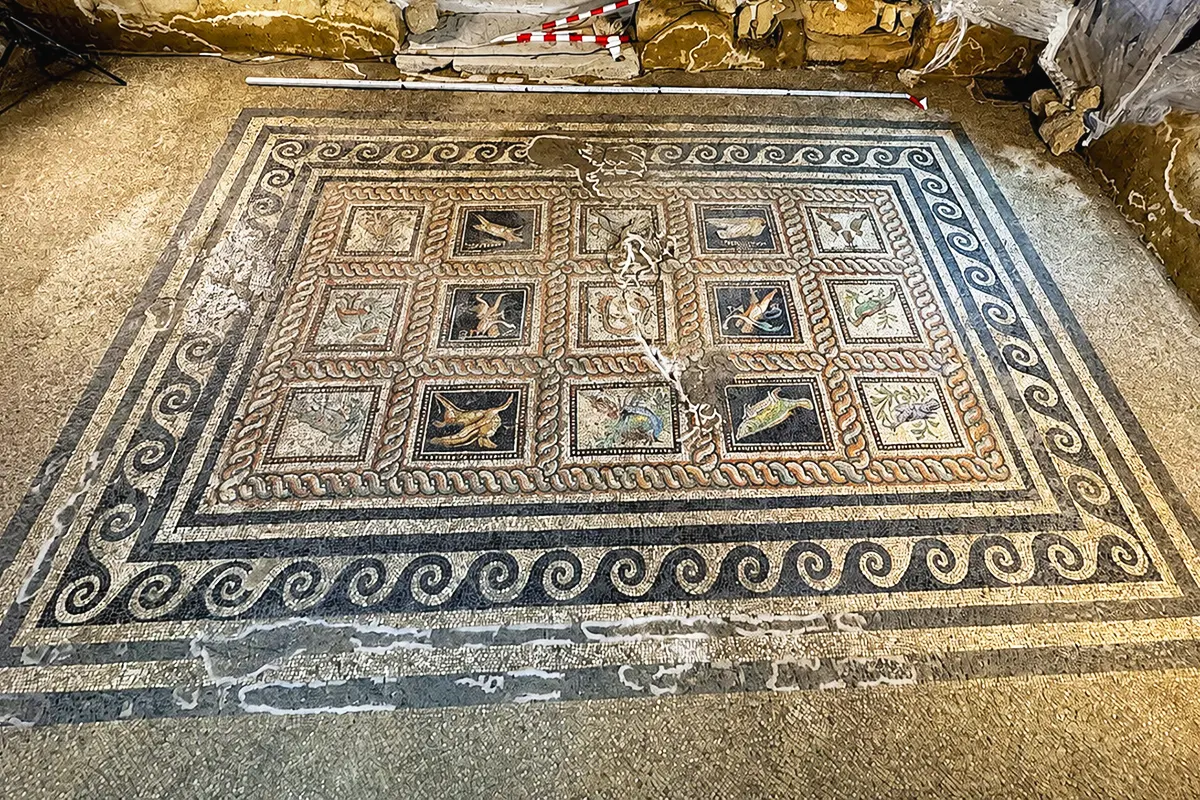
Archaeologists working at the ruins of the ancient city of Adramytteion, situated in the Burhaniye district of Balıkesir province, in north-western Turkey, have discovered a large Roman villa with mosaics that are remarkably well-preserved: a find that provides new insights into what daily life was like in this ancient Greek city, which flourished under the Roman Empire on the north-western coast of Anatolia.
Under the direction of the Balıkesir National Museum Directorate, the archaeological excavations carried out in the Ören neighbourhood have brought to light one of the city’s ancient residential areas dating from the Roman period. Turkish professor Murat Özgen, head of the research team excavating the ruins of Adramytteion (Adramyttium), explained in comments quoted by the Turkish newspaper Hürriyet that two excavation campaigns have been carried out over an area of approximately 9,000 square metres, where exploratory excavations have revealed several superimposed cultural layers.
It was during the second excavation campaign that a Roman residential structure was discovered. As Özgen explained, the building features a central area known as the “atrium”, around which three large rooms are arranged; these rooms are decorated with mosaic floors, walls featuring frescoes, and figurative and geometric ornamentation.
Mosaics featuring cats, dogs and winged horses
“In particular, the northern hall features 15 panels depicting different types of birds, fish and a winged horse, which appears on the coins of the city of Adramytteion from the 4th century BC onwards. The fact that the winged horse appears as a symbol of the city in a Roman-era structure, some 500 years after this motif was used on coins, is quite significant,” the expert emphasised.
The mosaics also include figures of cats and dogs, alongside inscriptions bearing the names of the pets. The cat is identified by a name meaning ‘Emerald’, whilst the dog is named ‘Okyanos’.
The mosaics also contain depictions of Medusa and the Gorgon, as well as figures of pygmies harassing birds. “We see the pygmy motif particularly in the repertoire of North African mosaics. The fact that Adramytteion was a trading city open to the Eastern Mediterranean basin, with its two ports, suggests that the villa may have belonged to a merchant with connections to North Africa,” explained Özgen.
A Roman residence in use for several centuries
According to Özgen, the decorations and objects found in the eastern room indicate that the building was in use during the 2nd century AD, at the height of the Roman Empire, although it continued to be used in later periods. Following the destruction of the villa during the Roman period, a new room was added to the south of the central hall during the 4th and 5th centuries AD, during the Late Roman Empire.
Archaeologists working in the area also identified, on the same plot, the foundations of a large earlier structure, dating from the Hellenistic period. “We have seen that these foundations were reused during the Roman period, which indicates continuity in the area. The finds clearly reveal the existence here of a sophisticated Roman residence, equipped with water features (fountains, ponds) and drainage systems”, explained the professor.
Pipes and other infrastructure elements related to water have also been documented at the site. Together with the newly discovered mosaics, these findings provide a better understanding not only of the architectural features of the Roman villa, but also of the way of life in ancient Adramytteion, the city’s trade relations and how different historical periods overlapped, just as is the case at the nearby ruins of Troy.
📚 If you want to learn more about the history of Turkey, we recommend:
🧿 Discover here more recommended products about Turkey
As an Amazon Associate, we earn from qualifying purchases. This comes at no extra cost to you and helps support this website.
VOTE

EDITORIAL TEAM
🧿 About us
.
Edited and reviewed by:

Pablo Gómez is a specialist in Turkey and has been editor-in-chief of Hispanatolia since 2011. He has been analysing current affairs and geopolitics in Turkey and the surrounding region since 2006.
…
📣 Your ADVERTISING on Hispanatolia
.
🤗 HELP US WITH A DONATION:
💗 Paypal