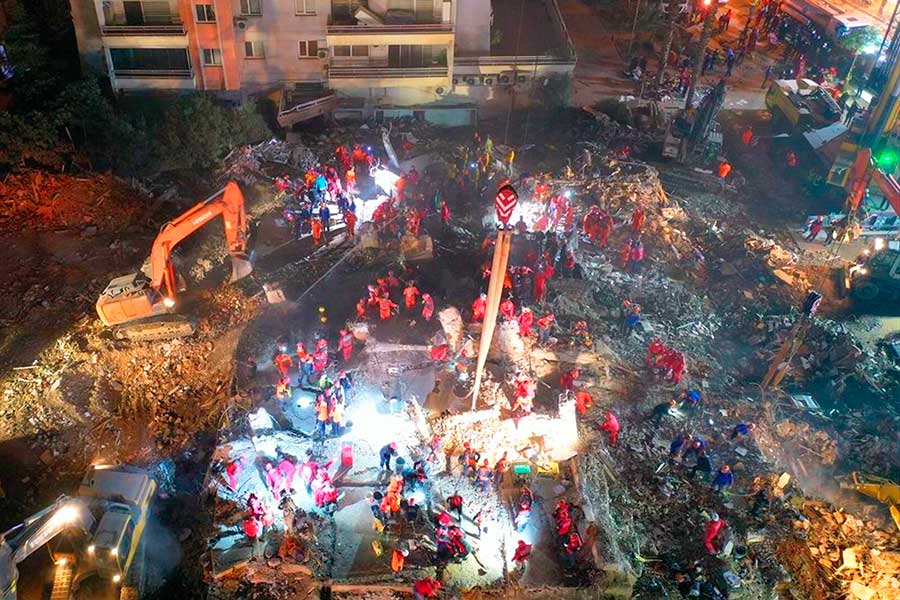
A strong earthquake measuring 5.8 on the Richter scale struck the Aegean coast of Turkey early this morning, leaving one person dead and at least 69 injured. This is the same region of the Eastern Mediterranean where two powerful earthquakes measuring 6 and 6.2 respectively have hit Greece and Turkey in recent weeks, although seismologists insist that the seismic activity in the Aegean is not linked to the recent earthquake in Istanbul that left hundreds injured.
According to the Disaster and Emergency Management Agency, quoted by Turkish media, the quake struck at around 2:17 a.m. local time (1:17 CET) with its epicentre in the Aegean Sea between the coasts of the Turkish province of Muğla and the Greek island of Rhodes, some 10.4 kilometres off the coast of the Marmaris district. In addition to Muğla, it was also felt in the Turkish provinces of İzmir, Aydın, Antalya, Bursa and Kütahya.
The earthquake originated at a great depth – 67.91 kilometres below the earth’s crust – which minimised its effects on the surface but still triggered panic among the region’s population, who rushed out of their homes and in many cases spent the night outdoors, sleeping in parks or in their cars for fear of further aftershocks.
14-year-old girl injured in the quake dies
Most of the 69 people injured in the earthquake in Turkey were panic-stricken people who jumped from windows and balconies, including a 14-year-old girl who died in the town of Fethiye, Turkish Interior Minister Ali Yerlikaya confirmed on social media.
‘In Fethiye, a 14-year-old girl named Afranur Günlü was taken to hospital after a panic attack. Unfortunately, despite all efforts, she died,’ said the minister, who added this morning that 46 of the injured were still being treated at emergency centres, while 14 received first aid treatment at the scene of the incident and eight were released after being treated at medical centres.
Turkey’s Minister of Environment, Urban Planning and Climate Change, Murat Kurum, said that so far no structural damage has been reported in the affected areas, although teams from AFAD and other institutions continue to carry out on-site inspections to detect possible areas damaged by the quake. Experts have however warned residents in areas near the quake’s epicentre to avoid approaching potentially damaged buildings, as aftershocks of up to 5.0 magnitude are possible in the coming hours.
Experts warn of risk of a major earthquake
In addition to several provinces in western Turkey, the powerful earthquake could also be felt strongly on several Greek islands in the Dodecanese, according to media reports in Greece, including on Rhodes, where many tourists were evacuated from their hotels on the island, although no damage was reported. Seismic shock waves also reached Egypt, according to information from the National Research Institute for Astronomy and Geophysics.
This region of the Mediterranean has produced in recent weeks several earthquakes of intensity 6 or higher that have led seismologists to warn about the risk posed by the area of the so-called Hellenic Volcanic Arc, a region of the southern Aegean that connects the coast of Athens in Greece with the coast of Muğla in Turkey through the island of Santorini and is prone to generate earthquakes and volcanoes, due to the collision of the African plate with the Eurasian plate.
Experts in Turkey such as Professor Hasan Sözbilir stress that this region has the potential to generate earthquakes of magnitude 7 or higher with great destructive power, capable of unleashing tsunamis that would affect the entire Mediterranean.
VOTE

EDITORIAL TEAM
🧿 About us
.
Edited and reviewed by:

Pablo Gómez is a specialist in Turkey and has been editor-in-chief of Hispanatolia since 2011. He has been analysing current affairs and geopolitics in Turkey and the surrounding region since 2006.
…
📣 Your ADVERTISING on Hispanatolia
.
🤗 HELP US WITH A DONATION:
💗 Paypal