A new earthquake in the Aegean Sea measuring over 6 on the Richter scale has sparked fear among the population of Greece and Turkey, and new warnings from scientists, who alert that earthquakes in the region—which has the potential to trigger earthquakes of magnitude 8.5—will continue and that coastal populations should take precautions against possible tsunamis.
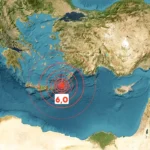
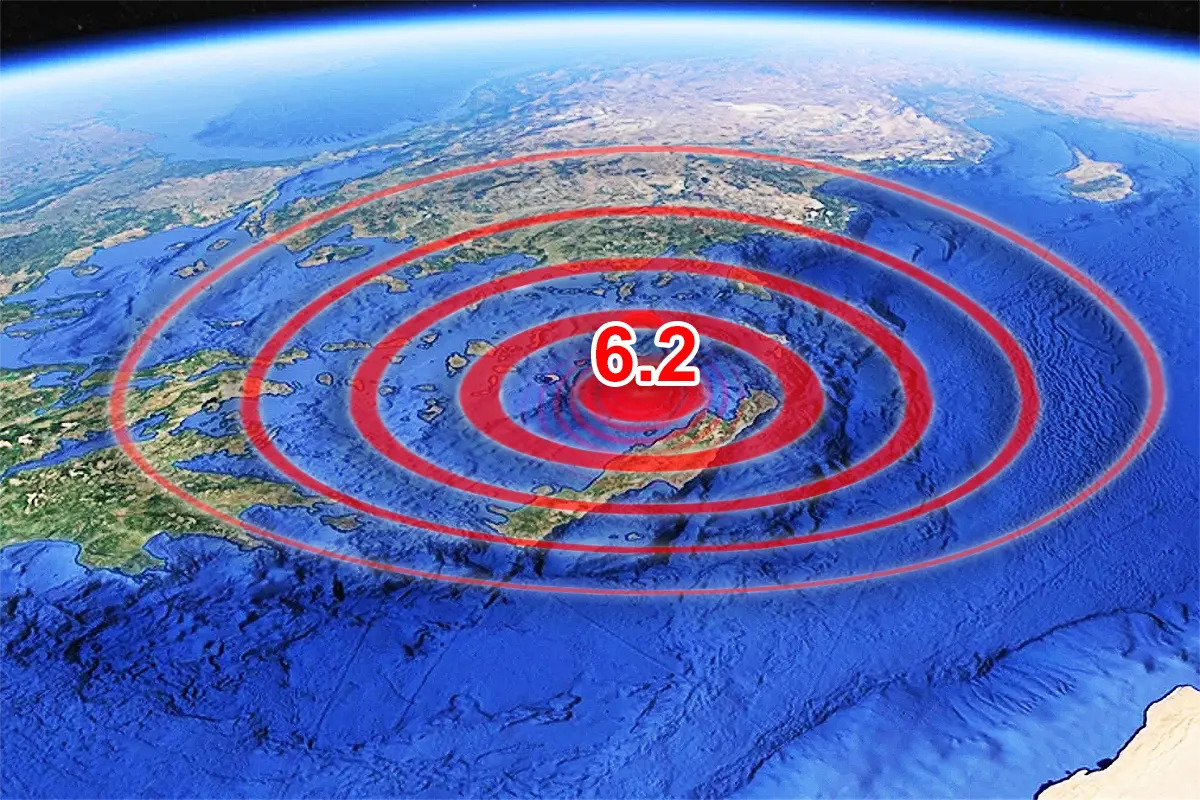
The earthquake struck early this morning at 6:19 local time (5:19 CET) at a great depth – 68 km below the Earth’s crust – with its epicentre in the Aegean Sea, just between the Greek islands of Crete and Santorini, and was felt on these islands as well as on the south-west coast of Turkey and even in Egypt.
The Turkish Disaster and Emergency Management Agency (AFAD) located it about 170 km off the coast of Datça, in the Turkish province of Muğla, and determined its magnitude at 6 on the Richter scale, although the United States Geological Survey (USGS) raised its intensity to 6.2.
Greek authorities located the epicentre of the earthquake 82 kilometres northeast of the city of Heraklion in Crete, where many residents of the Rethymno and Lasithi regions in the east of the island woke up startled in the early hours of the morning and took to the streets, leaving their homes as a precaution, although no significant damage was reported.
Minor aftershocks were subsequently recorded in the same region, reaching an intensity of 3.4. The Euro-Mediterranean Seismological Centre (EMSC) issued a tsunami warning for coastal towns in Turkey and Greece, as well as Italy, France and Portugal.
‘Earthquakes of 8.5 magnitude can occur in this region’
‘This region is a place that constantly produces earthquakes of this magnitude, and has the potential to produce a major earthquake,’ said Turkish professor Şerif Barış of Kocaeli University, speaking to local media outlets. ‘Earthquakes occurring 190 or 200 km from the coast do not have the power to cause damage; however, if a major earthquake of 7.5 or 8 occurs, the tsunami it will produce will affect the Aegean and Mediterranean coasts,’ said Barış, adding that people living in coastal areas should take precautions against this possible phenomenon.
In other statements to media in Turkey, renowned seismologist Süleyman Pampal confirmed that this region of the Aegean is highly prone to seismic activity and even volcanic eruptions. ‘The tectonics of this place, where the African plate subducts beneath the Eurasian plate, generates enormous potential for both earthquakes and tsunamis,’ the expert said, referring to the so-called Hellenic Arc.
Also known as the Aegean volcanic arc, this region lies between Santorini and Crete, stretching from northern Greece to southern Turkey. It is precisely in this Hellenic Arc that this expert claims that not only volcanic eruptions but even ‘earthquakes of magnitude 8 or 8.5, which may not cause major damage in Turkey but pose a serious risk of tsunami,’ could occur, he warned.
Although Pampal clarified that the earthquake measuring over 6 on the Richter scale that occurred this morning – just one week after another earthquake measuring 6 in the same area – is unlikely to trigger a major earthquake measuring 8 or higher, the seismologist insisted that the Mediterranean population must be prepared for major earthquakes and tsunamis that will undoubtedly occur in the future: ‘The authorities should make citizens aware of this. There are traces of large earthquakes that have occurred in the past off the coasts of Muğla, Antalya and İzmir.’
VOTE

EDITORIAL TEAM
🧿 About us
.
Edited and reviewed by:

Pablo Gómez is a specialist in Turkey and has been editor-in-chief of Hispanatolia since 2011. He has been analysing current affairs and geopolitics in Turkey and the surrounding region since 2006.
…
📣 Your ADVERTISING on Hispanatolia
.
🤗 HELP US WITH A DONATION:
💗 Paypal