Turkey, Syria and Jordan have reached an agreement to restore the historic Hejaz Railway, a project that will be an important step towards restoring communications between the countries of the region and preserving the common heritage inherited from the Ottoman Empire, a senior Turkish official was quoted as saying in media reports this week.
According to Turkish media reports, the agreement was reached at a tripartite meeting held in early September in Amman (Jordan), as confirmed by the Turkish Transport and Infrastructure Minister Abdulkadir Uraloğlu. The three countries have reportedly reached a preliminary agreement on a draft Memorandum of Understanding, which sets out a comprehensive framework for collaboration on transport infrastructure, Uraloğlu said.
As part of the agreement, Turkey has reportedly committed to complete 30 kilometres of missing superstructure on the section of the Hijaz Railway that runs through Syria: “An agreement has been reached to complete the missing 30 kilometres of the Hejaz Railway superstructure with the support of Turkey,” Minister Uraloğlu announced. For its part, Jordan is assessing its technical capacity to support the maintenance, repair and operation of locomotives inside Syria.
The three countries also plan to conduct joint technical studies to improve Turkey’s access to the Red Sea through the Jordanian port of Aqaba. In addition, road transport between Turkey and Jordan through Syria is expected to resume after being suspended for 13 years due to the Syrian civil war, which came to an end in December 2014 with the fall of the dictatorship of Bashar al-Assad, who fled into exile in Russia.
An Ottoman railway between Istanbul and Mecca
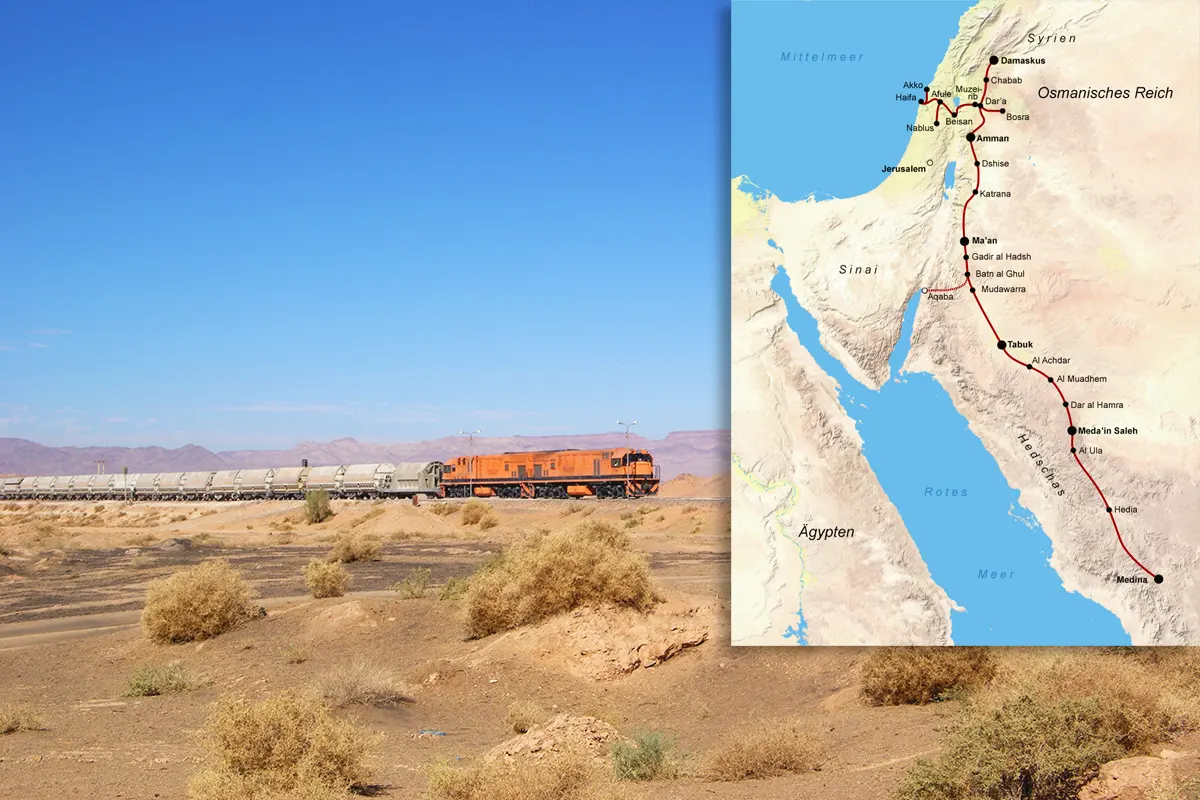
The 1,322-kilometre-long Hejaz Railway was built between 1900 and 1908 during the final years of the Ottoman Empire, connecting Damascus to the holy city of Medina, with a branch to Haifa on the Mediterranean coast. During World War I, the railway was destroyed by Arab rebels supported by British forces under the command of the famous Lawrence of Arabia, fragmenting into several sections and losing its strategic importance.
Construction began in 1900 under the reign of the Ottoman Sultan Abdulhamid II, with the original idea that it would be some 1,750 kilometres long, starting from the Haydarpaşa station in Kadıköy (Istanbul) and linking the imperial capital with the Islamic holy cities of Mecca and Medina, as well as Damascus and parts of Yemen. Construction was halted, however, with the outbreak of World War I, by which time the railway line only ran from Damascus to Medina.
Although designed to facilitate the pilgrimage to Mecca, the Hejaz Railway played a key military and administrative role in strengthening Ottoman control over the far-flung provinces of Arabia. The work included remarkable feats of engineering along its route: stone viaducts, stations in the middle of the desert, and narrow-gauge tracks adapted to difficult terrain. Much of the route was dismantled or damaged during the Great War and subsequent conflicts, but sections of the railway are still standing and have been the subject of multiple restoration efforts over the years, and are even a tourist attraction in countries such as Saudi Arabia.
VOTE

EDITORIAL TEAM
🧿 About us
.
Edited and reviewed by:

Pablo Gómez is a specialist in Turkey and has been editor-in-chief of Hispanatolia since 2011. He has been analysing current affairs and geopolitics in Turkey and the surrounding region since 2006.
…
📣 Your ADVERTISING on Hispanatolia
.
🤗 HELP US WITH A DONATION:
💗 Paypal