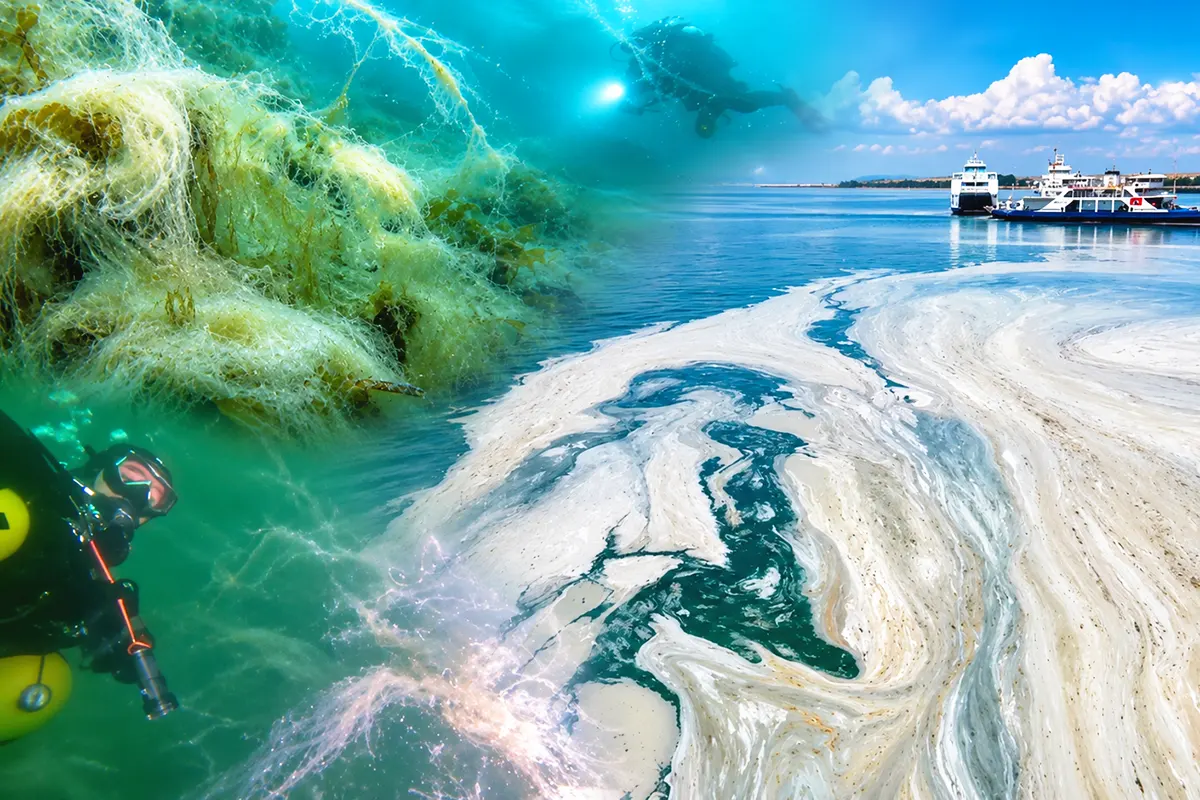
Turkish fishermen have found the dreaded sea snot in their nets instead of fish whilst fishing in the Gulf of Gemlik, due to the return of this viscous substance to the Sea of Marmara, the presence of which is clogging their nets, damaging their boat engines and threatening the fishermen’s livelihoods: a worrying sign given the possible return of the ‘marine mucilage‘, which five years ago forced Turkey to launch the largest marine clean-up operation in its history.
The reappearance of the dangerous mucilage in Gemlik Bay has brought small-scale fishing to a standstill throughout the region. The substance, detected at depths of between 5 and 30 metres, has prevented some 70 fishing boats from going out to fish for approximately 11 days, according to reports in the Turkish media.
The phenomenon was detected during dives carried out between Narlı and Kapaklı, on the northern coast of Gemlik Bay, although its concentration is particularly high from a depth of 10 metres onwards. This situation is having serious consequences for fishing activity, as fishermen are unable to use their nets and have been forced to suspend their catches because the snot sticks to their nets and engines, rendering them unusable, as well as suffocating marine species.
Small-scale fishing, completely at a standstill
Hüseyin Dalarel, chairman of the Gemlik Fishing Cooperative, has warned that the increase in mucilage in the Sea of Marmara has left small-scale fishing virtually at a standstill.
“Our fishermen have been unable to go out to sea for approximately 11 days. The nets are covered in mucilage and we are struggling to haul them on board because of their weight. Furthermore, the fish are not entering the nets because of the mucilage. That is why everyone has stopped fishing,” explained Dalarel, who confirmed that the 70 vessels registered in Gemlik have suspended their activities and warned of damage to fishing gear and engines on the boats.
“It extends from a depth of 5 to 30 metres and becomes particularly dense from 10 metres downwards,” stated Dalarel, emphasising that the damage is also affecting the machinery and technical equipment used by the fishermen.
“We are unable to catch any fish. On the contrary, our nets end up covered in mucilage. In addition to the fuel we consume, the workers’ wages and all the effort we put in, the technical damage we are suffering is putting us in a very difficult situation,” lamented the representative of the fishermen’s union in statements reported by local media.
Scientists warn: sea snot reappears in the Sea of Marmara
Professor Mustafa Sarı, known for his scientific research on the Sea of Marmara, has also warned of the reappearance of the sea snot. He stated that fishermen from different areas of the Marmara have informed him of difficulties in hauling in their nets and that instead of fish they are pulling up this viscous substance.
Sarı explained that the so-called sea snot is formed by a combination of several factors: the rise in sea temperature, the decrease in sea currents and the increase in marine pollution. The phenomenon usually appears during autumn and remains in the depths throughout the winter, although it occasionally rises to the surface again during the spring and summer months.
The expert warned that the Sea of Marmara continues to suffer from pollution problems and called for coordinated action between central government, local authorities, the private sector, civil society organisations and universities. “The Sea of Marmara is the heart of the Mediterranean’s marine ecosystem”, emphasised Sarı, also warning of the threat posed by the marine mucilage phenomenon to the Mediterranean Sea as a whole.
VOTE

EDITORIAL TEAM
🧿 About us
.
Edited and reviewed by:

Pablo Gómez is a specialist in Turkey and has been editor-in-chief of Hispanatolia since 2011. He has been analysing current affairs and geopolitics in Turkey and the surrounding region since 2006.
…
📣 Your ADVERTISING on Hispanatolia
.
🤗 HELP US WITH A DONATION:
💗 Paypal