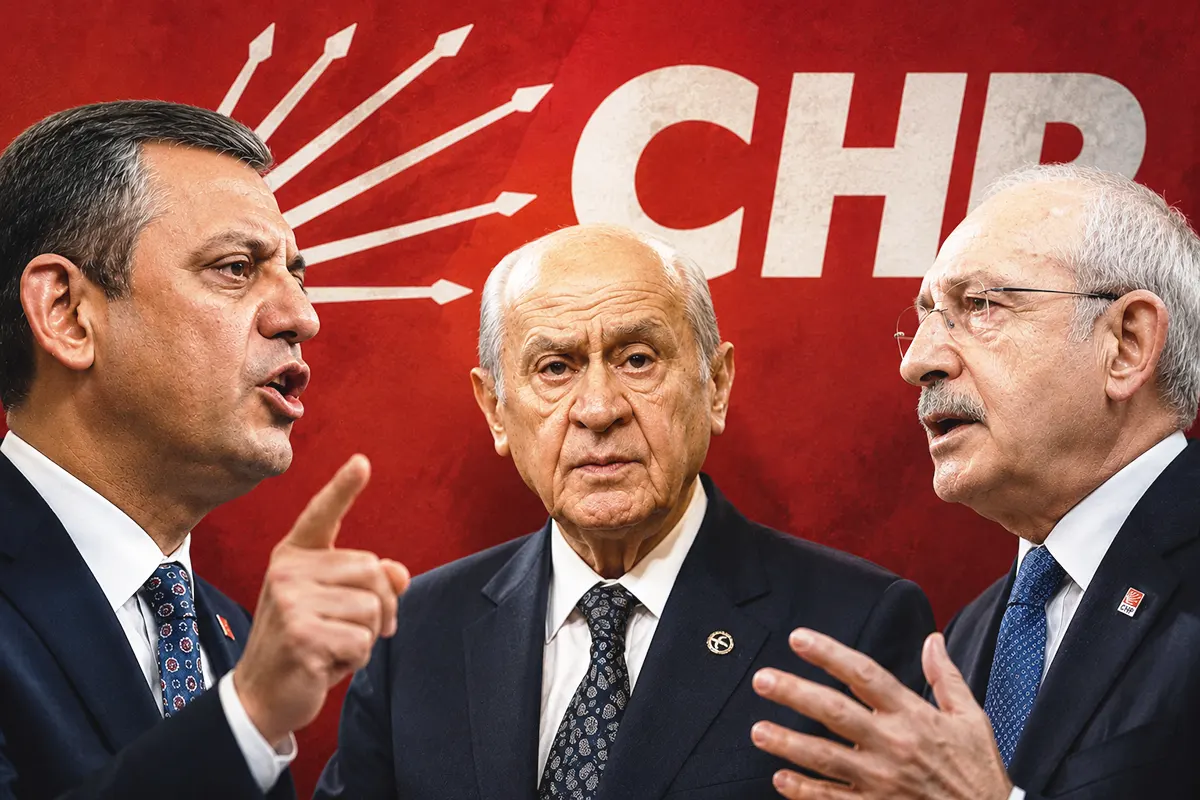
The leader of the Nationalist Movement Party (MHP), Devlet Bahçeli, claims that the struggle for leadership within Turkey’s main opposition party – the CHP – could intensify political polarisation and jeopardise social stability in Turkey: statements that come a day after the Supreme Electoral Council (YSK), to which Özgür Özel and his supporters had appealed to overturn the decision taken on 21 May by the Ankara Regional Court of Appeals – which reinstated Kemal Kılıçdaroğlu as party leader – responded that it lacks the legal authority to review the court ruling, reiterating that the competent body is the Supreme Court (Yargıtay).
“The internal crisis within the Republican People’s Party (CHP), which began with the decision of ‘absolute nullity’ (issued by the Ankara court), quickly evolved into a dead end. As the Nationalist Movement Party (MHP), and in line with our responsible political approach, our calls for dialogue and reconciliation have so far gone unanswered. The internal conflict within the CHP first turned into a clash between factions and has subsequently paved the way for a split,” stated Bahçeli, a close ally of Erdoğan, in an interview with the daily Türkgün published today by the Turkish newspaper Hürriyet.
The nationalist leader maintained that recent events have gone from being unbecoming of the institutional nature of the main opposition party to becoming a situation that damages political culture and democracy. He also admitted that he had initially hoped that Kılıçdaroğlu and Özel would reach a mutual agreement capable of preserving and strengthening the institutional identity of a party such as the CHP, but that this expectation has been fading in the wake of recent events. “Although the statements made by the parties on the first day the ruling of absolute nullity was issued (regarding the 2023 congress that ousted Kılıçdaroğlu) raised hopes of reconciliation, subsequent events show that the CHP is rapidly moving away from a consensus,” he stated.
Bahçeli warned in this regard that Özgür Özel’s political stance, and his actions within the party, do not resemble traditional and healthy internal competition, nor do they align with other precedents related to the emergence of new parties from internal dissent. On the contrary, he argued, Özel is taking measures that deepen the crisis without waiting for a final ruling from the Supreme Court.
“Özel has created a parallel leadership as the de facto leader of the CHP”
“Firstly, through a de facto intervention, Mr Özel has seized control of the CHP’s parliamentary group, establishing a new parallel centre within the party; he has assumed the role of de facto leader of the CHP, in contradiction to the legally defined status of the general chairman. Secondly, he has turned this duality within the CHP’s institutional structure into a crisis of party representation,” warned the nationalist politician.
To back up his arguments, Bahçeli recalled several historical episodes from the political tradition of the CHP itself – founded in 1923 by Atatürk himself – such as the dismissal of Şükrü Kaya – CHP general secretary under Atatürk – by İsmet İnönü when the latter assumed the Presidency of the Republic in 1938 amidst disputes over Atatürk’s succession; or the historic victory of Bülent Ecevit over İnönü himself in 1972, thanks to the support of the party’s grassroots during another leadership dispute. These examples were used by Bahçeli to highlight that internal differences within the CHP were usually resolved through the party’s own institutional mechanisms.
However, he also pointed out that on two occasions throughout history, internal opposition within the CHP ultimately led to the formation of a new party. He cited as examples the creation of the Democratic Party following the so-called “Declaration of the Four” by Celal Bayar, Refik Koraltan, Adnan Menderes and Fuad Köprülü, as well as the founding of the Güven Party by Turhan Feyzioğlu and his allies following Ecevit’s rise to the leadership of the CHP. As Bahçeli explained, both movements emerged from ideological debates within the CHP that eventually evolved into new political projects, prompting him to warn of a possible split in Turkey’s main opposition party.
An internal conflict within the CHP that threatens to spread to society
The MHP leader also accused Özel of attempting to strengthen his position “by transforming the party’s internal problems into a broader social opposition through confrontation with the government, mobilising the CHP’s structures in his favour and seeking the support of other opposition parties”. “In this situation, an internal problem within the CHP has consciously and systematically created an artificial agenda centred on ‘power and authoritarianism’ in Turkey” which has caused divisions over values shared by society, said the MHP leader during the interview.
“The increasingly fierce struggle for leadership within the CHP could further exacerbate the existing polarisation. In particular, the fact that both sides do not view each another as political rivals, but as individuals whose legitimacy is at stake, leads to a hardening of political discourse, an increase in tensions on social media and in the traditional media, a narrowing of the scope for social consensus, and a deterioration in confidence in the institution’s own identity,” he emphasised.
“The escalating tension within the CHP, a party with a long tradition in Türkiye, could hinder the search for common ground on national issues that require broad political consensus, such as social peace. Public attention could shift away from issues such as a Turkey free of terrorism or pending reforms, towards internal party disputes… Therefore, a possible split within the CHP should not be viewed merely as a party matter. It could also have repercussions on Turkey’s democratic culture, the level of political institutionalisation and social peace,” Bahçeli stressed.
The nationalist leader also harshly criticised the recent marches led by Özel towards the Turkish Grand National Assembly and Anıtkabir, Atatürk’s mausoleum, considering them to be a political exploitation of symbolic spaces and national historical figures. He also questioned the divisive language used by Özel and his followers, which he attributed to a narrative based on the idea of “either you are with us or you are against us”.
Özel acts like a “teenage revolutionary” and calls those who do not support him “traitors”
“With his divisive language and style, with actions detrimental to Turkey’s stability and security, and with an unquestionable willingness to carry out requests from sources from which he receives instructions… Özgür Özel has no potential to be the guardian of Anıtkabir, the heir to Atatürk’s legacy, or the leader of Turkish youth. Someone who, during his leadership of the CHP, avoided taking a firm stance on the moral and ethical issues that arose within the party, and who preferred to cover up allegations (of corruption) rather than investigate them, cannot be the heir to Atatürk’s legacy nor the leader of Turkish youth,” he stated.
Bahçeli also accused Özel of having broken with the CHP’s institutional and historical tradition and of apparently acting like a “teenage revolutionary”. He added that this approach does not reflect a responsible conception of politics “neither for the party nor for Türkiye”, and criticised Özel’s tendency to label those who do not share his positions within the party as government collaborators or traitors: “This is a reflection of Özel’s problematic conception of politics,” he insisted.
“His refusal to accept the legal process has led to a de facto political fragmentation within the party. However, the legal process will run its course, (the party) will be renewed at the congress and the CHP will decide its fate in accordance with the law. Therefore, CHP members must distance themselves completely from what remains of FETÖ (the group linked to Gülen that orchestrated the 2016 coup) and from an approach based on street protests, and should completely abandon any attempt to spread the internal turmoil within the CHP across Turkey,” emphasised Bahçeli, who also called on the Supreme Court to rule as soon as possible on the appeal filed by Özel. “Turkish politics and democracy must not be allowed to be damaged,” he continued.
Özel and İmamoğlu plan to form a new political party, Bahçeli says
The Turkish nationalist leader also referred to a possible roadmap for the formation of a new political party led by Özel. As he explained, the negotiations held in Silivri (the prison where İmamoğlu stays) and “the statements made from there suggest that Ekrem İmamoğlu and Özgür Özel could base this scenario on three pillars”.
The first would relate to planning an organised exit from the party in parallel with the disciplinary proceedings. Bahçeli stated that Kılıçdaroğlu’s decision to suspend the membership of members subject to legal proceedings on charges of corruption and bribery, together with the purge of İmamoğlu and Özel’s inner circle, could trigger attempts to found a new party on the grounds that “the CHP has been taken over by the ruling party (Erdoğan’s AKP)”, he explained.
The second pillar would consist of preparing the social opposition and public opinion in Turkey for a decision by Özel and his supporters to form a new party, whilst the third would relate to the support that some opposition parties have given to Özel since the very beginning of the crisis, which could open the door to new alliances within Turkish politics.
“In conclusion, although the discussions are political in nature, the issue is a legal one. It is essential to wait for the judicial process to conclude. (But for now) the court ruling stands, and the current leader is Kemal Kılıçdaroğlu,” Bahçeli reiterated. “The actions of Özgür Özel and his team, aimed at giving the impression that they are the ones in control of the CHP and at demonstrating their power, are of a political nature… His statements claiming ‘We are facing an alliance between an absolute sultan (Erdoğan) and an absolute nullity’, which insinuate Kemal Kılıçdaroğlu’s cooperation with the government, are nothing more than a manifestation of Özel’s intention to divert attention from the real problem by implicating the government and, in so doing, legitimise himself and gain support”, concluded Bahçeli.
VOTE

EDITORIAL TEAM
🧿 About us
.
Edited and reviewed by:

Pablo Gómez is a specialist in Turkey and has been editor-in-chief of Hispanatolia since 2011. He has been analysing current affairs and geopolitics in Turkey and the surrounding region since 2006.
…
📣 Your ADVERTISING on Hispanatolia
.
🤗 HELP US WITH A DONATION:
💗 Paypal