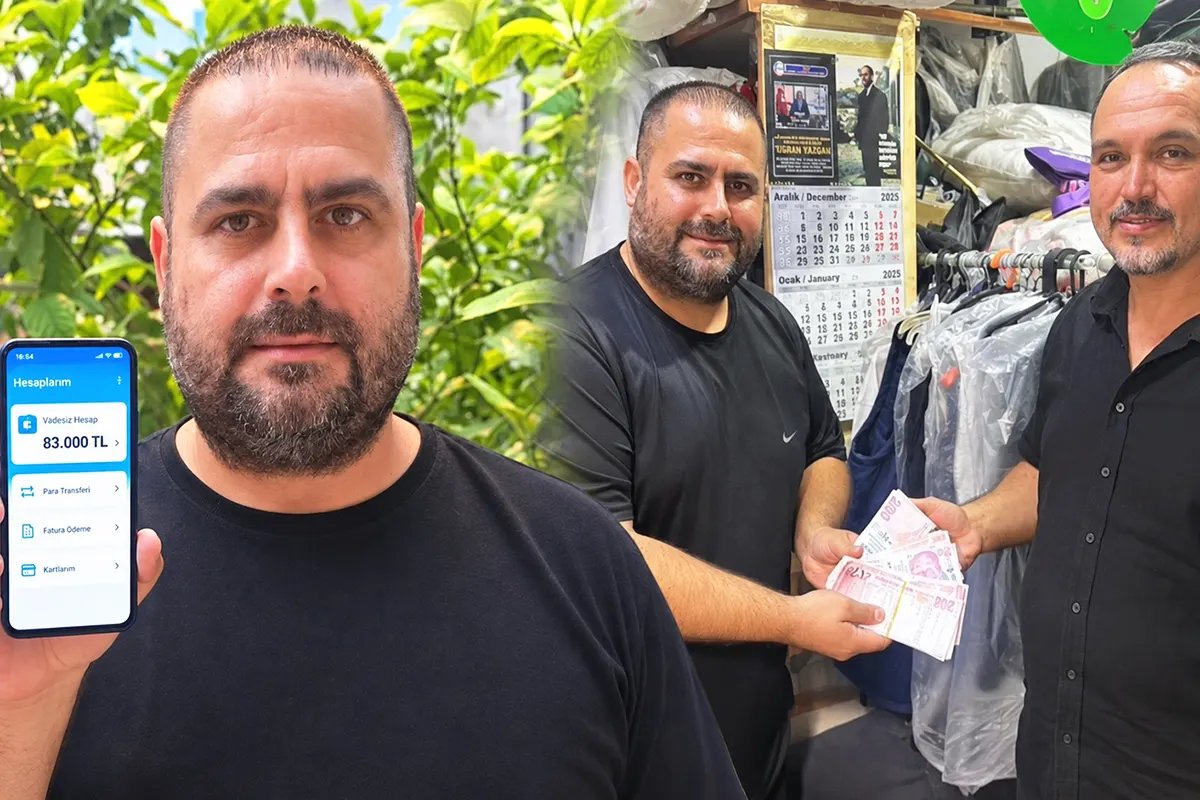
Murat Mercan, a Turkish man who works as a dry cleaner in the city of Izmir, on Turkey’s west coast, set out to find the sender of an unexpected bank transfer of 83,000 Turkish liras – around 1,500 euros – which he received in his bank account from someone he did not know. When he went to the bank to return the money, the staff told him they could not provide him with the sender’s details due to restrictions imposed by the Law on the Protection of Personal Data (KVKK, in Turkish).
After checking his previous account transactions and with the help of a cousin who is a police officer, Murat managed to discover that the sender had been a customer at his shop, and he tried to track them down to return the money, hoping the owner would get in touch with him.
An unexpected transfer of 83,000 liras
Mercan, a shopkeeper in the Buca district of Izmir, received a bank notification at around 5.00 pm last Monday that took him by surprise. No less than 83,000 liras, equivalent to around 1,500 euros, had been deposited into his account by someone unknown to him named Ramazan Ahmet Kılıçaslan.
Although he is by no means well-off, Mercan did not for a moment consider keeping the money and, as it was a very large sum for his small business, he decided to go straight to the bank to find out where it had come from. However, the staff explained that they could not disclose the customer’s details due to data protection regulations.
“Last Monday, at around 5.00 pm, we received a notification on our account. When I opened it, I saw that approximately 83,000 Turkish liras had been deposited. As we are small business owners, I was very curious to know where such a large sum had come from. We don’t have any transactions of that kind with anyone,” he said in comments reported by Turkish media. “It’s a very worrying situation for us; I was in shock. When I went to the bank, the clerk told me they couldn’t disclose the customer’s details and that I shouldn’t touch the account or spend the money,” Mercan explained.
“That money isn’t ours”
Unable to obtain any information directly from the bank, Mercan asked his cousin, who works as a police officer, for help. Following his advice, he checked the IBANs previously used at the business to see if the same name appeared in any transactions.
That was how he discovered that the person who had made the deposit, Ramazan Ahmet Kılıçaslan, had previously paid 400 liras at the dry cleaners on 19 June. In this way, he was able to establish that the person who had sent the money by mistake had been a customer at his business.
“I have a cousin who is a police officer and works here, and I explained the situation to him. He told me to check the IBANs we use for transactions at the shop and see if there had been any similar transactions previously. When we checked, we realised that on 19 June, Mr Ramazan Ahmet Kılıçaslan had made a transaction here for 400 lira. We haven’t earned this money; it isn’t ours”, explained Mercan.
“A single cent that isn’t ours is the same as 83,000 liras”
The shopkeeper tried to track down the man via social media but received no reply. Even so, having received no response to the messages sent via Facebook and Instagram, he decided to take steps to return the amount received to its rightful owner, recalling a lesson he learnt from his father, who passed away last year.
“I sent him messages on his social media accounts, Facebook and Instagram, to try and find him, but even after three days I received no reply. It’s a large sum, equivalent to three minimum wages for a worker. From the principles instilled in us by our mother and father, we learnt one thing: a single cent that isn’t ours is the same as 83,000 liras,” he emphasised.
“People here entrust their clothes to us; we’ve been here for years. This isn’t money we’ve earned through our own hard work; it’s that man’s money. I lost my father last year, and the greatest legacy my father left us was this advice: ‘Son, money you haven’t earned through your own hard work and money that isn’t yours does not belong to you’. He bequeathed his honesty to us,” he added.
Mercan also explained that the situation has prevented him from sleeping properly over the last few days, worried that the money might have been intended for an urgent need: “I haven’t been able to sleep for two days because of my conscience. Perhaps this money was meant for an operation, perhaps to pay school fees, perhaps for a house he’d been dreaming of… Through you, I am appealing to that man: please get in touch with us; your money is safe with us. Give us the chance to return your money and put our minds at rest. We haven’t earned that money,” he told the media. “That money will not be touched in our account; that would not be right of us,” he added.
A curious story with a happy ending
The story ultimately had a happy ending. After the news appeared in the Turkish press and social media, Ramazan Ahmet Kılıçaslan – who had contacted his bank after realising the error in the transfer, but had not been offered a solution – learnt that his money was in the safe hands of Murat.
After getting in touch with him, this humble Turkish dry cleaner was able to fulfil his wish to return the money to its rightful owner. “Thank God he found me whilst I was waiting for news from the bank,” said Kılıçaslan, who was very grateful to Murat; Murat, for his part, breathed a sigh of relief at having achieved his goal: “Now I can sleep in peace,” he said.
VOTE

EDITORIAL TEAM
🧿 About us
.
Edited and reviewed by:

Pablo Gómez is a specialist in Turkey and has been editor-in-chief of Hispanatolia since 2011. He has been analysing current affairs and geopolitics in Turkey and the surrounding region since 2006.
…
📣 Your ADVERTISING on Hispanatolia
.
🤗 HELP US WITH A DONATION:
💗 Paypal