Spain and much of Europe are set to experience a particularly exceptional solar eclipse this Wednesday. This astronomical phenomenon is the first in a unique series of eclipses that will allow observers from certain parts of the Iberian Peninsula and Europe to witness two total eclipses and one annular eclipse between 2026 and 2028. Today’s eclipse will be visible as a total eclipse across a wide swathe of the Peninsula and the Balearic Islands, whilst much of the rest of Europe will be able to observe it as a partial eclipse.
The uniqueness of this sequence will not end today. On 2 August 2027, another total solar eclipse will cross the southern tip of the Peninsula, including Cádiz, Málaga, Ceuta and Melilla, before an annular eclipse traverses much of Spain on 26 January 2028. After that, we will have to wait until 2053 to witness another total solar eclipse from Spain.
Today’s eclipse, however, will not be visible in Turkey, as the phenomenon will occur just as the sun has already set below the horizon. Nevertheless, it is precisely Türkiye that offers one of the most fascinating historical accounts related to eclipses: over 2,000 years ago, the sudden disappearance of the Sun served to halt a battle in Anatolia.
The eclipse that halted a great battle in antiquity
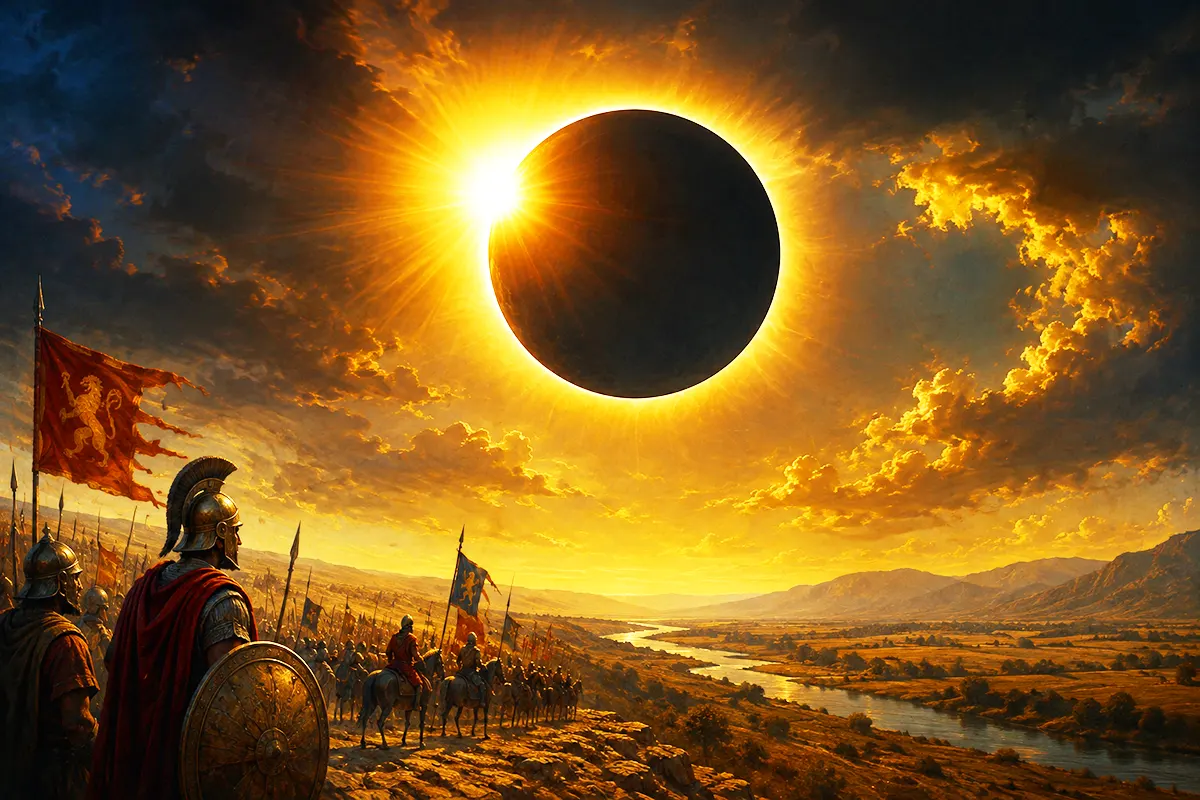
The story dates back to the 6th century BC, when the Medes and Lydians had been at war for several years. According to the Greek historian Herodotus, during a battle, day suddenly turned to night, and the two armies interpreted the phenomenon as a divine sign and ceased fighting. The episode took place in Anatolia, in what is now Turkey, and ultimately led to a peace agreement between the two peoples.
Modern astronomical calculations link Herodotus’ account to a total solar eclipse that occurred on 28 May 585 BC. NASA includes this event in its compilation of historical eclipses and does indeed identify it as an eclipse associated with the conflict between the Medes and the Lydians.
Tradition also linked the phenomenon to Thales of Miletus, one of the earliest philosophers and scientists of ancient Greece. Herodotus claimed that Thales had managed to predict the year in which the eclipse would occur; however, it should be noted that the method he might have used is unknown and that this claim remains a subject of debate amongst historians.
When eclipses were signs from the gods
For ancient societies, a solar eclipse could be a deeply unsettling event with religious connotations. The temporary disappearance of the Sun during the day suddenly altered the appearance of the sky and, before its astronomical causes were understood, many peoples interpreted it as an omen or a supernatural sign. In fact, in virtually all civilisations with historical records, total eclipses were viewed with fear before the development of mathematical and astronomical methods capable of predicting and explaining them.
Ancient records preserve some particularly striking examples. The Assyrians documented a solar eclipse that occurred in the 8th century BCE, whilst Chinese and Greek texts also recorded eclipses and linked them to extraordinary events. In ancient Greece, the poet Archilochus described an eclipse that took place in the 7th century BC using imagery typical of a world in which the Sun could suddenly vanish in broad daylight.
Over the centuries, eclipses ceased to be merely events associated with omens and also became opportunities for scientific observation. During a total eclipse, the Moon blocks the bright solar disc, allowing observation of the solar corona – the Sun’s faint outer atmosphere, which is normally obscured by its intense brilliance. Eclipses have even played a role in major scientific breakthroughs: in 1919, observations made during an eclipse provided evidence of the deflection of light predicted by Albert Einstein’s theory of general relativity.
Turkey looks forward to the 2027 solar eclipse
Turkey’s connection with eclipses is not confined solely to Antiquity. The country was the setting for scientific observations during the total solar eclipse of 29 March 2006, which was visible in the Manavgat district of Antalya, and during which observations enabled the physical properties of the solar corona to be studied.
Furthermore, although this is not the case with today’s eclipse, the next major solar eclipse will not leave Turkey on the sidelines. On 2 August 2027, there will be an eclipse that will be total in various regions of the world and will once again cross Spain; however, from Turkey it will only be visible as a partial eclipse, being most intense in the westernmost regions of the country. In Fethiye, for example, the peak will occur around midday, when the Moon will obscure 75% of the Sun’s disc.
More than two millennia ago, a solar eclipse changed the course of a battle in Anatolia at a time when this phenomenon was seen as something mysterious and almost magical; today, those very same precise movements between the Sun, the Moon and the Earth allow us to study how our star works and bring together hundreds of thousands of curious onlookers around the world: something unthinkable for those who, 2,500 years ago, watched with fear and amazement as day suddenly turned to night in the midst of fierce combat.
VOTE

EDITORIAL TEAM
🧿 About us
.
Edited and reviewed by:

Pablo Gómez is a specialist in Turkey and has been editor-in-chief of Hispanatolia since 2011. He has been analysing current affairs and geopolitics in Turkey and the surrounding region since 2006.
…
📣 Your ADVERTISING on Hispanatolia
.
🤗 HELP US WITH A DONATION:
💗 Paypal