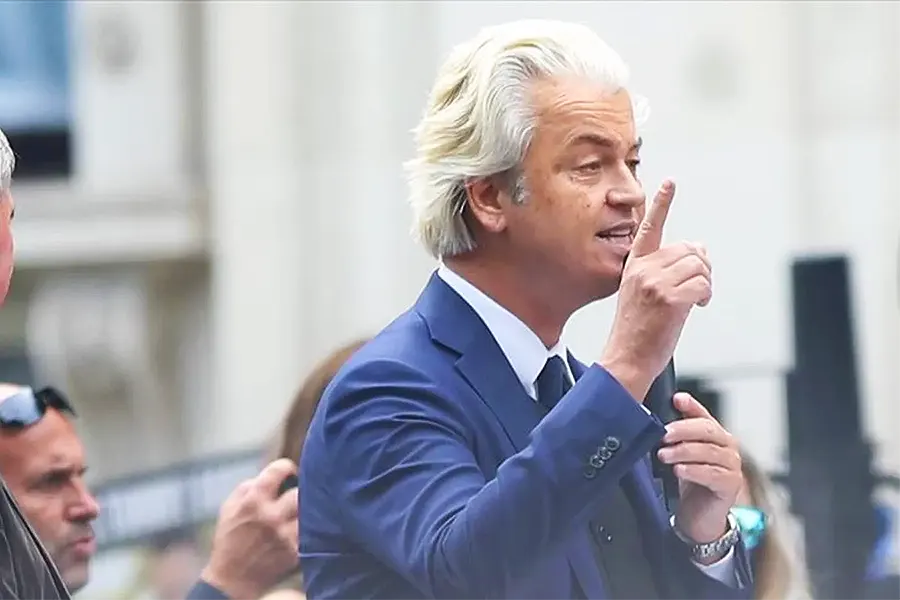
The unprecedented victory of far-right politician Geert Wilders in the Dutch general election has sparked concern and fears among Muslims and people of immigrant background, including the large Turkish minority living in the Netherlands. Wilders and his Party for Freedom (PVV) beat all forecasts and won 37 of the 150 seats in the Dutch parliament, far ahead of the combined Labour and Greens, and outgoing conservative prime minister Mark Rutte.
Muhsin Köktaş, the leader of a Muslim association in the country, told the Turkish news agency Anadolu of his disappointment at the victory of Wilders, who has claimed that mosques, Islamic schools and the Quran do not belong in the Netherlands. “It is worrying for the future of Muslims. The Netherlands will not be liveable for Muslims if Wilders implements his agenda and his views are accepted by his coalition partners,” warned Köktaş. “He may not be able to keep all his promises… but Wilders and the far-right parties will do everything they can to make life impossible for Muslims. They cannot ban everything, but they could impose strict rules,” he said.
In fact, throughout his political career Wilders has been controversial for his outspoken opposition to the Turkish minority in the Netherlands and to Islam, claiming that the Netherlands is under an “Islamic threat”. In addition to questioning Dutch membership of the EU, the far-right politician also opposes Turkey’s entry into the European Union because of its “backward Muslim culture”, and is the author of several anti-Turkish and anti-Muslim articles, including an Islamophobic documentary. He went so far as to call for Turkey’s expulsion from NATO; and after Erdoğan’s victory in this year’s elections, he asked Turks in the Netherlands who had voted for Erdoğan to leave the country.
Some associations representing the Turkish minority living in the Netherlands, which numbers some 400,000 members (mainly descendants of Turks who migrated in the 1960s to the Netherlands for work), fear that Wilders may try to change the country’s constitution to favour his discriminatory policies against Muslims.
More pressure on Turks, Muslims and migrants
This is the case of Murat Gedik, president of the Dutch Turkish Federation, who argues that the growing voter support for Wilders gives wings to other far-right groups. “His election puts psychological pressure on Muslims, Turks and migrants. We will see people from these backgrounds more alienated, isolated. Turkish NGOs will face more pressure. They have this rhetoric that Turkish expatriates are ‘Ankara’s fifth column’, and we will see more and more of this rhetoric,” he said.
Muslims make up about 5% of the population of nearly 18 million people in the Netherlands, while Turks account for about half (2.4%). Among Turkish residents in the Netherlands, many have received Wilders’ victory in the Netherlands with a mixture of fear and disappointment: fear for what might happen in the near future, and disappointment because the result is evidence that many people in the Netherlands have xenophobic views and reject foreigners and Muslims, as Wilders advocates. And although it is not clear that the far-right politician can govern, and if he does he will need the support of other parties that are now far from his Islamophobic theses, it is no less certain that the rest of the parties – due to the “contagion effect”, or simply due to their own political interest – in the end will copy part of his anti-immigration and anti-Islam discourse in order to win back votes.
VOTE

EDITORIAL TEAM
🧿 About us
.
Edited and reviewed by:

Pablo Gómez is a specialist in Turkey and has been editor-in-chief of Hispanatolia since 2011. He has been analysing current affairs and geopolitics in Turkey and the surrounding region since 2006.
…
📣 Your ADVERTISING on Hispanatolia
.
🤗 HELP US WITH A DONATION:
💗 Paypal