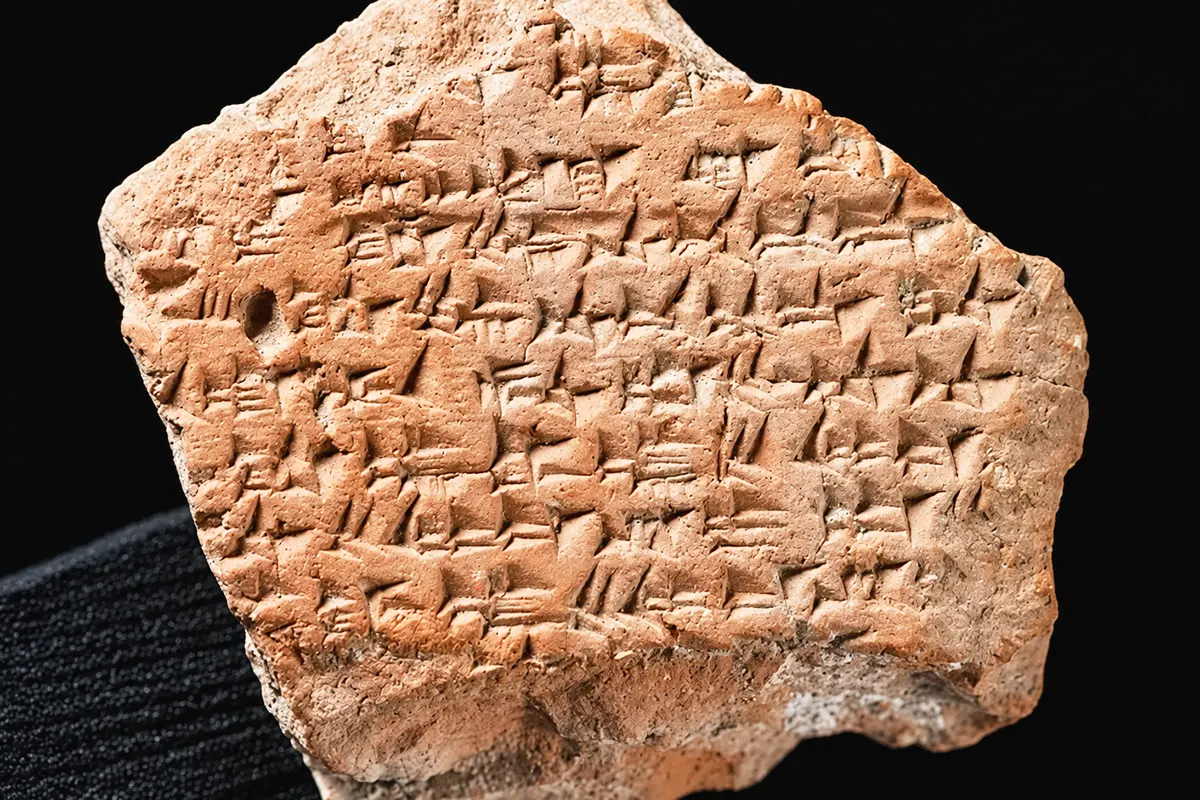
A fragment of a cuneiform tablet discovered during excavations by archaeologists at Büyükkale in the ruins of Hattusa, the ancient Hittite capital situated in the present-day Turkish province of Çorum, has been identified as part of one of the copies of the Treaty of Kadesh, considered to be the first peace treaty in history.
The Minister of Culture and Tourism, Mehmet Nuri Ersoy, announced the discovery on his social media accounts, highlighting that the document contains provisions relating to people seeking refuge in another country, emphasising the important role played by Anatolia in the history of peace and diplomacy.
“We have found traces of peace spanning thousands of years in the land of Anatolia. Scientific studies have determined that a fragment of a cuneiform tablet found during the excavations at Büyükkale, in Hattusa, Çorum, belongs to one of the copies of the Treaty of Kadesh,” announced the minister, as quoted by the Anadolu news agency.
“This new fragment contains lines relating to the provisions of the treaty governing the treatment of people seeking refuge from one country to another. The provisions regarding the non-destruction of people’s homes convey a powerful message that has resonated from thousands of years ago right up to the present day. This valuable discovery, which we shared with the public on 21 September, World Peace Day, once again highlights Anatolia’s deep-rooted place in the history of peace and diplomacy,” added Ersoy.
A treaty between the Hittite King Hattusili III and Pharaoh Ramses II
According to the Turkish Ministry of Culture and Tourism, the fragment was discovered during archaeological work carried out near the so-called ‘Building E’ at Büyükkale. Only one side of it remains and the cuneiform inscription underwent detailed scientific analysis for approximately one year.
Studies finally determined that the piece belongs to one of the copies of the Treaty of Kadesh agreed between the Hittite king Hattusili III and the Egyptian pharaoh Ramses II. The new discovery contains fragments corresponding to articles 12 to 20 of the treaty, which set out rules regarding the treatment to be accorded to people fleeing their countries and seeking refuge in another state.
The legible parts of the cuneiform text, which has some sections broken and others missing, mention people fleeing from Egypt and the Hittite lands. They also include references to the prohibition on destroying dwellings.
The treaty was signed 15 years after the famous Battle of Kadesh
The new discovery represents a major contribution to the work aimed at completing the copies of clay tablets of the Treaty of Kadesh found in ancient Hattusa. The ongoing excavations at Büyükkale have, among their objectives, finding other parts of the treaty that are still missing.
The Treaty of Kadesh was signed around 1259 BC and officially brought to an end centuries of conflict between the Egyptian Empire of Ramses II and the Hittite Empire of Hattusili III. The treaty was drawn up approximately 15 years after the famous Battle of Kadesh, considered the greatest chariot battle in history, which took a heavy toll in terms of resources and troops for both empires and ended without a clear winner.
The treaty is of enormous historical importance, as it is today regarded as the oldest surviving written peace treaty. Historically, it served to establish permanent peace between two great empires, a mutual defence pact and a formal agreement on the extradition of political refugees, recognising for the first time the borders between two states and acting as a precursor to several concepts of modern diplomacy.
Following its signing, the Egyptian version of the peace treaty was inscribed in hieroglyphs on the walls of temples in Egypt, whilst fragments of clay tablets bearing the text in Akkadian were sent to Hattusa, where they were discovered more than 3,000 years later during the first phase of the archaeological excavations at Hattusa, between 1906 and 1912.
VOTE

EDITORIAL TEAM
🧿 About us
.
Edited and reviewed by:

Pablo Gómez is a specialist in Turkey and has been editor-in-chief of Hispanatolia since 2011. He has been analysing current affairs and geopolitics in Turkey and the surrounding region since 2006.
…
📣 Your ADVERTISING on Hispanatolia
.
🤗 HELP US WITH A DONATION:
💗 Paypal