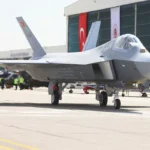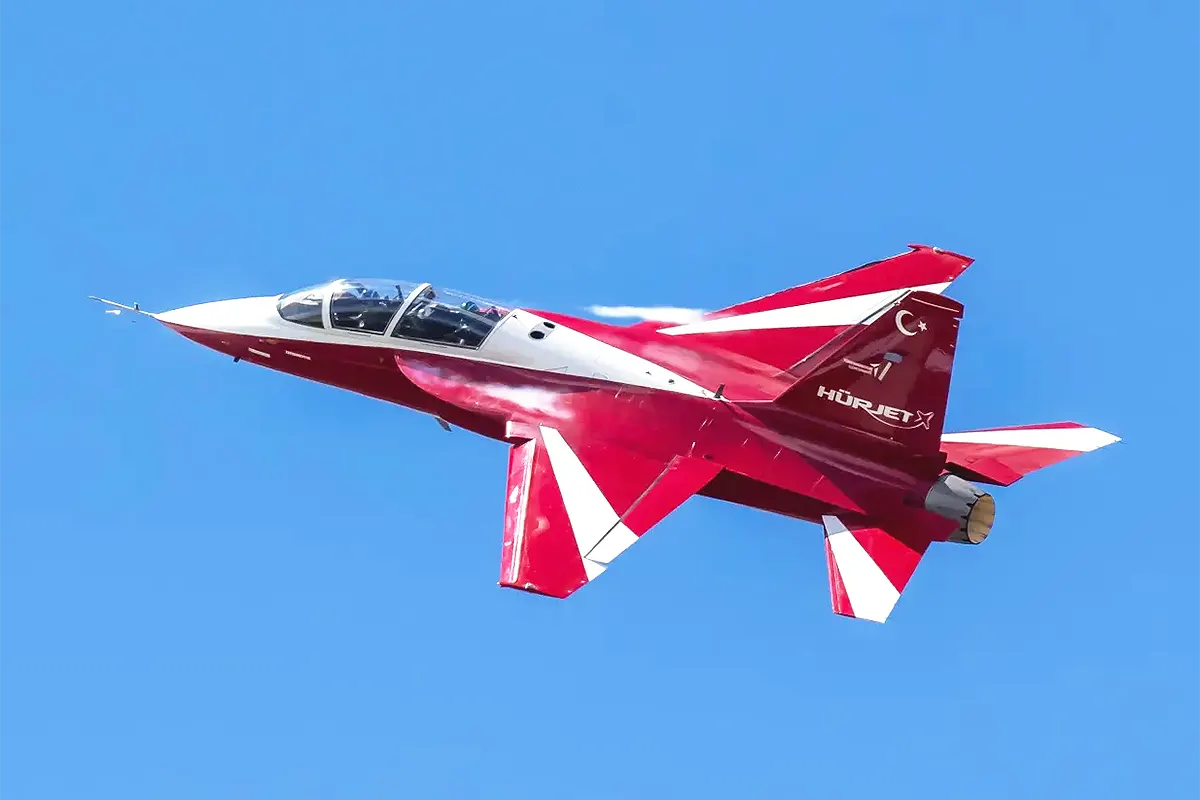
Turkey continues to advance testing, series production and future export plans for its first domestically produced advanced trainer aircraft, the Hürjet. The programme, developed by Turkish Aerospace Industries (TAI) under the coordination of the Defence Industries Presidency, which Spain has acquired to replace its ageing F-5 fleet, has already shaped two prototypes that have so far completed 340 sorties and nearly 260 flight hours.
As reported by Turkish news agency Anatolia, the first deliveries of the Hürjet will be made in 2026 to the Türk Yıldızları (Turkish Stars), the Turkish Air Force’s famous aerobatic and air show group. Assembly work on the first units is already underway and the new aircraft is scheduled to make its maiden flight in the first quarter of next year, in parallel with the advancement of the production line.
The HÜRJET project, conceived in 2017 as a domestically developed light attack and training aircraft, reached a key milestone in June 2022, when its first complete component moved onto the final assembly line. This was followed by completion of ground testing – including landing gear, wiring, mechanisms and electrical checks – and verification of avionics, fuel and power systems, prerequisites for engine start-up.
Finally, the Hürjet, Turkey’s first supersonic trainer aircraft, started its engine on 30 January 2023 and successfully performed its first flight test on 25 April of the same year. Since then, it has continued flight testing as part of design refinements. TAI is also already working on an infrastructure capable of producing two units per month, which will allow for an initial delivery of 16 aircraft to the Turkish Air Force.
The first Hürjet units will arrive in Spain in 2028
This single-engine, tandem-cockpit aircraft is designed to perform key roles in modern fighter pilot training, as well as air patrol missions – armed or unarmed – and aerobatic displays. At 13.6 metres long, 4.1 metres high and with a wingspan of 9.5 metres, the Hürjet will be able to reach a speed of Mach 1.4 and operate at up to 45,000 feet. The aircraft will have seven stations – six under the wings and one under the fuselage – with the capacity to carry more than three tonnes of cargo.
As reported by Anatolia, the export of the Hürjet fighter to Spain is close to being formalised. Speaking to the Spanish press, TAI CEO Mehmet Demiroğlu assured that “we are fully prepared”. “We are counting down the weeks. There are no outstanding issues between the parties. The final supply contract will be signed shortly,” said Demiroğlu, who also stressed that, while the model is primarily intended as a trainer aircraft, TAI has the capacity to quickly adapt it to new missions or even to develop variants for different tasks. Spain, which has finally acquired 45 units of the Hürjet, will start receiving the first units in 2028.
VOTE

EDITORIAL TEAM
🧿 About us
.
Edited and reviewed by:

Pablo Gómez is a specialist in Turkey and has been editor-in-chief of Hispanatolia since 2011. He has been analysing current affairs and geopolitics in Turkey and the surrounding region since 2006.
…
📣 Your ADVERTISING on Hispanatolia
.
🤗 HELP US WITH A DONATION:
💗 Paypal