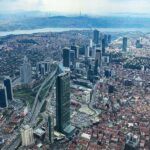
The Turkish government has acknowledged that it currently has no plans to proceed with the construction of the controversial ‘Istanbul Canal’ (Kanal İstanbul), a mega-project that seeks to build an artificial waterway parallel to the Bosphorus Strait, crossing the province of Istanbul and connecting the Black Sea and the Sea of Marmara, similar to the Panama Canal or the Suez Canal.
‘With regard to the Istanbul Canal, we have nothing related to it on our agenda at this time. We have already said that it is not possible. These are attempts to create controversy and divert attention,’ Turkish Minister of Urbanisation and Environment Murat Kurum told the media before a meeting of deputies from Erdoğan’s AKP party.
Kurum was responding to accusations by the main opposition party that work on the mega-project had already begun in Istanbul. The city’s mayor, Ekrem İmamoğlu, in prison on corruption charges following his arrest on 19 March, had claimed that the construction of 24,000 homes was the first phase of the controversial artificial canal.
In this regard, the minister explained that these works correspond to a social housing construction project that is in no way related to the Kanal İstanbul project. Kurum also denied rumours that these homes will be sold to citizens of Gulf countries: ‘No homes have been sold to Arabs or citizens of any foreign country. Each of these homes is being allocated to Turkish citizens who do not own a home,’ he stressed.
The Istanbul Canal project was first announced in 2011 by Tayyip Erdoğan, then Turkish prime minister, as an alternative to the Bosphorus Strait to reduce the traffic of ships and goods through the latter. The pharaonic project, which would effectively turn the European part of Istanbul into an island, as it would be crossed by a navigable canal 43 km long and 400 m wide, has always been surrounded by enormous controversy due to its enormous costs, the urban speculation it would generate and its repercussions for the infrastructure and environment of the region.
VOTE

EDITORIAL TEAM
🧿 About us
.
Edited and reviewed by:

Pablo Gómez is a specialist in Turkey and has been editor-in-chief of Hispanatolia since 2011. He has been analysing current affairs and geopolitics in Turkey and the surrounding region since 2006.
…
📣 Your ADVERTISING on Hispanatolia
.
🤗 HELP US WITH A DONATION:
💗 Paypal