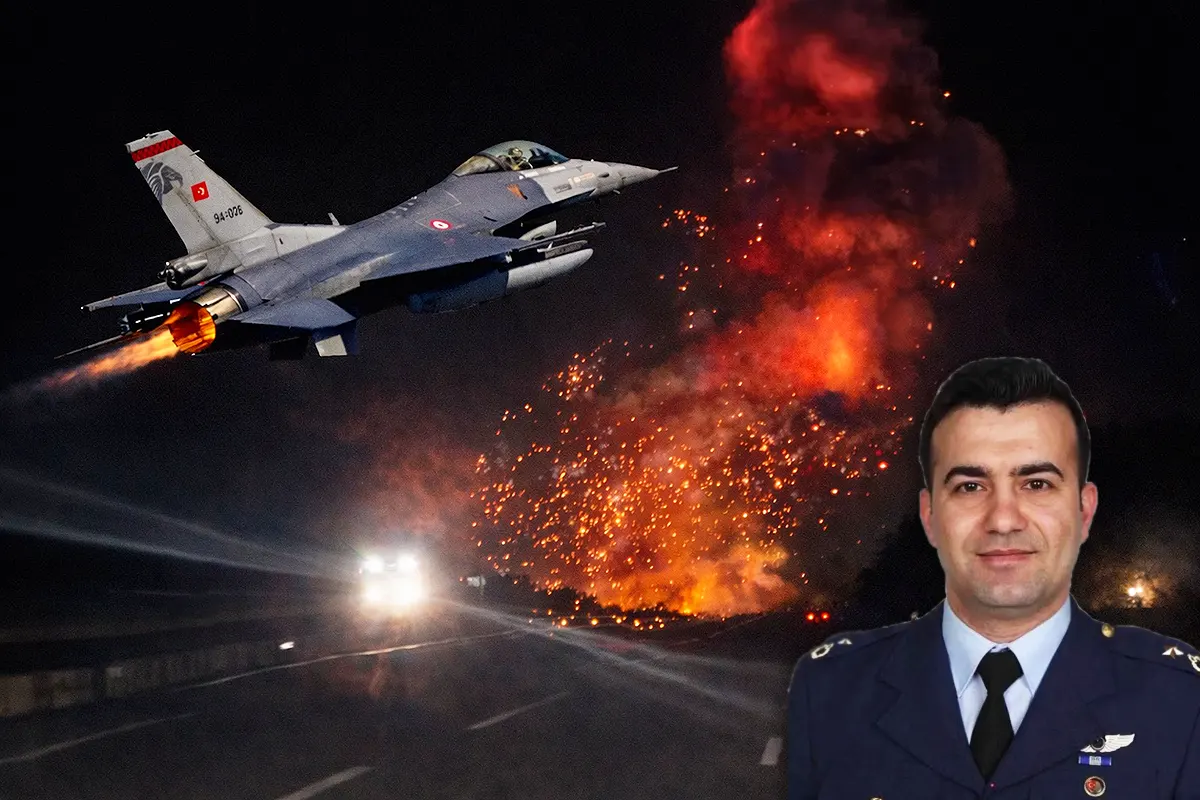
Turkey’s Ministry of National Defence gave in the last hours new information about the F-16 fighter jet that crashed in the early hours of yesterday morning shortly after taking off from a nearby air base, killing the pilot: the initially undisclosed reason why the fighter jet took off was after an unidentified radar contact was detected near the Bulgarian border.
The aircraft crashed near a motorway in Balıkesir province, after radio and radar contact with the fighter jet was lost at around 00:56 in the early hours of 25 February. The pilot reportedly tried to eject at the last moment but died as a result of the impact, which was recorded by a driver on the motorway.
“Analysis has determined that our heroic pilot activated the ejection system at the last instant to abandon the aircraft. Our heroic pilot was martyred in this accident. The cause of the incident will be clarified after a detailed investigation by the accident investigation team,” the ministry said, Turkish media reported.
The statement added that the flight was part of a rapid reaction mission involving two F-16 fighters as usual, and was activated after an unidentified radar signal was detected near the border with Bulgaria, with communication subsequently lost with one of the fighters, which tragically crashed, killing the pilot. It was later determined that the detected airborne radar signal did not pose a threat.
The Turkish defence ministry stressed once again that the control and security of Turkey’s airspace is ensured 24/7 through an integrated, layered architecture that includes radar, early warning systems, electronic warfare and interception capabilities. Within this framework, it is common for military aircraft to conduct interception missions to identify and track detected or unidentified signatures on radar systems.
Turkey will not invade Iran and will not send S-400s to Somalia
Meanwhile, Turkish Defence Ministry sources also denied reports in some media and social networks alleging that “Turkey plans to enter Iranian territory for security reasons if the United States attacks Iran“, stressing that military preparations are limited to measures necessary to protect its borders, regardless of tensions in the region.
The ministry also denied that Russian-made S-400 systems, the purchase of which prompted Turkey’s exclusion from the F-35 programme, would be sent to Somalia. “The S-400 air defence systems were procured in accordance with the operational needs of the Turkish Armed Forces and are ready for service. There are no plans to use the S-400 systems in Somalia,” the defence ministry concluded.
VOTE

EDITORIAL TEAM
🧿 About us
.
Edited and reviewed by:

Pablo Gómez is a specialist in Turkey and has been editor-in-chief of Hispanatolia since 2011. He has been analysing current affairs and geopolitics in Turkey and the surrounding region since 2006.
…
📣 Your ADVERTISING on Hispanatolia
.
🤗 HELP US WITH A DONATION:
💗 Paypal