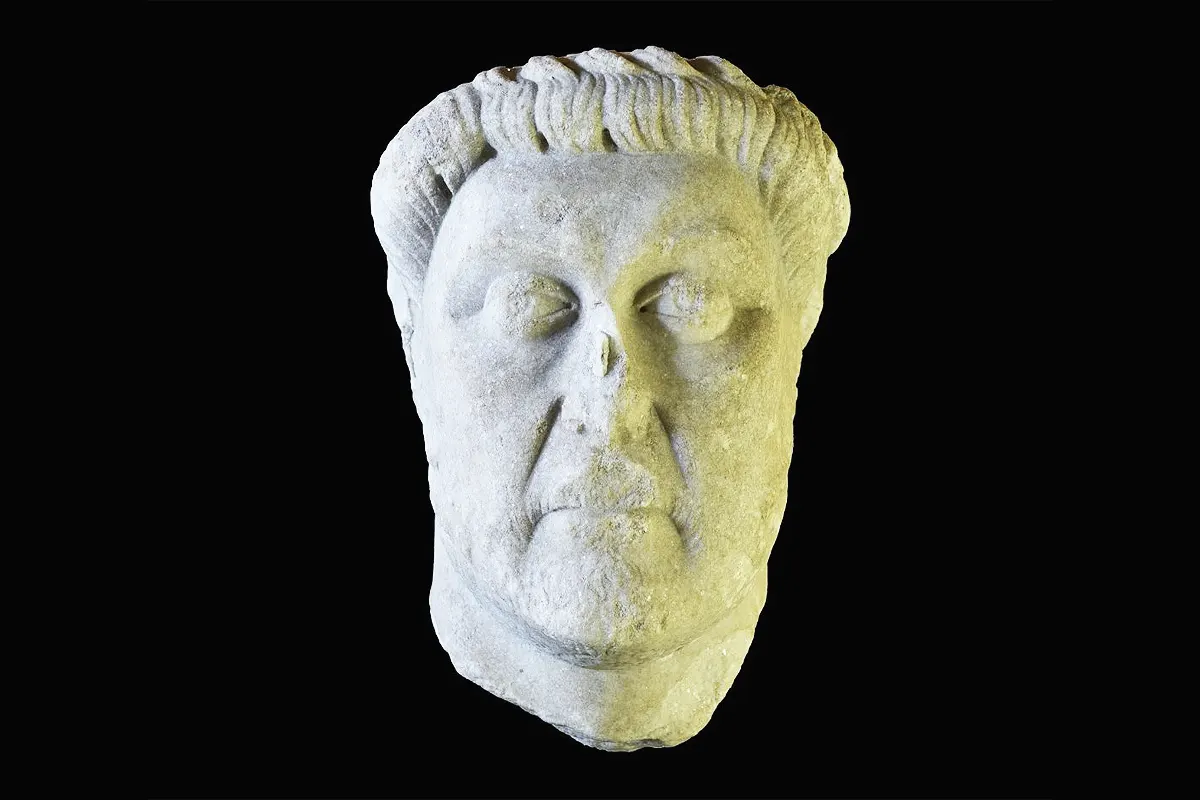
Turkey has secured the return of a stolen Roman marble head from the ancient city of Smyrna that had been on display in the United States after being illegally removed from the country, Turkey’s Minister of Culture and Tourism, Mehmet Nuri Ersoy, announced this week. The sculpture, dating from the 5th century A.D., is now on display at the Archaeological Museum of Smyrna (Izmir).
In a statement released via the Turkish social media platform NSosyal, Ersoy indicated that the piece, which was part of the collection of the Denver Art Museum, was returned following a scientific verification of its origin, as reported by the Turkish news agency Anatolia.
Both documents dating back to 1934 and recent analyses by experts confirmed that the marble head originated from excavations in the agora of the ancient city of Smyrna, dating to the time of the Roman emperor Theodosius. The minister stated that the object had been illegally removed from the country: “Through cooperation and constructive dialogue with the Denver Art Museum, we have brought this artifact back home,” Ersoy emphasized.
Records from the American museum indicate that the piece entered its collection in 1989 as a personal donation from the estate of a woman named Marie Thérèse Macy, whose husband, Clarence Edward Macy, had served as U.S. Consul General in Istanbul between 1946 and 1948. Subsequent examinations by Turkish experts confirmed that the piece originated from excavations at the agora of ancient Smyrna, and based on archives and scientific analysis, it was concluded that it had been illegally removed from Türkiye.
The sculpture, dating from the time of Emperor Theodosius, is a symbol of authority
The sculpture, 25 centimeters tall, depicts a male figure, although it is broken at the neck. The hair and eyebrows show evidence of chisel work, while the pupils are defined by perforations. The gaze is directed outward, and the facial features convey a striking expression.
According to historians, the figure exhibits stylistic characteristics typical of the period of Emperor Theodosius, and based on its details, it has been concluded that it was likely crafted in a workshop located in the Ephesus–Smyrna region. Although the identity of the man whose face is depicted is unknown, given his features and the quality of the carving, it is highly likely that it was displayed in a public setting or in a prominent building, where such sculptures represented a symbol of authority and power in Late Antiquity.
In recent years, Turkey has intensified its fight against the plundering of its cultural and archaeological heritage and has secured the return of important stolen historical artifacts that were illegally removed from the country, particularly in the 1960s and 1970s.
Among the most significant recent achievements is the return in 2025 of a statue of the Roman emperor Marcus Aurelius, stolen 65 years ago from the ancient city of Bubon—in the present-day province of Burdur—and smuggled out of the country. The work had been acquired in 1986 by the Cleveland Museum of Art in the United States, which failed to verify its provenance when acquiring the piece and, nevertheless, attempted to block its return in court without success.
VOTE

EDITORIAL TEAM
🧿 About us
.
Edited and reviewed by:

Pablo Gómez is a specialist in Turkey and has been editor-in-chief of Hispanatolia since 2011. He has been analysing current affairs and geopolitics in Turkey and the surrounding region since 2006.
…
📣 Your ADVERTISING on Hispanatolia
.
🤗 HELP US WITH A DONATION:
💗 Paypal