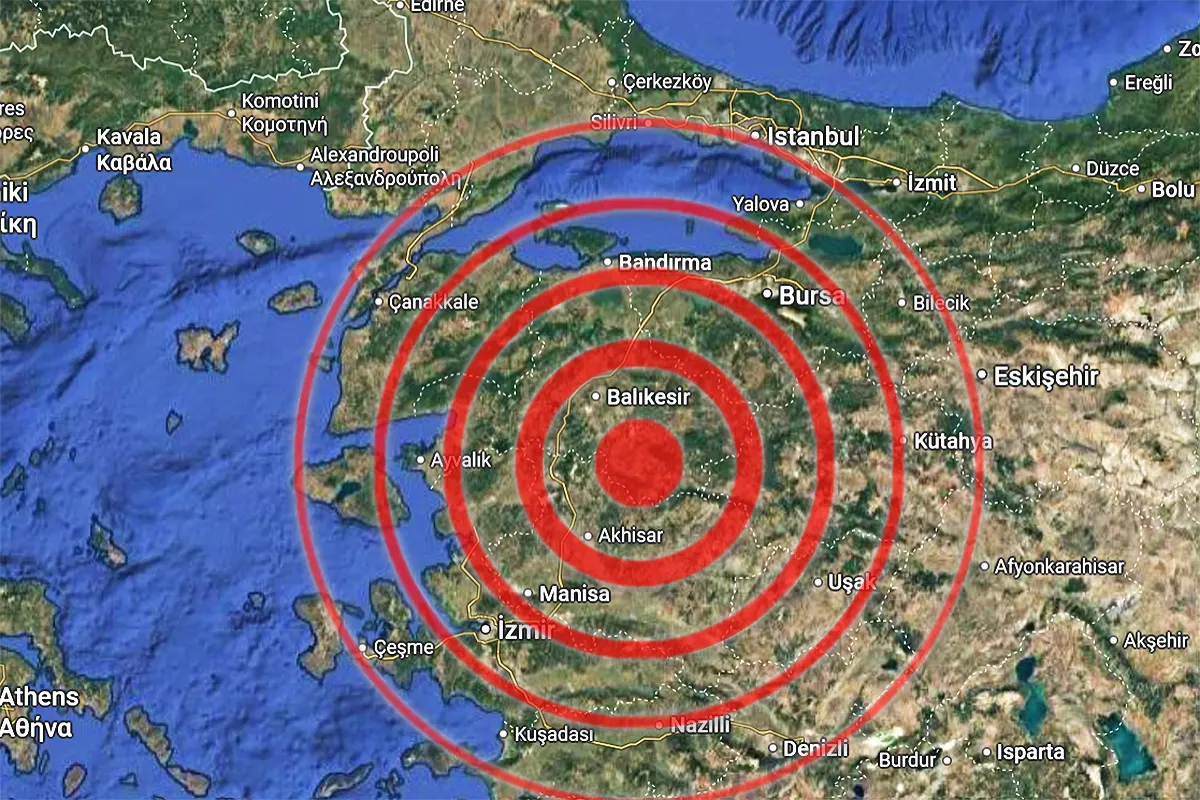
The inhabitants of Balıkesir, a province in north-western Turkey, have spent a sleepless night after a 4.8 magnitude earthquake struck last night, followed by more than 200 earthquakes throughout the night. The same region was also hit by another earthquake measuring 6.1 on the Richter scale on 10 August, which left dozens of people injured and could be felt also in Istanbul.
According to Turkish media reports in the last few hours, the first earthquake was detected at 21:58 local time (20:58 CET) with its epicentre in the district of Sırdırgı, the same district where the earthquake of 10 August originated. After this main tremor, only a few minutes later another 4.2 and then another 4.3 tremor occurred, which could also be felt in neighbouring provinces.
The quakes continued throughout the night, and by 7:00 this morning the authorities confirmed that at least 221 aftershocks had been recorded, most of them below magnitude 3, but still enough to keep virtually everyone in the area awake all night.
In a statement, the Disaster and Emergency Management Agency (AFAD) confirmed that there were no reports of casualties or major damage , although field inspections are continuing: “At the moment no negative situations have been detected following the 4.8 and 4.2 magnitude earthquakes that occurred at 21:58 and 22:00 in the Sındırgı district of Balıkesir province. Inspections on the ground are continuing. We wish a speedy recovery to our affected citizens,” the statement posted on social media said.
Scientists puzzled by succession of aftershocks
Interior Minister Ali Yerlikaya reported that several emergency teams had been deployed throughout the region, while the governor of the province, İsmail Ustaoğlu, also confirmed that “no adverse situations” had been detected so far. The fear among citizens, however, remains: it should not be forgotten that on 10 August Sındırgı was already the epicentre of a violent 6.1 magnitude earthquake that left more than 250 aftershocks and caused dozens of injuries.
Speaking on television, geological expert Okan Tüysüz drew attention to the unusual fact that the aftershocks have continued for the past two weeks in the region, and that they have affected a larger area than expected: “It is not normal,” admitted the scientist, who attributed these events to the configuration of the underground structure in the region. Although Tüysüz announced that the aftershocks are likely to continue for several days, he ruled out that these tremors are the prelude to a major earthquake.
VOTE

EDITORIAL TEAM
🧿 About us
.
Edited and reviewed by:

Pablo Gómez is a specialist in Turkey and has been editor-in-chief of Hispanatolia since 2011. He has been analysing current affairs and geopolitics in Turkey and the surrounding region since 2006.
…
📣 Your ADVERTISING on Hispanatolia
.
🤗 HELP US WITH A DONATION:
💗 Paypal