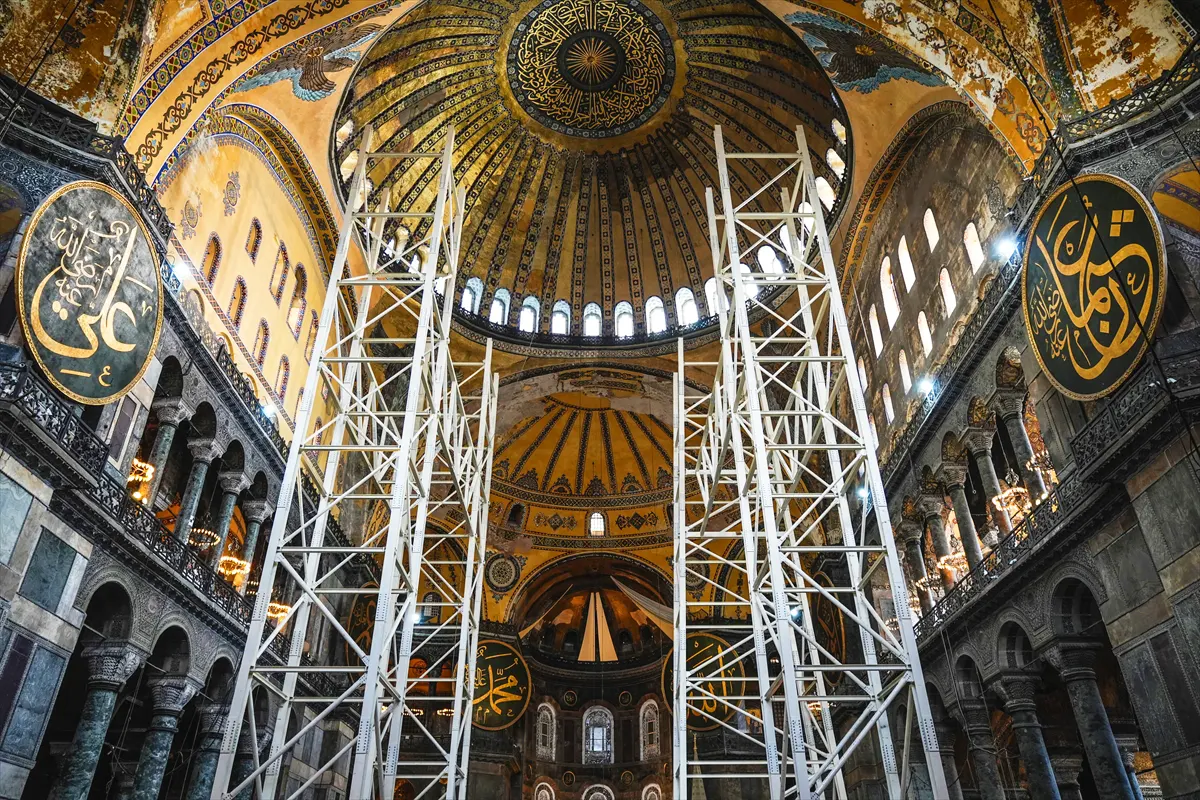
A member of the scientific committee responsible for the restoration of Hagia Sophia has responded to the doubts and criticisms generated by the presence of cranes inside the Great Mosque during the restoration work on the temple. The expert explained that the temporary platform installed in the monument is designed to support the heavy machinery necessary in this phase of the project.
Structural analyses carried out at Hagia Sophia concluded that the main dome of the building – which is 31 metres in diameter, rises to a height of some 55.6 metres and sits on four arches supported by large pillars – needed to be reinforced against earthquakes. Based on these findings, a process supervised by a Scientific Committee was initiated, and the dome is now undergoing what is considered to be the largest restoration in its history, aimed at improving its resistance to a future major earthquake while faithfully preserving the historic structure of the building.
Professor Ahmet Güleç, a member of the committee of experts overseeing the work at Hagia Sophia, said in statements reported by the Anatolia news agency that he wished to clear up any “misunderstandings” about the vehicles seen inside the holy site, the subject of public criticism in recent days. “You see the platform we have set up inside Hagia Sophia. To install the scaffolding it is necessary to bring in certain equipment. It is heavy scaffolding. If they were built inside here, it would be more dangerous because of welding and similar processes. That’s why they are prepared outside, brought in blocks (by trucks) and put in place”.
Aim: to improve Hagia Sophia’s resistance to a major earthquake
The academic explained that until now they had been working with small cranes capable of reaching up to 20-25 metres in height, but that it has been necessary to bring in larger cranes as the work has exceeded that height. “We are already at 27 metres. The platform can support them. We discussed it at length in the scientific committee: how to bring them in and how to operate them? As a final solution, we created this platform”. He also pointed out that heavy rains pose a risk, because if the dome gets wet, repairing it becomes more complicated: hence the importance of placing a temporary roof.
Güleç described the system of layers installed: “We built a tiered system: marble floor at the base, covered by geotextile, fabric, felt, a sand fill of about ten centimetres, followed by plywood and a wooden platform topped with metal plates. This structure supports about 30 tonnes per square metre. Our crane carries a maximum of 6 tonnes, which is well below the limit”. These measures are essential to move forward with the pillars and upper support elements that will be installed in the coming months, he said.
The professor said that the construction machinery will remain indoors until the installation of the platforms is complete, which is planned for the end of the year, although the base of the floor will remain in place for longer to protect the mosaics during the work. “A walkway platform will be created to intervene immediately if there are any problems with the mosaics. The elevator you see now is essential to work on the exterior of the Hagia Sophia dome. That is why we are doing it,” Güleç concluded.
🧿 TOP TOURS IN ISTANBUL
VOTE

EDITORIAL TEAM
🧿 About us
.
Edited and reviewed by:

Pablo Gómez is a specialist in Turkey and has been editor-in-chief of Hispanatolia since 2011. He has been analysing current affairs and geopolitics in Turkey and the surrounding region since 2006.
…
📣 Your ADVERTISING on Hispanatolia
.
🤗 HELP US WITH A DONATION:
💗 Paypal