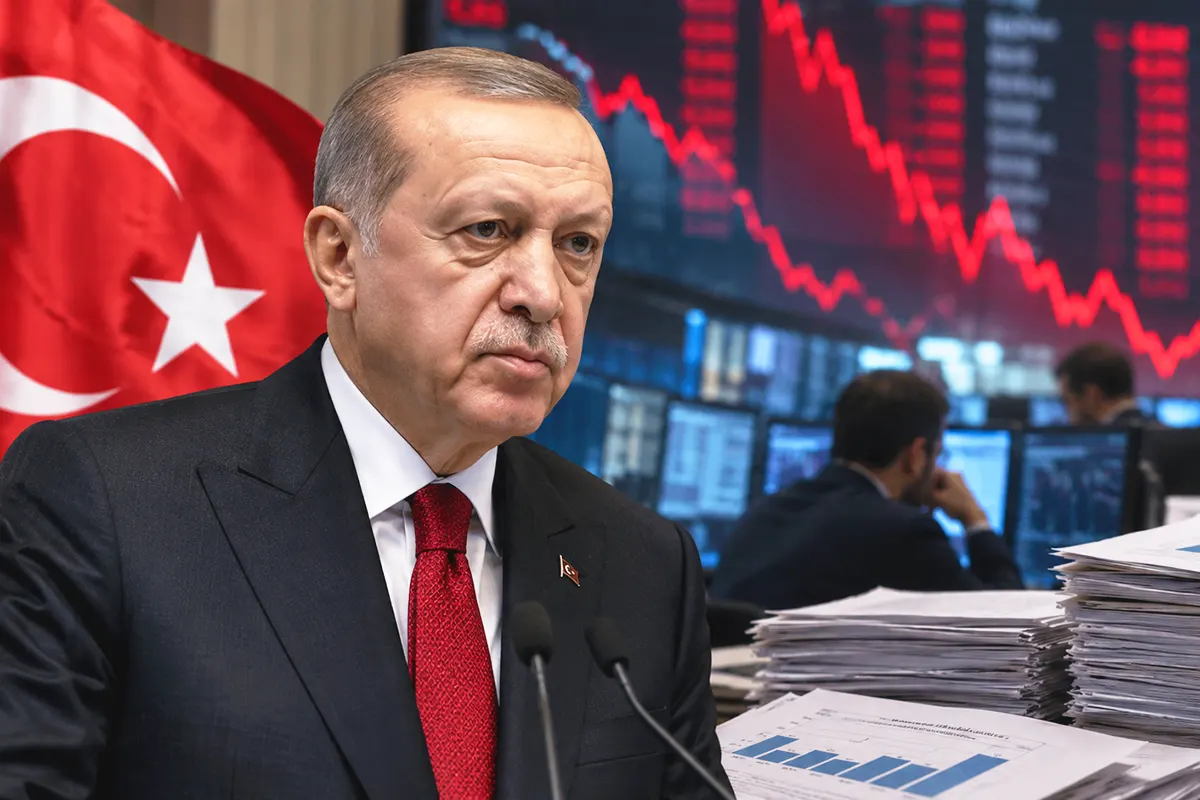
The Turkish President Recep Tayyip Erdoğan has intervened in the crisis involving 131 investment funds in Turkey, which affects nearly half a million investors, by setting up a special body tasked with speeding up their liquidation and the payments to the affected investors. The measure, announced on 29 September by the Presidency’s Communications Office, will be coordinated by the Turkish Vice-President, Cevdet Yılmaz.
The measure involves activating the highest-level administrative mechanism to date in relation to the investigation into the capital markets in Turkey, which directly affects hundreds of thousands of savers. The process includes the liquidation of 131 investment funds and actions taken against several brokerage firms, according to Turkish media reports.
The crisis erupted in mid-September, specifically on the 16th, when the first investment funds began to face difficulties in meeting requests for withdrawals amidst high volatility on the stock market; Tera Portföy reported that it was having difficulty making certain payments to investors who had requested to withdraw their money from two funds, and subsequently Pusula Portföy also reported similar problems.
The situation triggered a serious liquidity crisis, which led to heavy selling on the Istanbul Stock Exchange and prompted the Turkish authorities to intervene immediately. The investigation was subsequently extended to include alleged instances of market manipulation and possible fraud involving several companies and listed securities.
More than 455,000 investors affected
The new special body, known as the Fund Coordination Council, was established after Erdoğan met in Ankara with his economic team and senior officials from the regulatory bodies. The planned liquidation currently affects 131 funds managed by seven asset management companies and there are 455,758 investors affected, according to data provided by the Capital Markets Board (SPK).
The Presidency’s Communications Office stated in an official communiqué that the meeting had analysed recent developments in the capital markets, as well as the investigations carried out by the relevant institutions within their respective areas and the measures adopted as a result. Erdoğan emphasised that the priorities at this time are to protect investors’ rights in accordance with capital market regulations and to ensure fair payments as quickly as possible.
Turkey seeks to restore confidence in the financial markets
One of the most important decisions taken during the meeting in Ankara was precisely the creation of this special supervisory body tasked with speeding up settlement and payments by removing bureaucratic obstacles between institutions.
Furthermore, following direct instructions from the Turkish President, the State Audit Agency (DDK) officially launched an investigation into the recent operations of investment funds and the audit mechanisms of the capital markets.
According to sources within the DDK itself, the aim of this audit is to restore confidence, transparency and stability to the financial markets, to protect the constitutional rights of small investors and to identify systemic weaknesses in order to prevent similar abuses from occurring again.
The Capital Markets Board had initially set a maximum deadline of three months to complete the liquidation, although it subsequently extended this to six months to facilitate the process. This timeframe constitutes a maximum limit and does not mean that all investors will have to wait until then to receive their payments.
The Turkish government prepares measures against market manipulation
During the meeting in the Turkish capital, not only was a response to the current crisis agreed upon, but legal reforms aimed at creating a lasting environment of trust in the capital markets were also discussed.
Among other measures, new administrative and criminal regulations are being drawn up to strengthen the functioning of the markets and prevent a recurrence of similar attempts at market manipulation and financial fraud through alleged Ponzi schemes. There are also plans to establish further control mechanisms capable of instantly monitoring the risk profiles of management companies and unusual movements in portfolios using algorithms based on artificial intelligence.
In this regard, Erdoğan stated earlier this week that anyone who has participated in activities aimed at distorting the market through investment funds will have to face justice, whilst also warning of possible misconduct relating to public assets within his own party.
The investigation extends to Erdoğan’s AKP party
Fatma Betül Sayan Kaya, former Minister for Social Affairs and Family and deputy chair of the Justice and Development Party (AKP), announced last Saturday on social media that she was resigning from all her roles within the party, claiming that there were “various allegations” against her. Her resignation came amidst reports linking her to the investigation into the withdrawal of funds, with claims that she had benefited from fraudulent activities by exploiting her position.
It is estimated that the 131 funds affected – which are managed by seven portfolio management companies – have a combined value of around $17 billion, whilst the investigation continues; so far, more than fifty people have been arrested.
Opposition warns that ministers and former ministers are implicated in the fraud
Türkiye’s main opposition party, the newly founded New Party (YP), has meanwhile called on the Turkish government to conduct the investigation into the fund crisis with greater transparency and to reveal who made illegal profits through the alleged Ponzi scheme, particularly within the government and the AKP party.
Speaking to journalists about the affected investors, YP spokesperson Zeynel Emre warned Erdoğan: “They had better reveal who has made a fortune from this… AKP members know more than we do. We call on them to expose these people, before we do it ourselves”, and he claimed that among those linked to the investment fund fraud are ministers and former ministers, as well as deputy ministers in the Turkish government.
VOTE

EDITORIAL TEAM
🧿 About us
.
Edited and reviewed by:

Pablo Gómez is a specialist in Turkey and has been editor-in-chief of Hispanatolia since 2011. He has been analysing current affairs and geopolitics in Turkey and the surrounding region since 2006.
…
📣 Your ADVERTISING on Hispanatolia
.
🤗 HELP US WITH A DONATION:
💗 Paypal