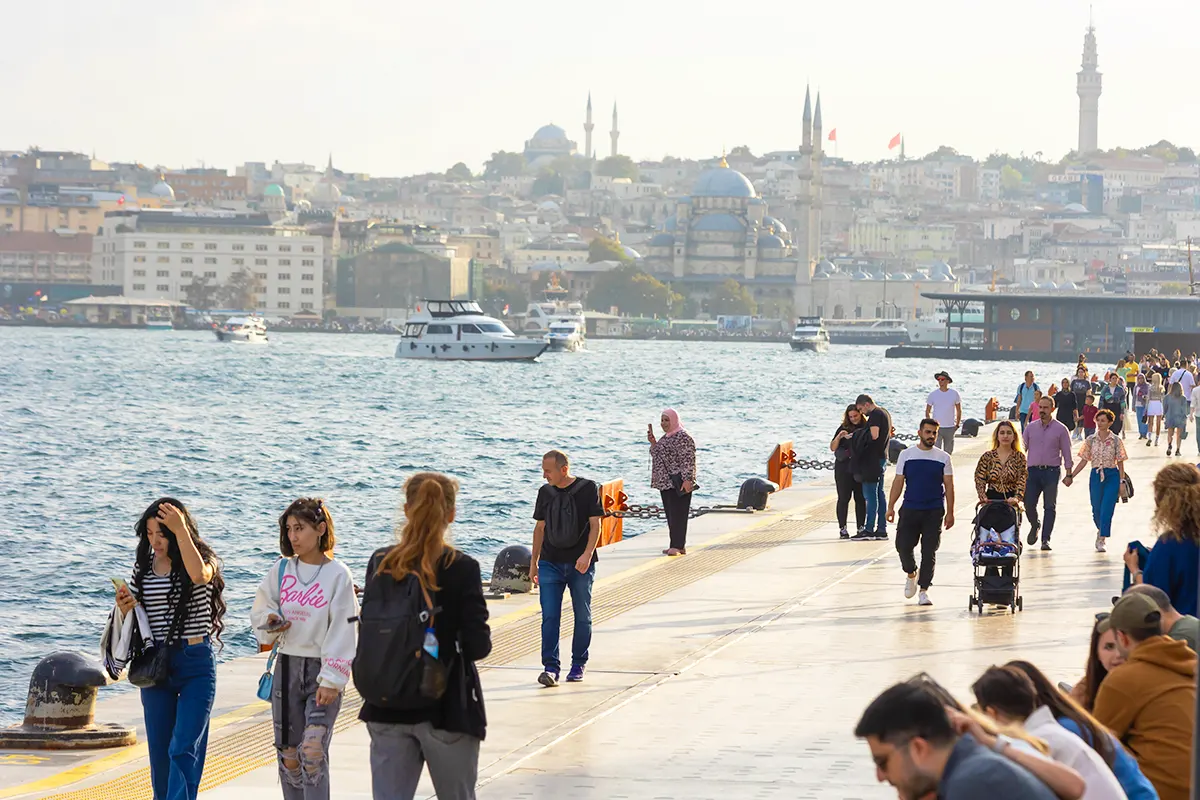
23.3% of young people in Turkey aged between 15 and 24 neither study nor work, according to the latest official data for 2025 released on Thursday by the Turkish Statistical Institute (TÜİK), which includes several interesting statistics on the country’s youth population, which stands at 12.7 million out of a total of 86.1 million inhabitants.
According to the results of the Address-Based Population Registration System (ABPRS), Turkey’s total population stood at 86,092,168 at the end of 2025, whilst the youth population aged between 15 and 24 — as defined by the United Nations — stood at 12,708,348. Thus, the young population accounts for 14.8% of Turkey’s total population, with 51.2% of this group being men and 48.8% women.
The TÜİK report, entitled “Youth in Statistics, 2025”, also indicates that the proportion of young people in Türkiye has fallen compared to previous decades; whilst in 1950 young people aged between 15 and 24 accounted for 20.8% of the population, by 2025 this figure had fallen to just 14.8%.
Compared with the countries of the European Union, however, Turkey has a proportion of young people above the EU average. Thus, among the 27 EU Member States, the average proportion of young people in Europe was 10.7% in 2025; Ireland topped the list with 12.7%, followed by the Netherlands and Denmark with 12.2%; at the other end of the scale were Malta with just 9.4% of the population aged 15–24, Bulgaria with 9.5% and Lithuania with 9.7%. The global average for the youth population in 2025 was 15.6% of the total.
More than half of young Turks say they are happy
By age group, in 2025, 30.3% of young Turks were aged between 15 and 17, 20.4% between 18 and 19, 29.2% between 20 and 22, and 20.1% between 23 and 24. The province with the highest proportion of young people is Şırnak at 20.4%, followed by Hakkari at 20.0% and Siirt at 19.8% (all in south-eastern Turkey); by contrast, the lowest youth population rates are found in Balıkesir at 11.7%, Ordu at 11.9% and Muğla at 12.0%.
According to the 2025 Life Satisfaction Survey, overall 53.3% of Turks aged 18 and over say they feel happy, whilst 13.0% admit to being unhappy. Among young people aged 18 to 24, the percentage of those who say they are happy is 54.4%, compared to 11.9% who say they feel unhappy.
As for the data obtained from the Study on Violence against Women in Turkey, it reveals that young women aged between 15 and 24 were the most exposed to some form of violence over the past 12 months. Psychological violence ranked first at 15.2%, followed by digital violence (7.3%), harassment (5.8%), economic violence (4.6%), physical violence (3.8%) and sexual violence (1.8%).
The report also reveals that 39.4% of young people in Türkiye aged between 16 and 24 who use the Internet say they use generative artificial intelligence; the figure is 38.3% among young men and 40.5% among young women. Among those who use AI, 75.3% said they use it for personal purposes, 53.9% for formal education and 19.7% for professional or work-related purposes.
According to the Household Labour Force Survey, the youth labour force participation rate rose from 47.2% in 2024 to 47.6% in 2025, whilst the youth unemployment rate fell from 16.3% in 2024 to 5.3% in 2025. Furthermore, the study reveals that the proportion of young people in Turkey who neither study nor work rose from 22.9% in 2024 to 23.3% in 2025: among young Turkish men, the percentage of “NEETs” is 16.3%, whilst among young women it reaches 30.9%. Finally, the statistical report reveals that, if the current demographic trend continues, the proportion of young population in Türkiye will remain at 14.8% in 2030, falling to 12.2% in 2040, to 10.3% in 2060 and to 8.8% in 2080, before rising slightly to 9.6% in 2100.
VOTE

EDITORIAL TEAM
🧿 About us
.
Edited and reviewed by:

Pablo Gómez is a specialist in Turkey and has been editor-in-chief of Hispanatolia since 2011. He has been analysing current affairs and geopolitics in Turkey and the surrounding region since 2006.
…
📣 Your ADVERTISING on Hispanatolia
.
🤗 HELP US WITH A DONATION:
💗 Paypal