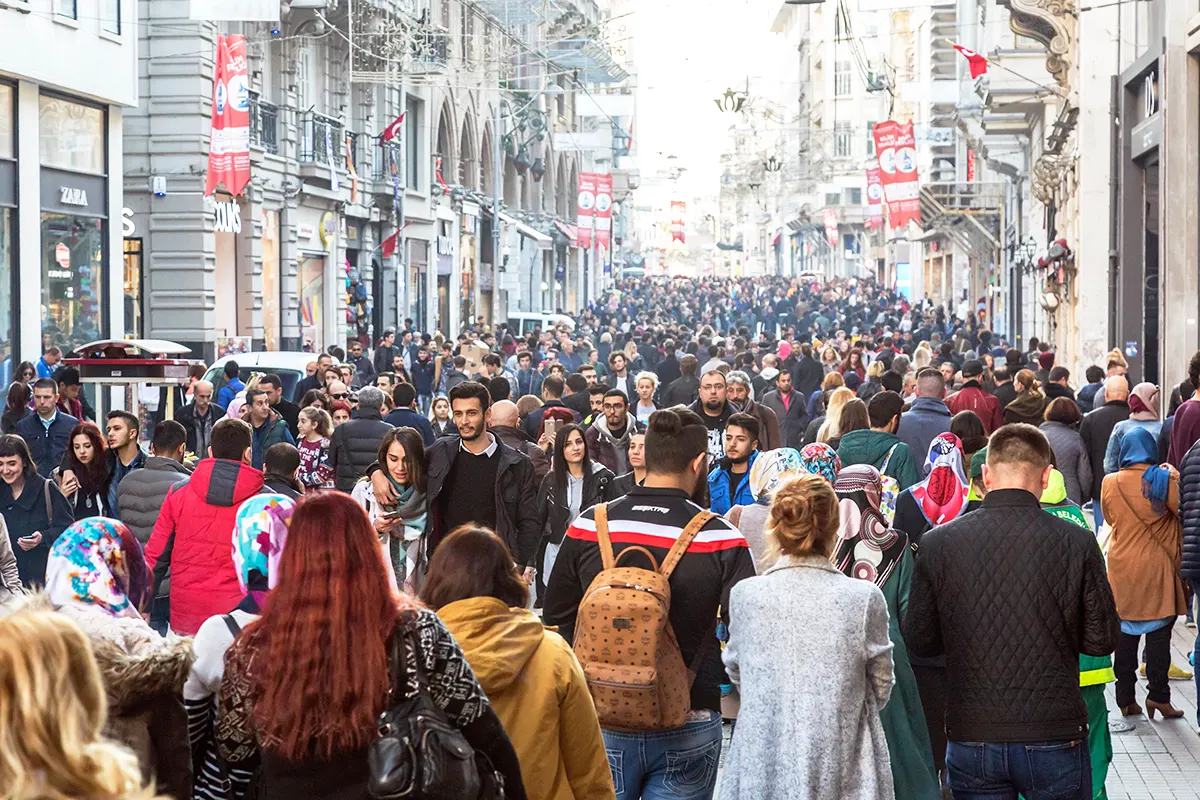
Turkey’s population hit an all-time high and reached 86.1 million last year, according to official data, reflecting the demographics of a country that continues to grow in population numbers but faces deepening demographic challenges due to falling birth rates, delayed marriage and childbearing, and a rapidly ageing population.
As reported by the Turkish news agency Anatolia, citing data from the latest report of the Turkish Statistical Institute (TÜİK), the results for 2025 of the Address-Based Population Registration System indicate that the national population, estimated at 85,664,944 in 2024, increased by 427,224 over the past year to 86,092,168.
Males accounted for 50.02% of the total, with 43,059,434 persons, while females accounted for 49.98%, with 43,032,734 persons. The annual population growth rate rose from 3.4 per thousand in 2024 to 5 per thousand in 2025. At the same time, the foreign population in Turkey increased by 38,968 persons compared to the previous year, reaching a total of 1,519,515 foreign residents; of this group, 49.3% are men and 50.7% are women.
On the other hand, the proportion of Turks living in urban centres increased slightly from 93.4% to 93.6%, while the proportion living in towns and villages decreased from 6.6% to 6.4%; moreover, 67.5% of the population resides in densely populated cities, 15.8% in medium-density areas and 16.8% in rural areas.
Istanbul is approaching 16 million inhabitants
While in 2024 the population decreased in 40 provinces, in 2025 the number of provinces where there was a loss of inhabitants decreased to 33. The population of Istanbul grew by 52,451 people in 2025 compared to the previous year and reached 15,754,053 inhabitants, making Istanbul 18.3% of the total population of the Eurasian country.
The Turkish metropolis was followed in the population ranking by Ankara (5,910,320), Izmir (4,504,185), Bursa (3,263,011) and Antalya (2,777,677). At the other end of the spectrum, Bayburt established itself as the least populated province in Türkiye, with only 82,836 registered residents, followed by Tunceli, Ardahan, Gümüşhane and Kilis.
Average age of Turks rises to almost 35 years old
In terms of age structure, the average age of the Turkish population rose from 34.4 years in 2024 to 34.9 years in 2025, while by gender, the average age increased from 33.7 to 34.2 years among men and from 35.2 to 35.7 years among women. At the provincial level, Sinop recorded the highest median age at 44 years, followed by Giresun and Kastamonu; on the opposite side, Şanlıurfa presented the lowest median age in the country at only 21.8 years, followed by Şırnak and Siirt provinces.
Population density – defined as the number of persons per square kilometre – stood at 112 persons/km2 at the national level. Istanbul was the province with the highest density, with no less than 2,943 persons per square kilometre, followed by Kocaeli (633) and Yalova – the province with the smallest area – with 395 persons. Tunceli was once again the least densely populated province in Turkey, with only 11 persons per square kilometre.
The declining birth rate: a pressing problem in Turkey
Beyond this population increase, however, Turkey continues to face a marked demographic shift. According to the most recent data, the fertility rate fell to just 1.48 live births per woman of childbearing age (15-49 years) in 2024, well below the replacement level of 2.1 children needed to sustain the population in the long term.
This decline is closely related to the delay in marriages and childbearing, in addition to the fact that more and more Turkish couples are deciding not to have children. Faced with this situation, the Turkish government launched an ambitious programme a year ago with important measures and incentives for families to have children as part of the ‘Year of the Family’ initiative, which aims to promote the birth rate and slow down the ageing of the population.
VOTE

EDITORIAL TEAM
🧿 About us
.
Edited and reviewed by:

Pablo Gómez is a specialist in Turkey and has been editor-in-chief of Hispanatolia since 2011. He has been analysing current affairs and geopolitics in Turkey and the surrounding region since 2006.
…
📣 Your ADVERTISING on Hispanatolia
.
🤗 HELP US WITH A DONATION:
💗 Paypal