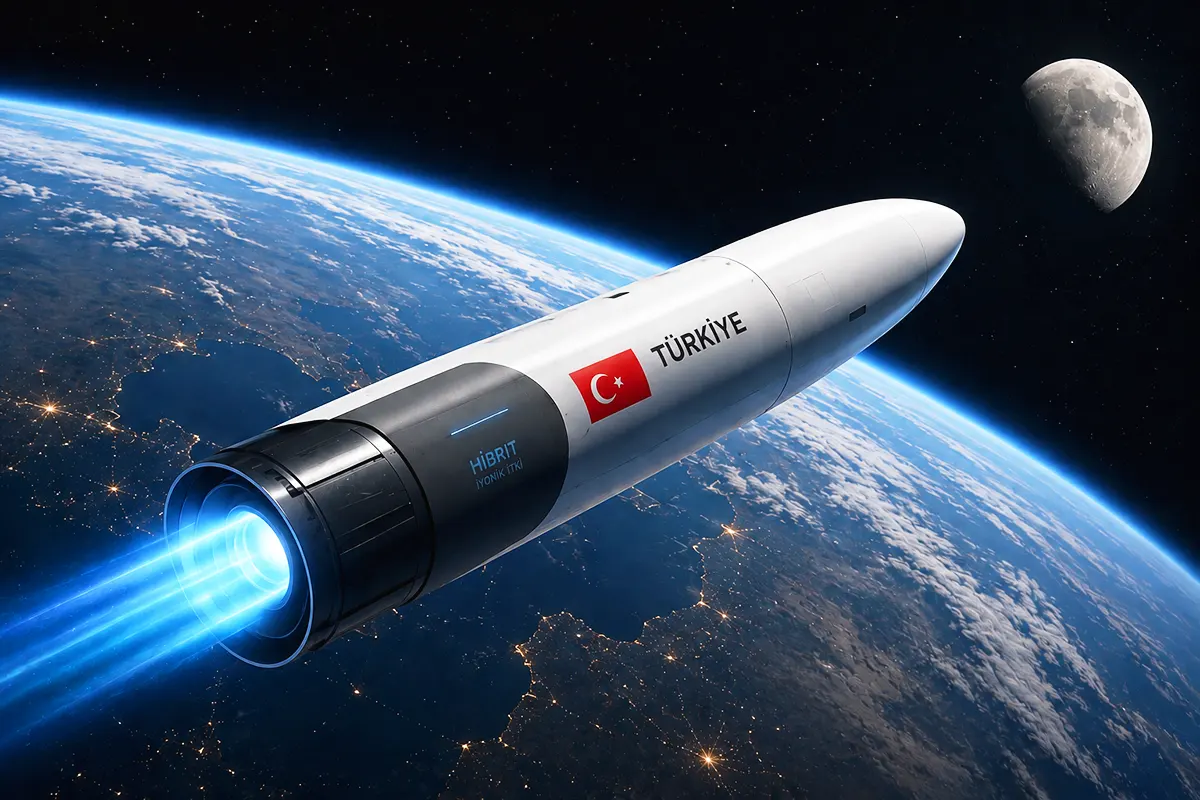
Turkish Minister for Industry and Technology, Mehmet Fatih Kacır, has announced that Turkey will send its own spacecraft to the Moon, equipped with a new hybrid propulsion system, during the early months of 2027.
Kacır explained that, as part of the National Space Programme, various projects aimed at deep space are currently being developed, and announced that Turkish engineers, researchers and scientists have been working for some time on the development of their own lunar orbiter, he said in comments reported by the Turkish news channel NTV.
The minister confirmed that the 2027 mission to the Moon will utilise home-grown technology, employing a hybrid propulsion system that has not been used before, and assured that all tests have now been successfully completed. “We have now also finalised our launch schedule. (Once the launch takes place) we will have made a reality a technology that very few countries in the world can achieve,” he stated.
Turkey moves towards independent access to space
Kacır also highlighted the capabilities Turkey has developed in recent years in rocket and missile technology. “We have very significant capabilities in rocket and missile technologies. Roketsan, TÜBİTAK Sage and Delta V are carrying out very important work in this field. We are gradually approaching the point where this work will enable us to produce our own satellites and rockets to send them into space using our own resources,” he said, whilst emphasising that achieving independent access to space is a strategic objective for Turkey.
“As Türkiye, we are taking a very strategic step and building our own spaceport in Somalia,” confirmed the minister. “Turkey will have the capacity to send its own satellites and spacecraft into space, launched by its own rockets, from its own spaceport.”
A spaceport in Somalia and a new space technology park
Kacır emphasised that developing these capabilities requires the creation of an entire technological ecosystem: “Of course, all of this is possible thanks to an ecosystem. The number of people working in this field in Turkey is increasing exponentially every year. But we need more,” he noted.
For this reason, the Turkish government is already preparing to establish a space technology park, in collaboration with the Middle East Technical University (METU), which will be built on its campus. According to Kacır, this infrastructure will bring together the institutions and companies working in this sector in Turkey and enable them to jointly carry out research and development (R&D) activities in space technology, with the aim of sending spacecraft to the Moon and beyond.
VOTE

EDITORIAL TEAM
🧿 About us
.
Edited and reviewed by:

Pablo Gómez is a specialist in Turkey and has been editor-in-chief of Hispanatolia since 2011. He has been analysing current affairs and geopolitics in Turkey and the surrounding region since 2006.
…
📣 Your ADVERTISING on Hispanatolia
.
🤗 HELP US WITH A DONATION:
💗 Paypal