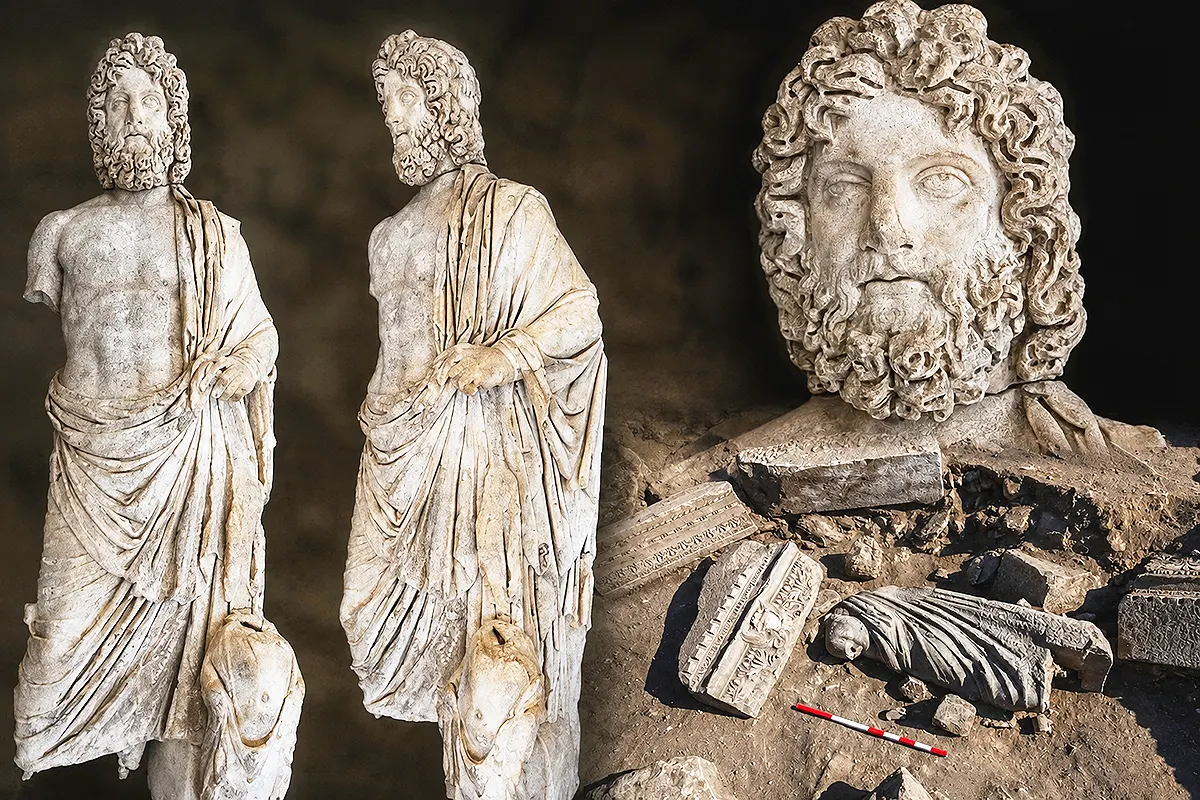
A marble sculptural group dating back some 1,800 years, which includes a statue depicting Asclepius, the ancient Greek god of healing, alongside his son and assistant Telesphorus, has been discovered at the archaeological site of Aspendos, in the province of Antalya, in southern Turkey.
Turkish Minister of Culture and Tourism, Mehmet Nuri Ersoy, confirmed the discovery in a post shared just a few days ago on social media: “In Aspendos, a symbol of healing dating back almost 1,800 years has come to light. During the excavation work we are carrying out in the ancient city as part of our ‘Legacy for the Future’ project, we have unearthed a group of marble statues, 2.20 metres tall, depicting the god of healing, Asclepius, and his son and assistant, Telesphorus,” said Ersoy, as quoted by the Anatolia news agency.
The artefact, dating from the period of Imperial Rome, was found amongst the ruins of the north wing of the Monumental Gate, situated on the western side of the East Square, on the Theatre Street. “The sculptural group, dated to the last quarter of the 2nd century AD, reflects the sculptural style of the period through the figures’ postures, the drapery of the himation (a typical cloak of ancient Greece), the facial features of Asclepius and the intricate detailing of his hair and beard,” added the minister.
A symbol of healing and health in antiquity
In antiquity, Asclepius was a symbol of medicine, healing treatments and the preservation of health. Telesphorus, depicted wearing a long hooded robe and tasked with assisting his father, embodied the culmination of treatment, healing and the period of convalescence.
The find is believed to have comprehensively represented the healing process, from the treatment of an illness to the individual’s full recovery. This significant archaeological discovery could also provide new and important insights into the cult practices related to health in Aspendos, its belief system and its social life.
The main figure in the group, Asclepius, is shown standing and facing the viewer, depicted as a mature man with long, thick hair and a beard. His weight rests on his left leg, whilst his right leg is slightly bent and positioned forward to one side. In front of Asclepius’s left foot stands Telesphorus, depicted on a much smaller scale than the main figure; this small figure is clearly identifiable as Telesphorus due to his long, hooded robe, which completely covers his body.
The fact that this sculptural group was found amongst the ruins of the Monumental Gate suggests that it was displayed in an area of the city of great public and ceremonial significance. The piece serves not only to document the existence of the cult of Asclepius, but also the importance of health-related beliefs in urban life in Aspendos during the Roman period.
A widespread cult in Anatolia during the Greek and Roman periods
Asclepius, regarded in Greek and Roman mythology as the son of Apollo, was usually depicted as a mature, bearded man with a staff around which a snake was coiled. This staff, in fact, continues to be used today as a symbol of medicine.
The healing centres dedicated to Asclepius, known as Asklepieion, could be regarded as the hospitals of the ancient world. Patients received treatment there, and some even slept in the temple, in the hope of being cured through dreams inspired by the god. Anatolia was one of the regions where this cult was most significant; indeed, the Asklepieion at Pergamon (whose ruins, designated a World Heritage Site, are situated near the Turkish town of Bergama) was one of the most important centres of healthcare in the ancient world.
Telesphorus was a deity of lesser rank, but he held a special place within beliefs relating to healing. He was often depicted as a child or a small figure, always clad in his characteristic hooded cloak. His cult was also widespread, particularly in Anatolia, during the Roman Empire, and he frequently appeared alongside Asclepius as a complementary figure.
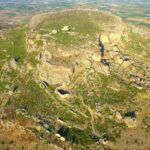
Aspendos, now known above all for its exceptionally well-preserved Roman theatre, was one of the most important cities in the ancient region of Pamphylia, which encompasses the southern coast of what is now Turkey. These new statues, recently discovered by archaeologists amongst the ruins, will shed new light on the nature of the cult of the Greek god of health and the belief system surrounding him, as well as on social life during Roman rule in this region steeped in history.
VOTE

EDITORIAL TEAM
🧿 About us
.
Edited and reviewed by:

Pablo Gómez is a specialist in Turkey and has been editor-in-chief of Hispanatolia since 2011. He has been analysing current affairs and geopolitics in Turkey and the surrounding region since 2006.
…
📣 Your ADVERTISING on Hispanatolia
.
🤗 HELP US WITH A DONATION:
💗 Paypal