

Archaeologists have made new discoveries at the Roman theatre of İznik (Nicaea) in north-western Turkey, where marble cobbled lanes, entrance and exit passages and an ancient sewage system have come to light in the western section of the 2,000-year-old building, located by Lake İznik in the province of Bursa. The discovery comes shortly before the expected visit of Pope Leo XIV, scheduled for the end of November, on his first official trip abroad on the occasion of the anniversary of the First Council of Nicaea, held in this historic city 1,700 years ago.
The excavations of the Roman theatre in İznik, supervised by the Directorate of the İznik Museum, cover an area of about 10,000 square metres. The work, begun in the 1980s and continuously resumed since 2016 by a team from Dokuz Eylül University, allowed the theatre to reopen to the public in March 2024: since then, the site has received more than 90,000 visitors, while archaeologists continue to excavate in the outer areas of the main building, Anatolia news agency reported.
During this year’s campaign, experts have unearthed access roads, marble-paved pathways and a sanitation system at the western end of the theatre. According to Professor Aygün Ekin Meriç, who is in charge of the excavations, this theatre is one of the few examples in all of Anatolia built on flat ground, without taking advantage of a natural slope. The three-storey structure, measuring 102 m by 79 m, is built entirely on solid vaults and originally reached a height of 24 m, with a capacity for 10,000 spectators.
The theatre ceased to host gladiatorial fights and was used for religious purposes
Built during the reign of the emperor Trajan, the theatre was used between the 2nd and 3rd centuries for shows and gladiatorial fights. From the 4th century onwards, however, the theatre acquired a religious function that lasted until the 6th century, as evidenced by Christian symbols, crosses and a fresco depicting the Virgin Mary and Child Jesus, considered one of the oldest examples of the Theotokos (depictions of the Virgin) type in all of Anatolia.
After the First Council of Nicaea in 325, the theatre became a centre of pilgrimage for Christian clergy. “At that time, the theatre stands were still intact, and an estimated 300 bishops from all over the world gathered here for a month,” Meriç explained. Some holes found in the stage, possibly used to install temporary roofs, indicate that part of these meetings were held inside the theatre itself: “Although the basilica (now submerged) is the main candidate, the frescoes and Christian symbols found clearly indicate that several meetings were also held in the theatre,” he said.
Between the 11th and 13th centuries, churches were built within the enclosure, one at the top of the cavea and another near the entrance; tombs dating back to the Crusades have been found around them, and archaeologists plan to excavate this necropolis in 2026.
The theatre also preserves remains from later times, including Ottoman rule, when ceramic kilns were installed there. “We have found ten kilns and numerous artefacts,” said Meriç, who noted that the ancient Roman theatre of Nicaea is the only building in İznik that has survived all the city’s historical stages: Hellenistic, Roman, Byzantine and Ottoman. “It is, in essence, a real stratified monument that summarises the entire history of the city,” the archaeologist concluded.
VOTE

EDITORIAL TEAM
🧿 About us
.
Edited and reviewed by:

Pablo Gómez is a specialist in Turkey and has been editor-in-chief of Hispanatolia since 2011. He has been analysing current affairs and geopolitics in Turkey and the surrounding region since 2006.
…
📣 Your ADVERTISING on Hispanatolia
.
🤗 HELP US WITH A DONATION:
💗 Paypal

+ POSTS
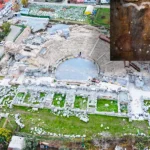 Archaeologists restore a fresco of Jesus and Mary in ancient Nicaea
  Iznik prepares for Pope Leo XIV’s visit on the anniversary of the Council of Nicaea
  3,000-year-old Babylonian text confirms location of Noah’s Ark according to the Bible
  Archaeologists uncover ancient Roman stadium in Antalya, Turkey