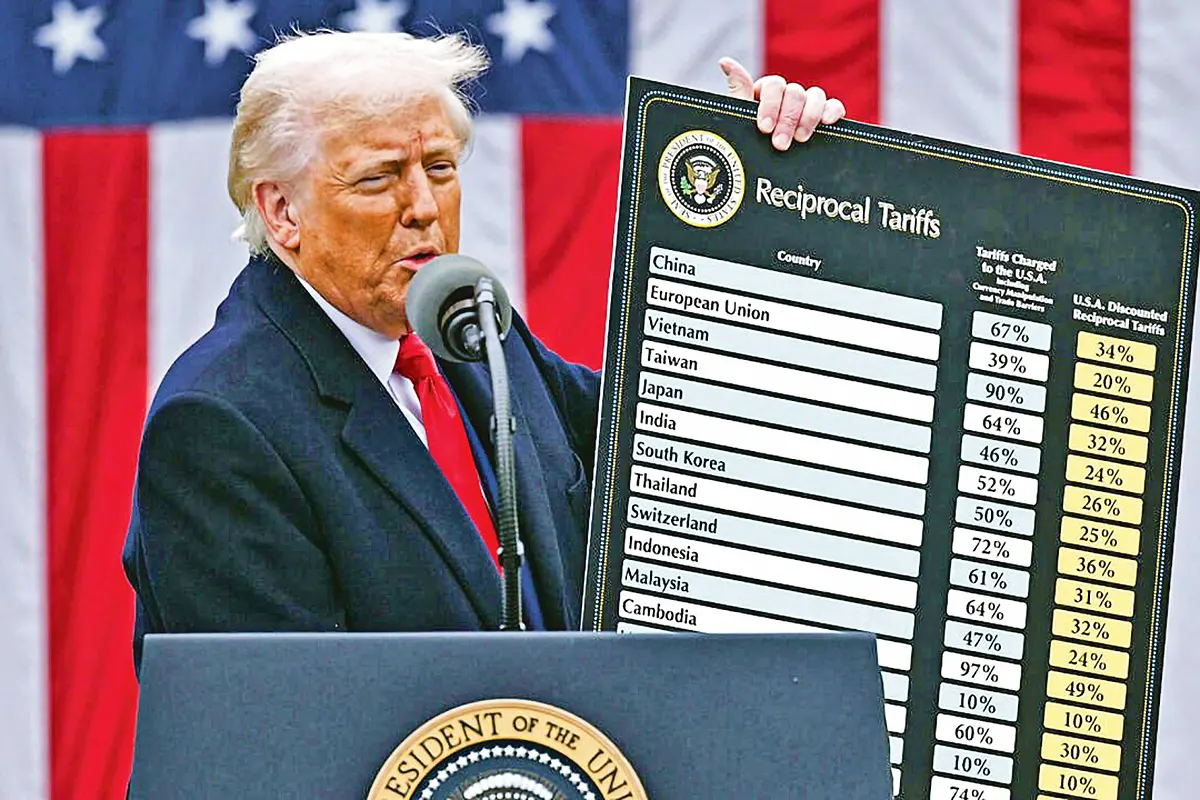
Trump has unleashed a storm in world markets with the imposition of tariffs on dozens of countries which, after signing an executive order on Thursday titled “Further Modifying the Reciprocal Tariff Rates”, in the case of Turkey are increased from an initially set 10% to 15%.
According to Turkish media reports in the last few hours, the United States has finally imposed tariffs of 15% on Turkish products, despite which Turkey is one of the countries suffering a smaller increase in customs tariffs following the executive order signed by the US President, which seeks to reduce the country’s trade deficit at the cost of increasing reciprocal tariffs for certain countries, and whose entry into force has been delayed until 7 August.
As announced by the White House, the ‘universal’ tariff for goods entering the United States will continue to be 10% – as established on 2 April – but this tariff will only be applied to those countries whose exports to the US are lower than their imports (that is, where the balance of trade is favourable to the USA): in practice, according to US officials, the new measures will mean an increase in tariffs for most countries.
Thus, with the new executive order signed on 31 July, the ‘basic’ tariffs for some 40 countries will rise to 15%, and although this tariff rate will in many cases be lower than that announced on 2 April, in the case of some countries – including Türkiye – it means in practice an increase in tariffs from 10% to 15%, applicable to all Turkish products destined for the US market.
These are the new US tariffs
With the new executive order signed by Trump, the US tariffs are as follows:
Europe
- Bosnia and Herzegovina 30%
- European Union: 15% for most goods
- Iceland 15%
- Liechtenstein 15%
- Moldova 25%
- North Macedonia 15%
- Norway 15%
- Serbia 35%
- Switzerland 39%
- United Kingdom 10%
Middle East and Central Asia
- Afghanistan 15%
- Brunei 25%
- Iraq 35%
- Israel 15%
- Jordan 15%
- Kazakhstan 25%
- Syria 41%
- Turkiye 15%
Africa
- Algeria 30%
- Angola 15%
- Botswana 15%
- Cameroon 15%
- Chad 15%
- Ivory Coast 15%
- Democratic Republic of the Congo 15%
- Equatorial Guinea 15%
- Ghana 15%
- Guyana 15%
- Lesotho 15%
- Libya 30%
- Madagascar 15%
- Malawi 15%
- Mauritius 15%
- Mozambique 15%
- Namibia 15%
- South Africa 30%
- Tunisia 25%
- Uganda 15%
- Zambia 15%
- Zimbabwe 15%
Americas
- Bolivia 15%
- Brazil 10%
- Canada 35%
- Costa Rica 15%
- Ecuador 15%
- Falkland Islands 10%
- Nicaragua 18%
- Trinidad and Tobago 15%
- Venezuela 15%
Asia-Pacific
- Bangladesh 20%
- Cambodia 19%
- Fiji 15%
- India 25%
- Indonesia 19%
- Japan 15%
- Laos 40%
- Malaysia 19%
- Myanmar (Burma) 40%
- Nauru 15%
- New Zealand 15%
- Pakistan 19%
- Papua New Guinea 15%
- Philippines 19%
- South Korea 15%
- Sri Lanka 20%
- Taiwan 20%
- Thailand 19%
- Vanuatu 15%
- Vietnam 20%
(Source: Al-Jazeera)
The United States is one of Turkey‘s main export destinations, with exports totalling almost $17 billion in 2022, second only to Germany. Last June alone, Turkey exported $1.2 billion worth of goods to the US, while importing $1.5 billion worth of US goods.
Even so, the US goods trade deficit with Turkey was $1.5 billion in 2024, equivalent to a 62.7% increase ($559.6 million) over 2023, according to the US government’s own data – a situation that Trump’s tariffs are intended to correct. The Turkish government’s target so far was to increase trade volume with the US to $100 billion, after bilateral trade has risen sharply in recent years to $32 billion by 2024.
VOTE

EDITORIAL TEAM
🧿 About us
.
Edited and reviewed by:

Pablo Gómez is a specialist in Turkey and has been editor-in-chief of Hispanatolia since 2011. He has been analysing current affairs and geopolitics in Turkey and the surrounding region since 2006.
…
📣 Your ADVERTISING on Hispanatolia
.
🤗 HELP US WITH A DONATION:
💗 Paypal