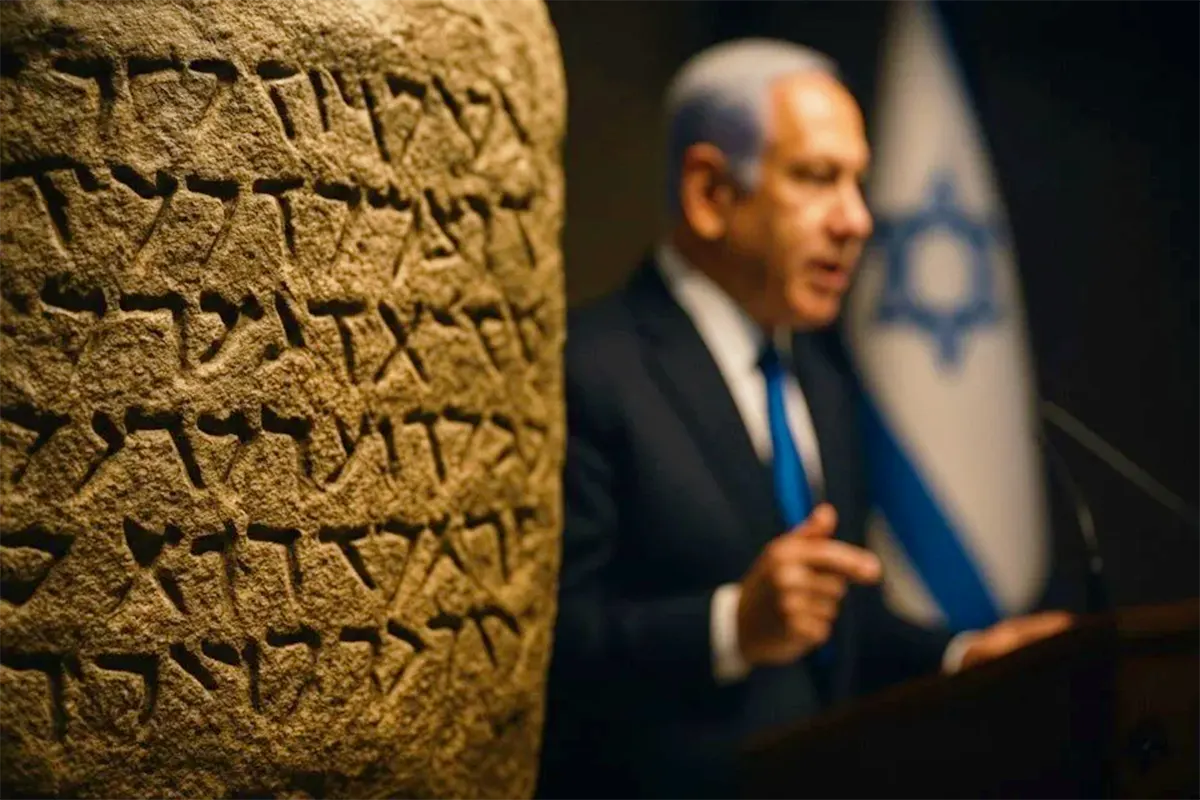
Israeli Prime Minister Benjamin Netanyahu has in recent days renewed his claims to the so-called Siloam Inscription, an engraved stone text some 2.700 years old, which Zionist sectors in Israel consider as proof and justification for the current State of Israel‘s territorial claims to Jerusalem and other territories; however, leading historians and legal experts in Turkey not only reject any legal claim to this object – currently on display in the Istanbul Archaeological Museum – but stress that it offers no historical or legal basis for claims on Jerusalem.
Carved in ancient Hebrew, the inscription was discovered in 1880 – when the territory of Palestine was part of the Ottoman Empire – in a water tunnel in Jerusalem built during the reign of King Hezekiah. Shortly afterwards it was sent to the Imperial Museum in Istanbul – currently the Istanbul Archaeological Museum – where it has remained since 1883. Today only a replica is on display in Jerusalem.
During his speech on 15 September at an event in Jerusalem in the presence of Secretary of State Marco Rubio, Netanyahu claimed that he had personally requested the inscription from the then Turkish Prime Minister Mesut Yılmaz during a visit he himself made to Türkiye in 1998, even offering to exchange it for all the Ottoman relics kept in Israel’s museums. Yılmaz rejected the request at the time, but over the years several Israeli leaders have made similar requests, which have also been rejected by Ankara.
The inscription, which Turkey refuses to hand over despite these insistent demands, is presented by the Israeli authorities as having a connection to Israel’s history and is considered as “proof that the historical, cultural and religious roots of Jews in Jerusalem go back thousands of years”, and would therefore support the “historical legitimacy of the modern Jewish state“, according to nationalist/Zionist sectors, Turkish broadcaster NTV reports.
The quest for legitimacy of the state of Israel
These historical claims become more controversial when one considers that, if the current state of Israel seeks to base its legitimacy on its historical origins through artefacts such as the Siloam Inscription, there is even stronger historical evidence that would justify the presence of the Palestinian people for thousands of years in the region.
While touring the tunnels near the Al-Aqsa Mosque with Rubio on 15 September, Netanyahu again brought up the issue of the Siloam Inscription, a copy of which is also displayed on a wall in the tunnel. In doing so, Netanyahu sought to impress the US Secretary of State, who is known for his interest in religious matters and his habitual references to the Bible, perhaps in an attempt to get him to support his claims against Turkey.
In his speech and before Rubio, Netanyahu stated that in 1998 he had asked Turkey to return the Siloam Inscription, found in Jerusalem and transferred to Istanbul in Ottoman times, claiming however that his request was rejected due to pressure from the then metropolitan mayor of Istanbul, the current Turkish president Recep Tayyip Erdoğan, and his supporters. According to Netanyahu’s account, in his conversation with former prime minister Mesut Yılmaz, the latter replied: “There is a growing Islamist base led by someone who is the mayor of Istanbul. You know his name. This segment of Turkish public opinion will react if we give Israel a tablet that proves that Jerusalem was a Jewish city 2,700 years ago.”
The fact, however, is that the Siloam Inscription is not by itself a historical object that can alone legitimise the current existence of the State of Israel. The text, which is only partially legible, details the construction of the tunnel that carried water from the Pool of Siloam to the City of David, under the southern end of the so-called Temple Mount, echoing the biblical account of the construction of the tunnel during the reign of King Hezekiah. The Istanbul Archaeological Museum also houses two other important historical objects from the region: the Gezer agricultural calendar, discovered in 1908 and dated to the 10th century BC, and the Temple Warning inscription, discovered in 1871 and some 2,000 years old. But since the State of Israel did not even exist at the time of their discovery and the territory was administered by the Ottoman Empire, the three objects are legally considered the property of the Republic of Turkey, the successor to the Ottoman State.
Turkish historian and scholar Erhan Afyoncu is one of the experts who has raised doubts about the dating of the Siloam Inscription itself: “Although the text is associated with the aqueduct built against the threat of an Assyrian siege, described during the reign of King Hezekiah in the Old Testament, there are also different opinions about its date,” Afyoncu wrote on social media. King Hezekiah, a historical figure who has haunted Netanyahu for many years, was the one who – according to the Bible – fearing that the Assyrians would besiege the city, built a canal that diverted water to the Pool of Siloam to withstand a siege.
Netanyahu and the search for his biblical origins
On 22 September 2018, The Times of Israel carried a statement by Netanyahu on the Siloam Inscription in which he said: “Is there a better and more definitive proof engraved in stone of the ancient link between the Jewish people and Jerusalem, the City of David and the Temple Mount? Certainly not”.
According to the Israeli newspaper, a 2,600-year-old clay tablet bearing the name Benayahu ben Netanyahu was to be delivered to Israel’s Prime Minister’s Office in 2019; this tablet, dated to 511 BC, would have been engraved during the Babylonian exile that followed the destruction of the First Temple mentioned in the Bible, and Netanyahu planned to show this tablet to his most distinguished guests to impress them and demonstrate the long history of the Jewish people in the region and their subsequent exile from Israel.
Netanyahu also reportedly held a meeting with experts from the Jerusalem’s Bible Lands Museum in which they surprised the Israeli Prime Minister by showing him an ancient inscription bearing the name “Netanyahu”. However, this attempt by the Israeli politician to seek his origins in the ancient history narrated by the Old Testament and to present himself as a descendant of the ‘Netanyahu’ on that tablet seems rather crude, since it is well known that the father of the current Israeli prime minister changed his original surname – Benzion Mileikowsky – when he emigrated to Israel from Poland. In other words, the choice of the surname Netanyahu was deliberately made to associate the family with the era of King Hezekiah, and is not the fruit of genuine descent.
Netanyahu in fact has a collection of antiquities, which he does not hesitate to show to visitors whenever he has the opportunity. The Times of Israel reports that “The American rock band Aerosmith visited the prime minister in 2018 after a concert, and the prime minister showed them the signet ring of an official named Netanyahu ben Joash, who had worked for the biblical king Hezekiah”. In this way, Netanyahu would persistently attempt to legitimise himself by seeking a link to a historical figure, despite the fact that the choice of his surname was far from coincidental.
“An attempt to construct Israel’s history“
Turkish experts argue on the other hand that the so-called Siloam Inscription cannot be used to support the political or territorial claims of the current state of Israel. Speaking to the daily Hürriyet, the renowned Turkish historian İlber Ortaylı stressed that such artefacts cannot be claimed on the basis of political claims either: “No country hands over such inscriptions. What legal basis could this have? If such logic was applied, the Romans could claim lands they ruled two thousand years ago,” he insisted.
Religious historian İsmail Taşpınar also questioned the validity of Netanyahu‘s claim about the famous inscription guarded in Istanbul: “Archaeological finds have long been linked to ancient scriptures as part of an attempt to construct the history of Israel,” recalled Taşpınar, who also confirmed that the dating and purpose of the Siloam Inscription is still the subject of debate among scholars, and therefore cannot be treated as if it was a conclusive proof of anything. “The existence of a civilisation in a place during a certain period does not make it its own forever, according to international law,” concluded Enver Bozkurt, a Turkish professor of International Law.
VOTE

EDITORIAL TEAM
🧿 About us
.
Edited and reviewed by:

Pablo Gómez is a specialist in Turkey and has been editor-in-chief of Hispanatolia since 2011. He has been analysing current affairs and geopolitics in Turkey and the surrounding region since 2006.
…
📣 Your ADVERTISING on Hispanatolia
.
🤗 HELP US WITH A DONATION:
💗 Paypal