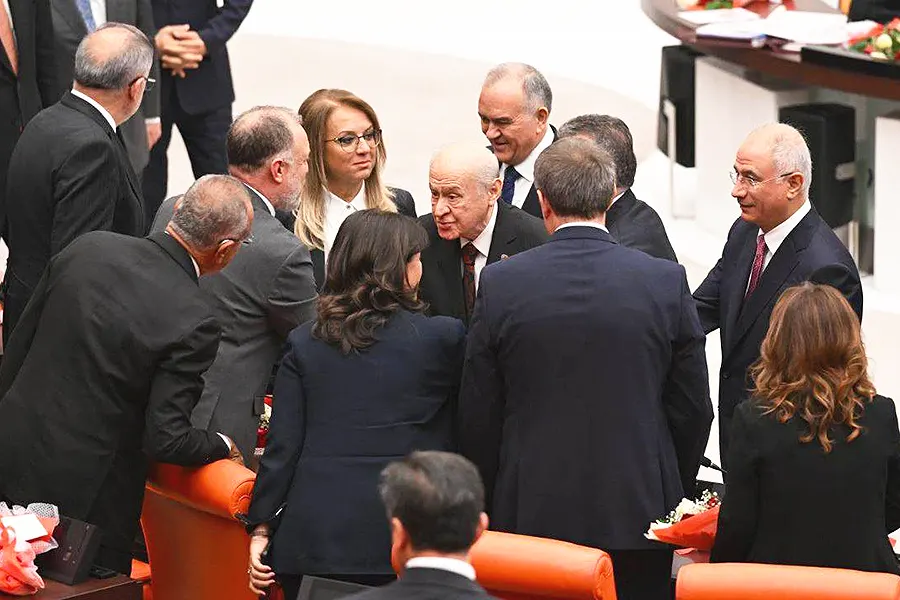
Turkey’s political class seems to have opted to join forces and exchange confrontation for concord in the face of the serious crisis in the Middle East following the Israeli offensive in Gaza and Lebanon and, more recently, the possibility that – as Turkish President Tayyip Erdoğan has recently warned – Turkey itself could become the target of Israel, which in the last year has already attempted to create several Mossad espionage networks on Turkish territory.
One of the most symbolic gestures of the last few days, reported by numerous media in Turkey, was the gesture of reconciliation made by the leader of the National Movement Party (MHP), Devlet Bahçeli, who during a ceremony held on Tuesday in the Turkish parliament on the occasion of the start of the new political year after the summer recess, went over to shake hands with Tuncer Bakırhan, co-chairman of the DEM party (Peoples’ Democracy and Equality Party), a successor political formation to the HDP party and linked to Kurdish nationalism in southeastern Anatolia. A fine gesture for which he was applauded by several MPs in the chamber.
‘We are entering a new era. If we want peace in the world, we must also maintain peace in our country’, Bahçeli later told reporters when asked why he went over to shake hands with Bakırhan and other deputies from the DEM, a party that the Turkish nationalist MHP has always seen as its main political enemy: even Bahçeli himself has repeatedly called the DEM to be banned for its alleged links to the PKK terrorist group.
Bahçeli, who hours earlier had lashed out at the new opposition leader Özgür Özel in a speech, also made a gesture towards the CHP chairman and did not hesitate to shake hands with him when Özel came to greet him: ‘I guess we don’t offend each other,’ said a smiling Bahçeli as the two shook hands in parliament.
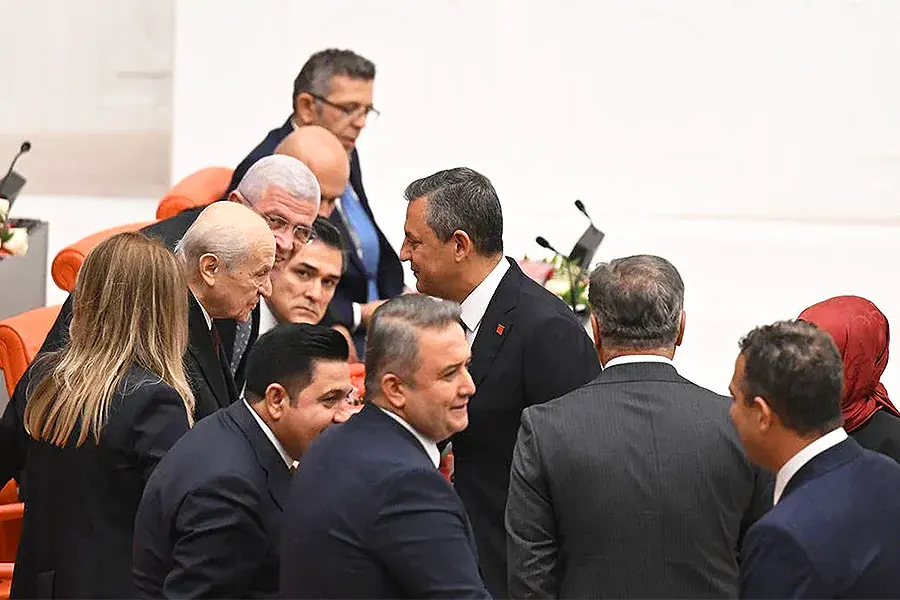
Erdoğan: ‘We must remain united as long as Israel is a threat’
Özel himself has been one of those involved in this curious turn in Turkish politics, radically changing the tone of his predecessor at the helm of the CHP (Kemal Kılıçdaroğlu) in dealing with the President of the Republic, Tayyip Erdoğan, with whom he has exchanged several cordial meetings in recent months in a quasi-historical event never seen in the last 8 years in Turkish politics.
Özel also called on his party’s deputies to stand to welcome Erdoğan during the opening session of parliament on Tuesday: an order that raised eyebrows within the political formation, with more than half of the CHP’s 127 deputies deciding not to be present in the chamber during Erdoğan’s entrance, while six of the MPs were present but defied their party and remained seated, local media reported.
This ‘new phase’ in Turkish politics appears to be partly in response to the recent call for unity made by Turkish President Tayyip Erdoğan, who on Tuesday warned that in the current situation of escalating war in the Middle East, Israel could set Turkey as its next target after Lebanon. ‘This is something that should be treated seriously,’ Özel told reporters when asked about Erdoğan’s comments. ‘The parliament should hold a closed-door session, and discuss that threat,’ the CHP leader added.
‘There are 85 million people here in Turkey that we must keep our internal front strong. We must find points of understanding, not conflict, in the face of Israeli aggression. As long as Israel is a threat to the region, Turkey must remain constructive, reconciliatory and united for the security of our nation and the peoples of the region,’ Erdoğan stressed in his speech to parliament.
Precisely as Turkey’s political class gathered at the parliamentary seat in Ankara to begin a new political course, Iran launched a massive attack with nearly 200 ballistic missiles on Israel; as soon as the first news of the attack arrived, several Turkish army generals attending the ceremony at the parliament immediately left the venue in the face of the new escalation in the Middle East.
VOTE

EDITORIAL TEAM
🧿 About us
.
Edited and reviewed by:

Pablo Gómez is a specialist in Turkey and has been editor-in-chief of Hispanatolia since 2011. He has been analysing current affairs and geopolitics in Turkey and the surrounding region since 2006.
…
📣 Your ADVERTISING on Hispanatolia
.
🤗 HELP US WITH A DONATION:
💗 Paypal