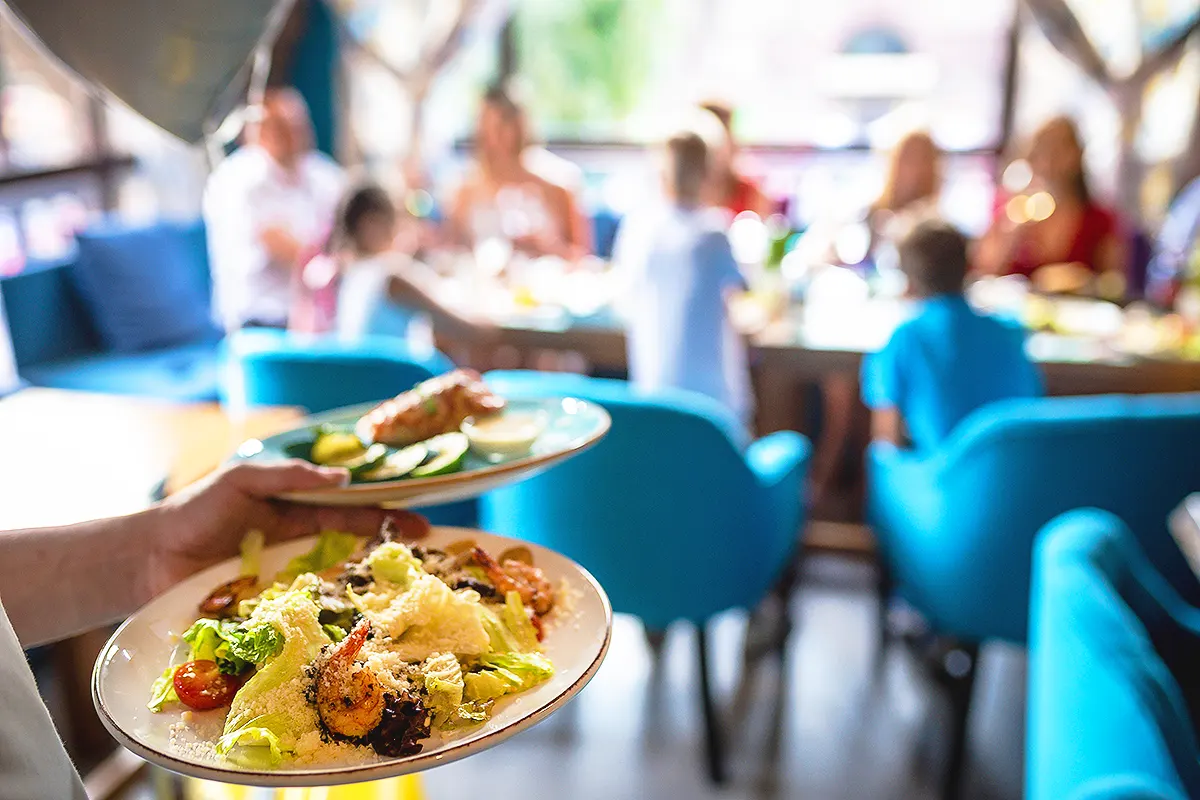
Turkey‘s Ministry of Agriculture and Forestry has passed a new regulation requiring restaurants and cafes to provide detailed menus, with the aim of encouraging healthier and better informed choices among consumers. The new legislation requires establishments to provide customers with information on ingredients and calorie content through menus, information boards or QR codes, and will be implemented progressively.
According to the already approved legislation, it will be mandatory for venues such as restaurants, cafés and canteens to share with customers information on the ingredients and calories of the products on offer. This information can be presented in a variety of formats, including menus, boards, leaflets, digital screens or scannable QR codes. If QR codes are used, customers will be able to request additional details, according to the Turkish daily Karar.
The new regulation also bans the sale of food products designed in a way that could negatively affect the physical and psychological development of minors or evoke violence. The production and marketing of food in the shape of weapons, skulls, brains, lips or eyes is banned.
Changes and restrictions on food labelling
Changes are also introduced to labelling: the use of terms such as ‘100% natural’, ‘the most natural’ or ‘authentic’ will be removed, and the term ‘natural’ can only be used if the product does not contain additives. The word ‘dairy’ will be restricted to products with a shelf life of 24 hours.
In addition, expressions such as ‘freshly squeezed’ or ‘freshly baked’ will be prohibited on packaged products, and no images of real fruit will be allowed on products containing flavourings. In these cases, the word ‘flavoured’ must be included. Designations such as ‘cheese-flavoured’ or ‘strawberry-flavoured’ may only be used if the ingredient is actually present. The use of the term ‘homemade’ on industrially manufactured products is also prohibited. These measures are all aimed at preventing misleading practices in the food industry.
The new system will be implemented in phases during 2026 and 2027
The implementation of the system will be gradual. National chains will have to adapt by 1 July, while businesses with three or more branches in the same city will have until 31 December to update their menus. All other outlets will have to complete the process in two phases: first, include full ingredient information by the end of 2026, and then add calorie content by 31 December 2027. By 1 January 2028, all restaurants and cafeterias in the country must be fully compliant with this detailed menu system.
With this set of regulations for restaurants and cafes, Turkey aims to strengthen food transparency in the sector, protect minors, increase control over food labelling, and limit the use of confusing or misleading expressions for consumers in the food industry.
VOTE

EDITORIAL TEAM
🧿 About us
.
Edited and reviewed by:

Pablo Gómez is a specialist in Turkey and has been editor-in-chief of Hispanatolia since 2011. He has been analysing current affairs and geopolitics in Turkey and the surrounding region since 2006.
…
📣 Your ADVERTISING on Hispanatolia
.
🤗 HELP US WITH A DONATION:
💗 Paypal