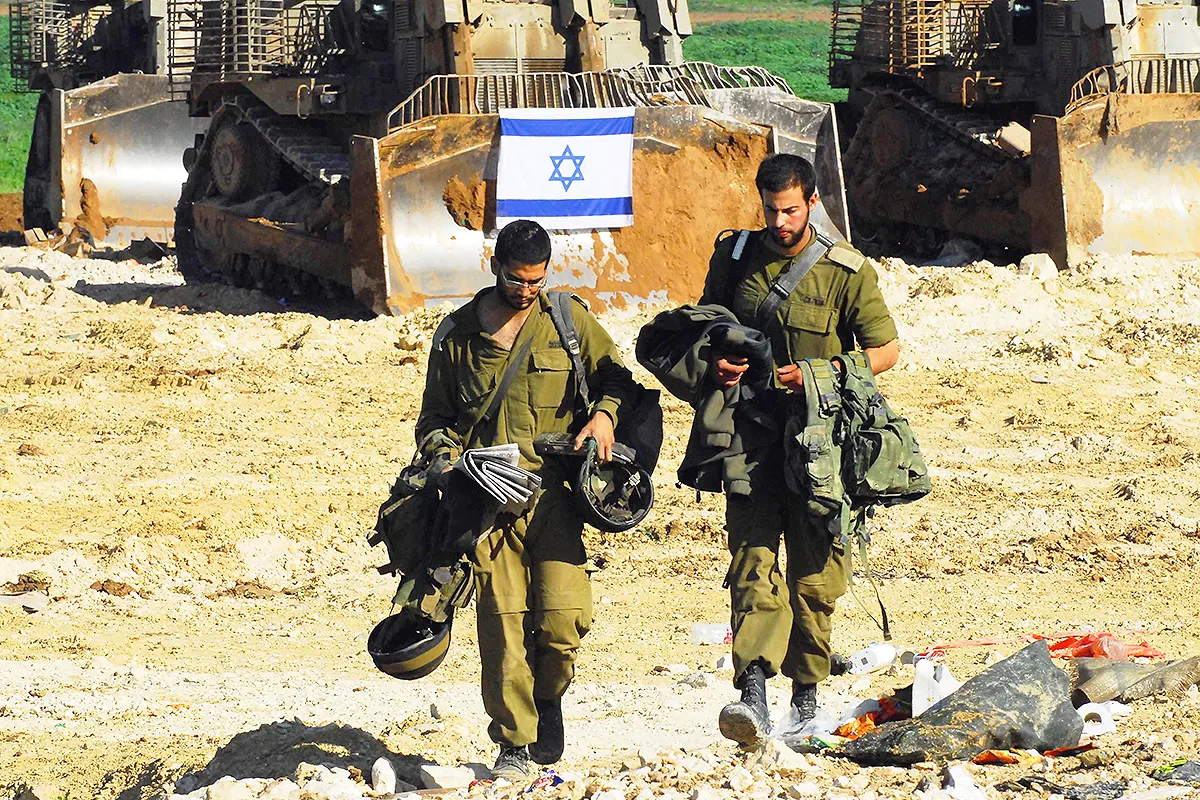
The prolonged war with Iran and the opening of new war scenarios and fronts in Syria and Lebanon have placed Israel and its army under a military tension not seen in decades, and the warnings of internal voices – both from the opposition to Netanyahu and from the IDF (Israel Defence Forces) itself – that warn of a “collapse” are beginning to clash with the official discourse and plans of the Tel Aviv executive, which insists on going ahead with its war plans for the region.
What until recently was presented as a controlled Israeli campaign against its multiple enemies in the Middle East is increasingly perceived, from within Israel’s own political and military establishment, as an effort that borders on the limits of its capacity and could compromise both its economy and its security in the medium and long term.
Statements made in recent hours by opposition leader Yair Lapid, warning that “The IDF is stretched to the limit and beyond” and that “The government is sending the army into a multi-front war without a strategy, without the necessary means, and with far too few soldiers“, reflect a growing internal unease and concern in Israel that is no longer confined to the political debate. This warning comes on top of others from within the Israeli military apparatus itself about the increasing difficulty of sustaining simultaneous operations, especially after the intensification of the northern front with the offensive on Lebanon.
The chief of staff, Lieutenant General Eyal Zamir, has also sounded the alarm, warning that “the IDF is on the verge of collapse“. According to various sources, the IDF currently has a shortfall of some 15,000 soldiers in a context of simultaneous operations in Gaza, Lebanon, Syria and the West Bank. Zamir himself has warned that the accumulation of missions and new fronts has significantly increased the operational needs of the army, which is composed of a hard core of some 170,000 professional soldiers but which – for times of war like the present – needs to call on its reservists: that is, citizens who live as civilians and have jobs outside the military sphere, but who are called up when the situation requires it.
According to information revealed by Israel’s Channel 13 and published by Al-Jazeera, during the last meeting of the Israeli security cabinet, General Zamir gave the Netanyahu government “10 red flags” about the situation of the army, which he described as “exhausted“.
These warning signs include the overloaded reservist system, with soldiers having been mobilised in up to six and seven rotations, and the increasing difficulty of covering all active fronts simultaneously. The IDF chief’s conclusions were clear: without urgent measures – such as changes to the conscription system or an extension of mandatory conscription – the operational deterioration of the Israeli army could worsen in the coming weeks.
Netanyahu could mobilise up to 400,000 reservists
This troop shortfall and the serious warnings issued by the head of the military leadership contrast with the Netanyahu cabinet’s mobilisation plans. Since the start of the US-Israeli attacks on Iran, the army has called up at least 100,000 reservists in addition to the troops already deployed. In the first days of the escalation with Iran, the total number of mobilised troops already exceeded 150,000, adding new call-ups to the existing ones.
But the true scale of the military effort with which Netanyahu is pushing his army and Israeli society itself to the limit is reflected in short-term plans. The Israeli government plans to raise the mobilisation ceiling to 400,000 reservists, according to reports in the Wall Street Journal: a figure that represents, in effect, the maximum level authorised to sustain prolonged operations in multiple scenarios.
At the same time, recent reports suggest that there are even plans to increase this figure to 450,000 troops – right at the limit of Israel’s estimated 465,000 – given the possibility of a large-scale ground offensive in Lebanon to wipe out Hezbollah, a group that has denounced Netanyahu’s plans for conquest in southern Lebanon as an attempt to create the ‘Greater Israel’.
The war is costing Israel some €300 million a day
The so-called northern front has become the main source of pressure on the IDF’s capabilities. Since the beginning of March, the Israeli army has deployed several divisions in southern Lebanon and established at least 18 new military positions in border territory as part of its offensive against Hezbollah. These operations include ground incursions and coordinated air strikes, with the stated aim of creating a security zone on Israel’s northern border.
But the escalation of the conflict also comes at a growing economic cost. Israel’s military budget for this year amounts to 142 billion shekels (about €39.2 billion) according to Le Monde newspaper, with an increase of more than 30 billion shekels to cover war spending, which is estimated at around 1 billion shekels per day (almost €280 million).
This war and financial effort reflects the scale of a campaign that for now seems to have no end date, as Netanyahu continues to open and reopen one front after another, whether in response to potential ‘threats’ in the region or to attacks that are – in turn – a response to other attacks that Israel itself initiated – such as the offensive on Iran and the subsequent Hezbollah response from Lebanon -, thus fuelling a never-ending spiral of war.
Israel fears being left alone in the war with Iran
The growing needs of the Israeli army have recently led to an end to the exemption from military service for the ultra-Orthodox – who are dedicated to Torah study – that has been in place since the founding of the state of Israel. The measure, backed by the Israeli courts, has nevertheless provoked protests and clashes with the authorities among the so-called Haredi community, as well as serious problems for Netanyahu’s relationship with the most ultra-nationalist elements of his governing coalition.
Moreover, of the thousands of ultra-Orthodox called up, only a tiny percentage have finally come forward; even if recruitment were successful, it would only add some 54,000 troops – to top it all, extremely reluctant to fight – to the army, according to the Israeli press, which is wholly insufficient to cover the operational and replacement needs of the army in the current situation.
Despite all these difficulties, Israel’s Prime Minister Benjamin Netanyahu maintains a hard line and has repeatedly reiterated that his goal is to neutralise Hezbollah and ensure security on the northern (Lebanese) border. But the growing divergence between the government’s official narrative and the army’s own alarm bells – so serious and evident that they even escape the secrecy of cabinet meetings – paints a complex and uncertain picture in the region.
The difficult balance between political objectives and military capabilities is becoming increasingly fragile and uncertain for an Israel that fears being left alone in the war with Iran if Trump abandons the Middle East conflict – something he is already seeking at all costs – however much Netanyahu needs to continue with his ‘neverending state of war’ strategy to save his political career.
VOTE

EDITORIAL TEAM
🧿 About us
.
Edited and reviewed by:

Pablo Gómez is a specialist in Turkey and has been editor-in-chief of Hispanatolia since 2011. He has been analysing current affairs and geopolitics in Turkey and the surrounding region since 2006.
…
📣 Your ADVERTISING on Hispanatolia
.
🤗 HELP US WITH A DONATION:
💗 Paypal