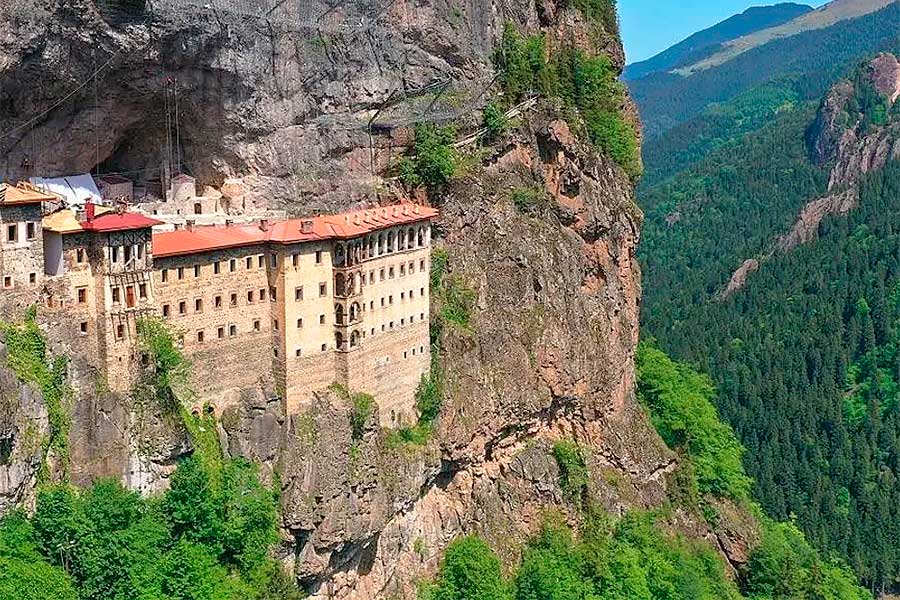
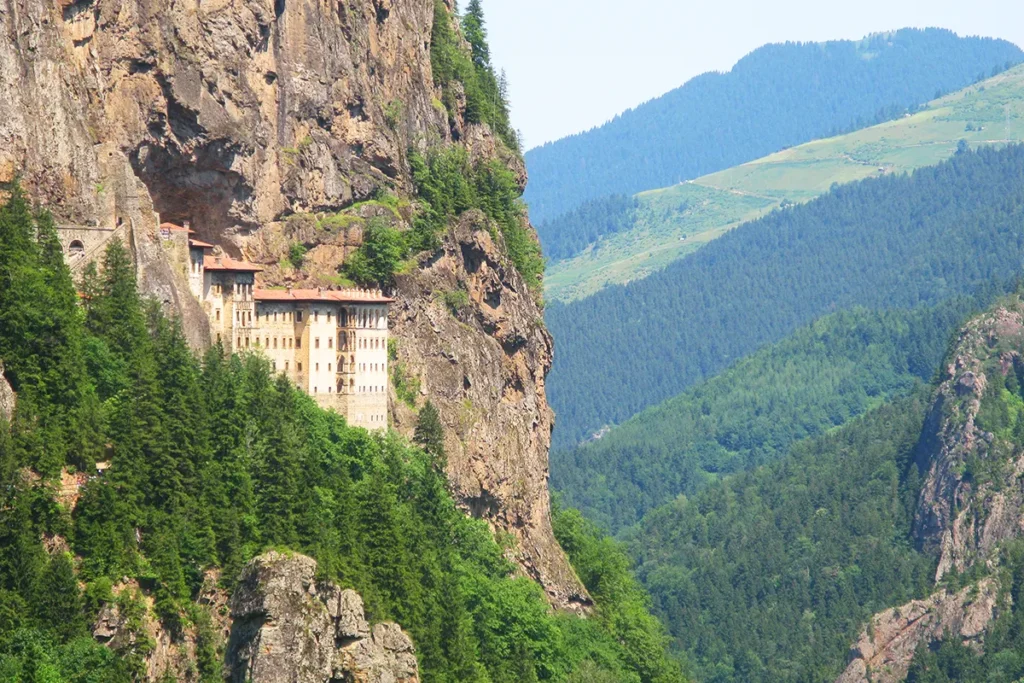
Thousands of people have visited so far this year Sumela, a famous Byzantine monastery built 1,600 years ago in the mountains of Trabzon, in Turkey’s Black Sea region, perched on an impressive cliff offering incredible views of Altındere National Park.
According to data published by the Anatolia news agency, a total of 48,466 tourists visited this ancient monastery in the first four months of the year alone. The monastery is on the list of candidates for UNESCO World Heritage status and, since its reopening in 2019 after extensive restoration work lasting several years, it has become one of the main tourist attractions on the Black Sea.
Excavated into a rock cavity about 300 metres high in the middle of Mount Karadağ, overlooking the Altındere Valley in the heart of the Turkish province of Trabzon (Trebizond), the monastery received around 1,600 visitors a day last year, but this year the figure has skyrocketed to 6,000 a day (especially at weekends), demonstrating its growing popularity, which is also being boosted by social media.
History of Sumela
Sumela Monastery (Sümela Manastırı in Turkish) is an architectural and spiritual gem nestled in the Pontic Mountains in the district of Maçka in the province of Trabzon, in north-eastern Turkey. Located at an altitude of approximately 1,200 metres above sea level, it stands on a cliff within the Altındere National Park, offering spectacular views of the region’s mountains and forests.
Founded around 386 AD, during the reign of Roman Emperor Theodosius I (375–395 AD), its origin is shrouded in legend, according to which two Athenian monks, Barnabas and Sophronius, discovered a miraculous icon of the Virgin Mary in a cave, attributed to the evangelist Luke, which led to the construction of the monastery on this sacred site.
Over the centuries, Sumela was restored and enlarged several times by several Byzantine emperors, notably the reconstruction and enlargement carried out in the 6th century by the Roman general Belisarius on the orders of Emperor Justinian I, but especially the reforms of the monastery in the 13th century under the rule of the Empire of Trebizond (Trabzon), especially during the reign of Emperor Alexius III, which gave it much of its current appearance.
After the fall of Constantinople in 1453 to the Ottoman Sultan Mehmet II, and the subsequent conquest of Trebizond in 1461, Mehmet II granted the Christian population the right to continue practising their religion freely and placed the Sumela monastery under his protection, a status that continued under the following Ottoman rulers.
Sumela continued to be an important place of prayer and pilgrimage for Orthodox Christians until the Russian occupation of Trabzon during the World War I (1916-1918), and was finally abandoned in 1923 when, following the fall of the Ottoman Empire and the population exchange between Greece and Turkey established in the Treaty of Lausanne – shortly before the proclamation of the Turkish Republic by Atatürk – the Greek and Orthodox population of the region moved to Greece.
A jewel in the Black Sea mountains
The Sumela monastery complex includes a church built in a cave, which forms the original core around which the rest of the buildings were erected, as well as chapels, monastic cells, a library, kitchens, a dining room, guest quarters, a sacred spring, and an 18th-century aqueduct that supplied water to the site.
The main church houses Byzantine frescoes dating from the 14th to 18th centuries, depicting biblical scenes and the lives of saints, which are considered among the finest examples of Byzantine art in Anatolia. The building at the front, overlooking the cliff, dates from the 19th century and housed the monks’ quarters and guest rooms.
During the restoration work, a mysterious secret tunnel, previously unknown, was discovered leading to a place believed to be an ancient temple or chapel used by the early Christians of the region, which could date the origins of Sumela back several centuries. New frescoes were also uncovered, depicting representations of heaven and hell and of life and death.
The Sumela Monastery has become one of the main tourist attractions in the Black Sea region of Turkey. Its location on a cliff and its rich history attract visitors not only from Turkey but from all over the world, especially during the Christian religious ceremonies held once a year. After a restoration that lasted several years due to the danger posed by rockfalls, the monastery reopened its doors to tourism in May 2019, once again allowing visitors to enjoy its beauty and spirituality.
Opening hours and prices for Sumela Monastery
This beautiful Byzantine monastery is located approximately 45 kilometres south of the city of Trabzon. from where you can reach the monastery by road – by car, taxi or minibus – to the vicinity of the monastery in the Altındere Valley; from there, you have to walk along a path that winds through the lush forests of the region’s mountains and offers beautiful views of Sumela itself and the entire valley and surrounding mountains.
The Sumela Monastery is open every day to visitors from 8:00 a.m. to 8:00 p.m. (last admission 30 minutes before closing time), and entrance fee is €20 for non-Turkish citizens. For more information, you can visit the official website of Turkish museums or the monastery’s website www.sumela.gov.tr (in Turkish).
✈️ If you are travelling to Turkey, we recommend:
We include affiliate links: if you buy through them, you don’t pay extra money and you help this website.
🧿 TOP TOURS IN TURKEY
VOTE

EDITORIAL TEAM
🧿 About us
.
Edited and reviewed by:

Pablo Gómez is a specialist in Turkey and has been editor-in-chief of Hispanatolia since 2011. He has been analysing current affairs and geopolitics in Turkey and the surrounding region since 2006.
…
📣 Your ADVERTISING on Hispanatolia
.
🤗 HELP US WITH A DONATION:
💗 Paypal