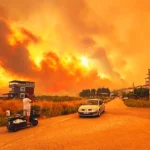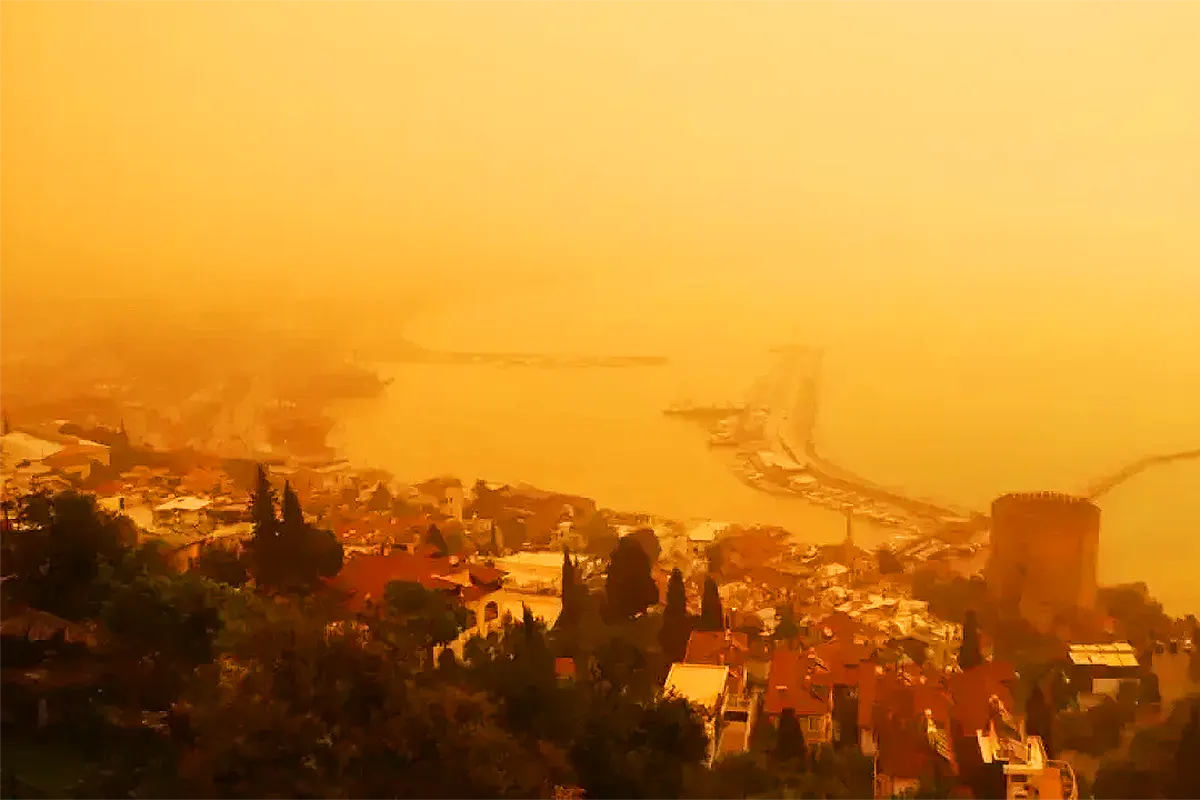
A massive dust storm from the Sahara that turned the sky red over the Greek island of Crete also severely affected Turkey on Friday, where several provinces in southern Anatolia, such as Adana, Hatay, Mersin, Osmaniye and Antalya, were blanketed in a reddish haze, resulting in a significant loss of visibility.
The desert dust, carried from Libya by strong winds, hit Hatay, the country’s southernmost province, with full force on Friday morning. Aerial images showed the city shrouded in a dense cloud, with the air thick and the sun barely visible despite it being broad daylight. According to the news channel NTV, visibility dropped to just 150 metres due to the dust cloud.
In the city of Adana, in southern Türkiye, dust storms deteriorated air quality and significantly reduced visibility, as well as leaving a layer of dirt on vehicles. The phenomenon also affected the neighbouring city of Mersin and the districts of Bozyazı, Silifke and Tarsus, where cars were covered in Saharan dust and the storm caused visibility problems in several areas.
The episode also reached Antalya, one of the main tourist destinations on the Turkish Mediterranean coast. In the popular district of Alanya, clouds of dust mixed with rain during the morning, covering vehicles and open spaces with a layer of brown mud. The puddles looked muddy, although the muddy rain gradually eased off towards midday and, thanks to the rainfall, the dust cloud almost completely disappeared during the afternoon.
A frequent phenomenon in south-eastern Anatolia
Turkey’s General Directorate of Meteorology (MGM) issued a public warning regarding the potential adverse effects of the Saharan dust storm, which mainly affected the provinces of the eastern Mediterranean and south-eastern Anatolia. Experts point out that this phenomenon reduces air quality and advise people with chronic illnesses to take precautions in light of the deterioration in air quality.
Dust storms are relatively common in Turkey, typically occurring several times a year, particularly in spring, during the months of March and April. They mainly affect the southern and south-eastern provinces, which are more exposed to air masses from North Africa and the Middle East; in the western provinces, including Istanbul, they may occur occasionally but are of lesser intensity and duration.
VOTE

EDITORIAL TEAM
🧿 About us
.
Edited and reviewed by:

Pablo Gómez is a specialist in Turkey and has been editor-in-chief of Hispanatolia since 2011. He has been analysing current affairs and geopolitics in Turkey and the surrounding region since 2006.
…
📣 Your ADVERTISING on Hispanatolia
.
🤗 HELP US WITH A DONATION:
💗 Paypal