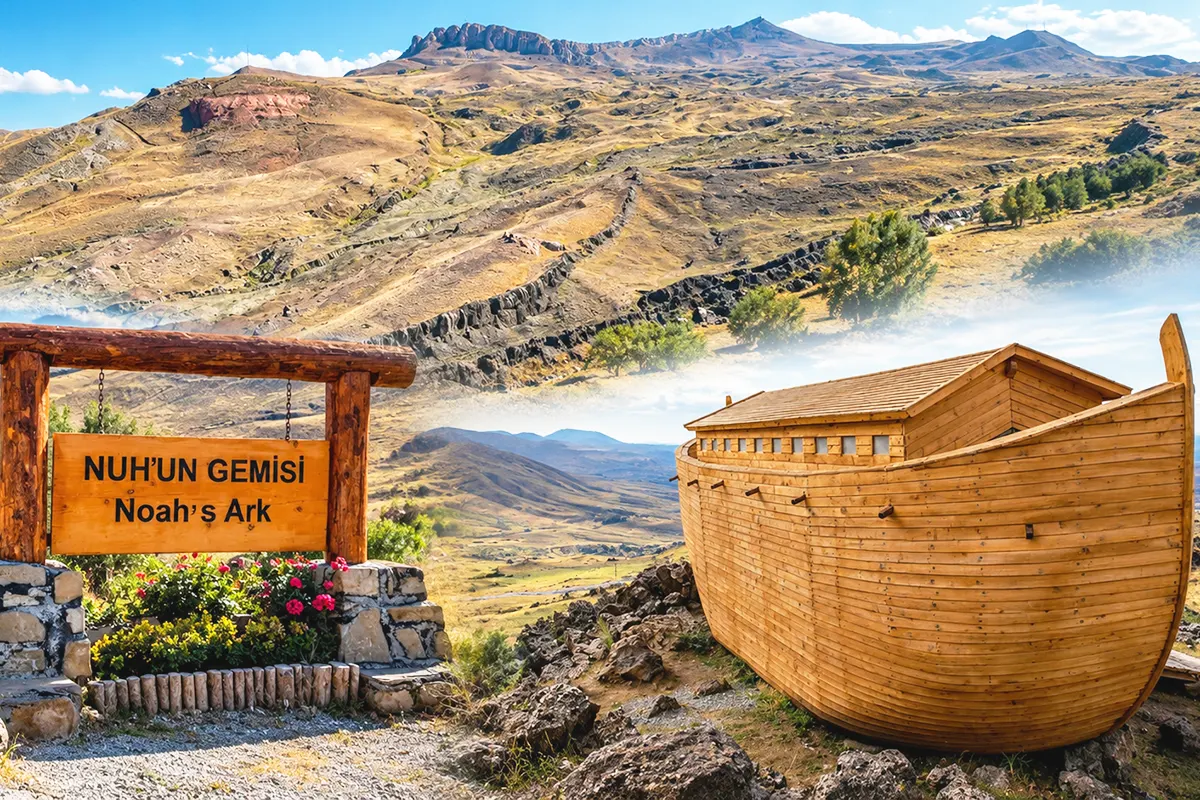
Tourism companies appear to be capitalising on the hype surrounding the as yet unconfirmed alleged location of Noah’s Ark in the foothills of Mount Ararat (Ağrı Dağı in Turkish), in eastern Turkey, to market luxury tourist tours costing as much as $3,600, despite the lack of solid scientific evidence to support the hypothesis that the Ark came to rest here after the Flood.
The geological formation at the foot of Mount Ararat known as Durupınar, considered by some to be the possible site of the Ark of Noah, has once again attracted attention in 2026 due to new research carried out in the area.
The Noah’s Ark Research Project, launched in May 2026 with the participation of some 20 scientists from five countries, carried out fieldwork for approximately 90 days at Durupınar, a ship-shaped geological formation located in the district of Doğubayazıt, in the Turkish province of Ağrı.
During the studies carried out this year, researchers created a model of the terrain’s surface using drones and examined the subsoil with a next-generation radar system. They also collected around a thousand soil samples from various points across the formation, which were sent to laboratories for analysis. In addition, they carried out drilling to extract samples from the subsoil.
Scientists discover that Durupınar is not made of solid rock
Andrew Jones, vice-chairman of the Noah’s Ark Research Project, stated that one of the most important findings has been the confirmation that the Durupınar formation does not originate from a single monolithic solid rock mass.
“Some people claimed that it was a natural formation, a monolithic rock that had eroded over millions of years to take on the shape of a ship. However, the most significant finding from the drilling is that the structure is composed entirely of soil,” said Jones, as quoted by the Turkish news portal NTV.
The researcher added that they found dark soil beneath the surface, rich in organic matter. Further analysis will need to determine whether this is the result of a natural process or whether it constitutes evidence of human activity, raising the possibility of a man-made structure.
Luxury tours to places mentioned in the Bible
Despite the absence of definitive scientific evidence, and the fact that the project’s organisers themselves insist that no firm conclusions have yet been reached and that further research is needed, several tour operators have already begun organising 12-day tours linked to Noah’s Ark, with prices reaching $3,600 per person.
The advertised itineraries include visits to the Durupınar formation on Mount Ararat, and to sites in eastern and south-eastern Türkiye supposedly mentioned in the Bible. They also include destinations such as the Ishak Pasha Palace, the castle and museum in Van, Urfa or Göbeklitepe; paradoxically, many of the sites included on these tours actually have no connection whatsoever with the biblical accounts.
The websites marketing these tours present, as supposed evidence of the discovery of Noah’s Ark, a document bearing a university letterhead signed by the Turkish professor Cenker Atila, director of the Noah’s Ark Research Project; interestingly, this document states that the scientific studies on the supposed site of the Ark are being carried out in collaboration with the tour operator, a fact that has raised numerous suspicions, as reported by the Turkish press.
A natural formation… or the remains of Noah’s Ark?
The Durupınar formation was discovered in 1959 by the Turkish cartographer İlhan Durupınar, after whom it is named. Since then, it has aroused great interest worldwide due to its striking resemblance to a vessel of enormous dimensions and its proximity to the iconic Mount Ararat.
Whilst geologists maintain that it is a natural formation, creationist groups and evangelical Christians continue to fund expeditions and research in the area in the hope of finding evidence to support the existence of the Ark and confirm that this was the spot in Turkey where the vessel built by Noah came to rest after the Great Flood.
🧿 TOP TOURS IN TURKEY
VOTE

EDITORIAL TEAM
🧿 About us
.
Edited and reviewed by:

Pablo Gómez is a specialist in Turkey and has been editor-in-chief of Hispanatolia since 2011. He has been analysing current affairs and geopolitics in Turkey and the surrounding region since 2006.
…
📣 Your ADVERTISING on Hispanatolia
.
🤗 HELP US WITH A DONATION:
💗 Paypal