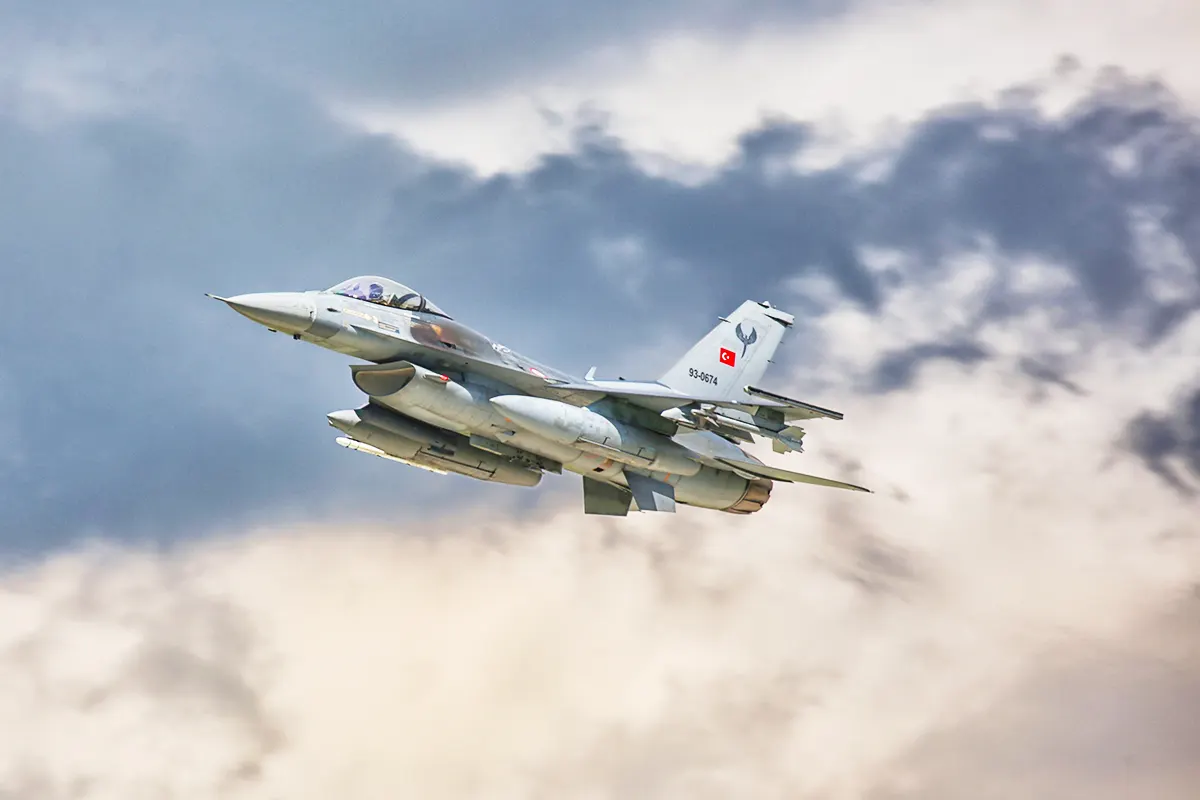
Turkey’s Air Force deployed late on Tuesday several F-16 fighter jets to intercept a passenger flight after a hijacking alert was triggered on board the aircraft, which was bound for Tel Aviv in Israel. Ultimately, however, authorities confirmed that there was no threat to security.
The plane, an Airbus A320 operated by the Bulgarian company Electra Airways on behalf of the Polish airline LOT Polish Airlines, was flying the route between Warsaw and Tel Aviv when it transmitted the code 7500 whilst flying over Bulgarian airspace. This code is an internationally recognised emergency signal indicating a possible unlawful interference or an aircraft hijacking.
After all security protocols had been activated, the aircraft was then diverted to Burgas Airport in Bulgaria, after spending some time flying over an area off the western coast of the Mediterranean island of Cyprus. During the flight, whilst flying over Turkish airspace, Turkey dispatched F-16 fighter jets to escort the aircraft until it left its airspace, according to reports by media outlets in the Eurasian country.
Following coordination between the Turkish and Bulgarian authorities, the passenger aircraft landed at Burgas Airport, situated on the western coast of the Black Sea. Initial investigations suggest, however, that the incident was caused by a transponder fault on the aircraft, which mistakenly transmitted the code 7500 due to a technical fault. So far, no evidence has been found to suggest a hijacking or a genuine threat.
The airline confirms that a fault mistakenly triggered the hijacking alert
In a statement issued by the Turkish Ministry of Transport and Infrastructure, and reported by the Turkish news agency DHA, it was confirmed that “a passenger aircraft operated by the Polish airline LOT Airlines, which was flying from Warsaw to Tel Aviv, transmitted the code 7500 (aircraft hijacking) whilst in Bulgarian airspace” .
“The aircraft subsequently entered Turkish airspace and, although the crew reported that there was no adverse situation, our authorities took all necessary measures in accordance with international aviation procedures. In this context, from the moment the aircraft entered Turkish airspace, it was closely monitored by two F-16 fighter jets from our Air Force, which escorted it until it left our airspace”, the official statement added.
“Following the necessary arrangements and once the Bulgarian authorities had authorised the landing at Burgas Airport, the aircraft was again permitted to use Turkish airspace, continuing to be escorted by our F-16 fighter jets until it left our airspace. Finally, the aircraft landed at Burgas Airport in Bulgaria at 17:12 local time. LOT Airlines issued a statement regarding the incident”, the statement noted.
According to authorities in Turkey, the airline has confirmed the account that the incident involving its flight en route to Tel Aviv was caused by an incorrect transmission of the international hijacking alert code by the pilot, but that there was no actual security threat to the flight and that the pilots themselves reported this to the control tower. For the time being, the case is being investigated by the relevant authorities to clarify all the details.
VOTE

EDITORIAL TEAM
🧿 About us
.
Edited and reviewed by:

Pablo Gómez is a specialist in Turkey and has been editor-in-chief of Hispanatolia since 2011. He has been analysing current affairs and geopolitics in Turkey and the surrounding region since 2006.
…
📣 Your ADVERTISING on Hispanatolia
.
🤗 HELP US WITH A DONATION:
💗 Paypal