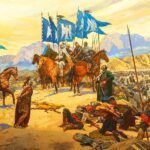
The Battle of Kadesh occupies a prominent place in the military history of humanity. Fought around 1274 BC between the New Kingdom of Egypt, ruled by Pharaoh Ramses II, and the Hittite Empire, it was one of the greatest battles of the Bronze Age and the first major conflict for which we have a relatively detailed account thanks to the surviving sources.
For centuries, the battle was presented by the Egyptians as a spectacular victory for Ramses II. However, analysis of the sources and modern research have revealed a far more complex reality. Far from being a crushing triumph for one of the combatants, Kadesh (or Qadesh) was an extremely hard-fought battle that ultimately transformed the balance of power in the Middle East and which, years later, would lead to one of the earliest known peace treaties in history.
The Middle East in the Bronze Age
By the mid-13th century BC, the eastern Mediterranean world was dominated by great powers vying for control of trade routes and strategic territories.
To the south lay the New Kingdom of Egypt, one of the richest and most advanced civilisations of its time. After centuries of expansion, the pharaohs had extended their influence over vast regions of Canaan and Syria.
To the north, the power of Hatti was emerging: the Hittite Empire, a mighty state with its capital at Hattusa, in the heart of Anatolia. For decades, the Hittites had expanded their dominions and consolidated a network of vassal kingdoms that allowed them to exercise effective control over much of Syria.

Between these two giants lay a region of enormous economic and strategic importance. As well as being home to major fortified cities, it formed a trade corridor linking Egypt with Mesopotamia and Anatolia. Raw materials, metals, timber, agricultural produce and luxury goods flowed through it. Whoever dominated Syria gained not only wealth but also a privileged strategic position on the political chessboard of the Near East.
The situation became particularly tense when the kingdom of Amurru, situated on the Syrian coast, broke away from Egyptian influence and switched its allegiance to the Hittites. For Ramses II, who was in the early years of his reign and seeking to consolidate his prestige, restoring Egyptian influence in the region became a priority. For Muwatalli II, on the other hand, maintaining control over Syria was fundamental to the security of his empire.
The strategic importance of Kadesh
At the heart of this dispute lay Kadesh, a fortified city situated beside the Orontes River. Although it was not the largest city in the region, it occupied an exceptional position from a military standpoint. It controlled important communication routes and served as a link between various territories under Hittite influence.
The city’s location also provided defensive advantages. Sources indicate that it was situated near a large bend in the Orontes, surrounded by natural features that made a direct attack difficult. For the Hittites, Kadesh was a key component of their defensive system in Syria. For Egypt, it represented the chance to regain the ground lost over the preceding decades.
The city’s importance explains why both rulers were prepared to mobilise enormous resources to control the area. The campaign that culminated at Kadesh was not a mere border expedition, but an operation intended to decide who would exercise hegemony over much of the Levant.
Ramses II and Muwatalli II: two opposing rulers
The battle pitted two of the most important rulers of their era against each other. On the Egyptian side stood Ramses II, one of the most celebrated pharaohs of all time. He had ascended the throne a few years earlier and inherited from his father, Seti I, the ambition to fully restore Egyptian influence in Syria.
Ramses was a young, energetic and determined ruler keen to demonstrate his military prowess. Control of Kadesh presented a perfect opportunity to consolidate his prestige and reaffirm Egypt’s power before both allies and enemies.
Opposing him was Muwatalli II, king of the Hittites. Aware of the danger posed by Egyptian ambitions, he devoted great efforts to strengthening the Hittite presence in Syria. He also mobilised a vast coalition of up to 19 contingents from allied states and vassals, carefully preparing the response to a possible invasion.
Both monarchs understood that the outcome of the campaign would have consequences that would extend far beyond the conquest of a single city.
The armies of Egypt and Hatti
The exact figures remain a matter of debate, but historians agree that both sides assembled forces of exceptional size by the standards of the time, in a battle unprecedented in the Bronze Age.
The Egyptian army was organised into four large divisions named after major deities: Amun, Ra, Ptah and Seth. Each had its own infantry, chariots and officers. In total, the Egyptian forces may have numbered around 20,000 men – including some 2,000 chariots – although estimates vary depending on the author.
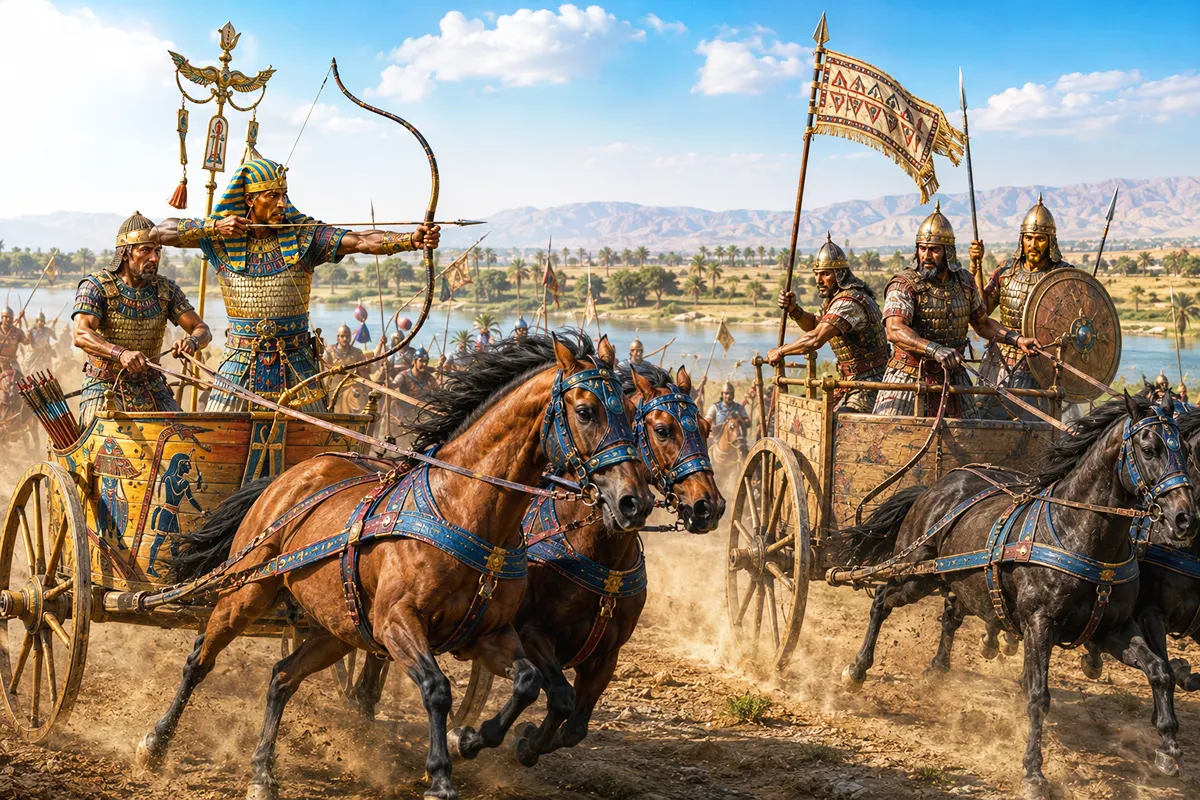
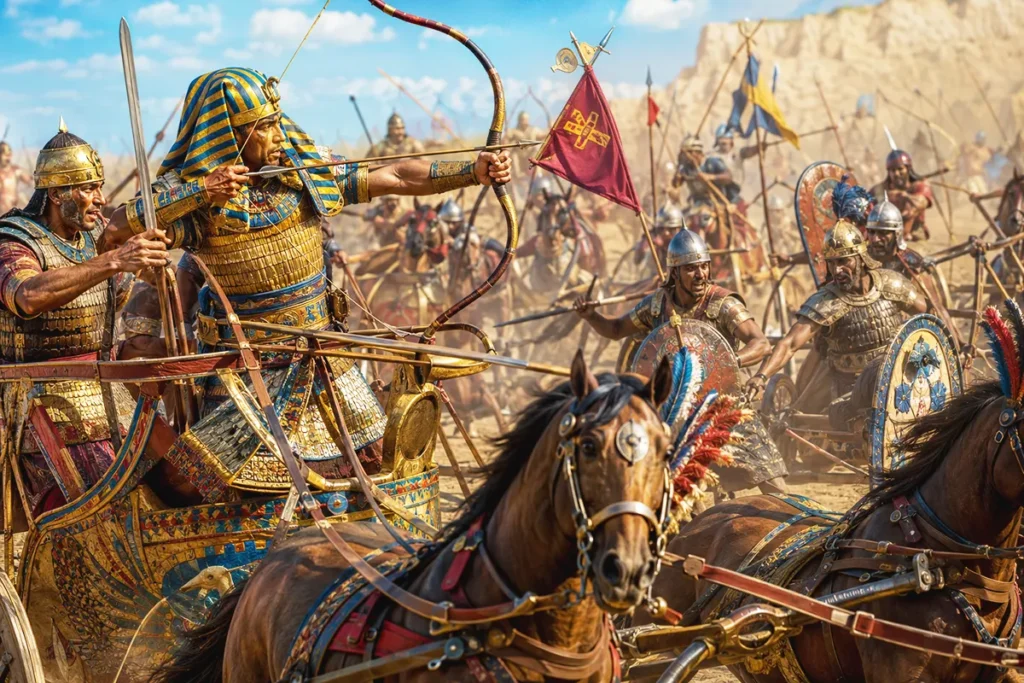
One of the Egyptians’ main advantages was precisely the quality of their chariots. These vehicles were light, fast and highly manoeuvrable. They usually carried two men: a driver and an archer armed with a powerful composite bow. Their main role was to harass the enemy from a distance, launch rapid attacks and withdraw before becoming bogged down in prolonged combat.
Muwatalli II assembled an even more diverse force. Egyptian inscriptions state that contingents arrived from numerous kingdoms allied with and vassal to the Hittites. Although these lists likely contain propaganda-driven exaggerations, specialists agree that the Hittite king succeeded in forming a grand coalition: in total, his army arrived at Kadesh with some 40,000 infantrymen and around 3,000 heavy war chariots.
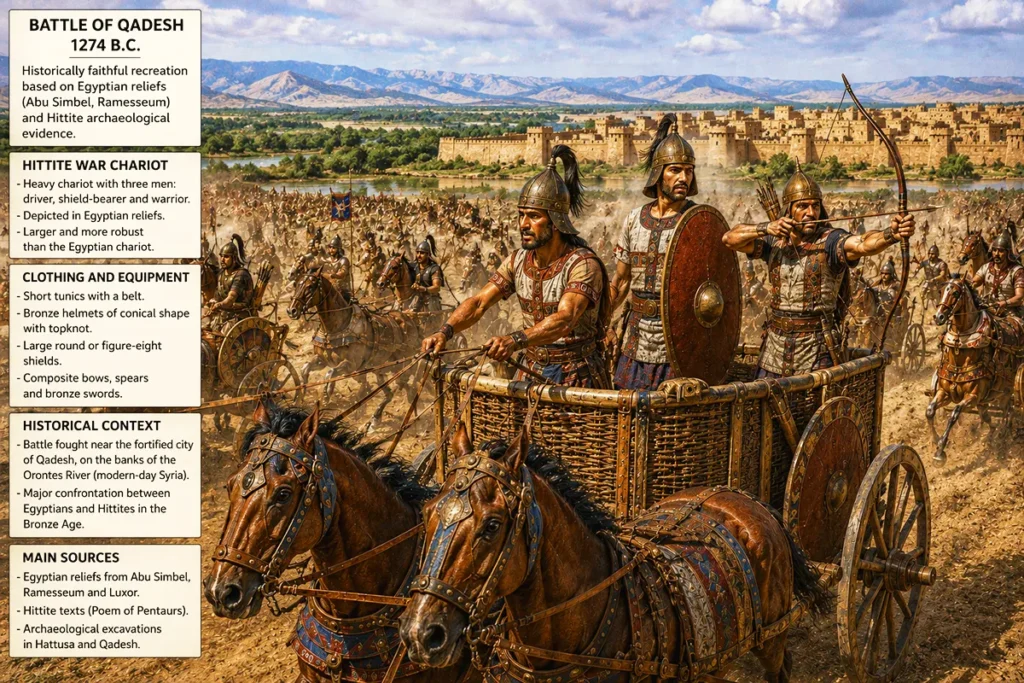
Hittite chariots differed from Egyptian ones and played a different role on the battlefield. Heavier and more robust, they were designed to act as a shock force. Most historians agree that they carried three crew members: driver, warrior and shield-bearer. This configuration allowed them to launch particularly powerful charges against enemy formations.
The trap that took Ramses by surprise
Paradoxically, the most famous episode of the Battle of Kadesh took place even before the fighting began.
During his advance towards Kadesh, Ramses received information from two alleged deserters who claimed that the Hittite army was still a long way from the site. Convinced that he had sufficient time to assemble all his forces, the pharaoh continued his advance with relative ease.
The reality was quite different. Muwatalli had concealed most of his army near the city of Kadesh and was precisely waiting for the Egyptians to approach without taking adequate precautions.
Shortly afterwards, Egyptian patrols captured several Hittite scouts. Upon interrogation, they revealed that the bulk of the enemy army was very close by. Ramses then realised that he had been deceived and that his divisions were dangerously scattered: in fact, the Amun division had already reached the outskirts of Kadesh, whilst the others were still marching several kilometres behind.
The Hittite attack
Muwatalli decided to immediately seize the opportunity presented by the trap into which his rival had fallen. Thousands of Hittite chariots crossed the Orontes River and charged the Ra division, which was advancing northwards unprepared for an attack of such magnitude. The onslaught caused chaos in the Egyptian ranks: numerous soldiers were scattered and the Hittite chariots managed to penetrate deep into the enemy rear.
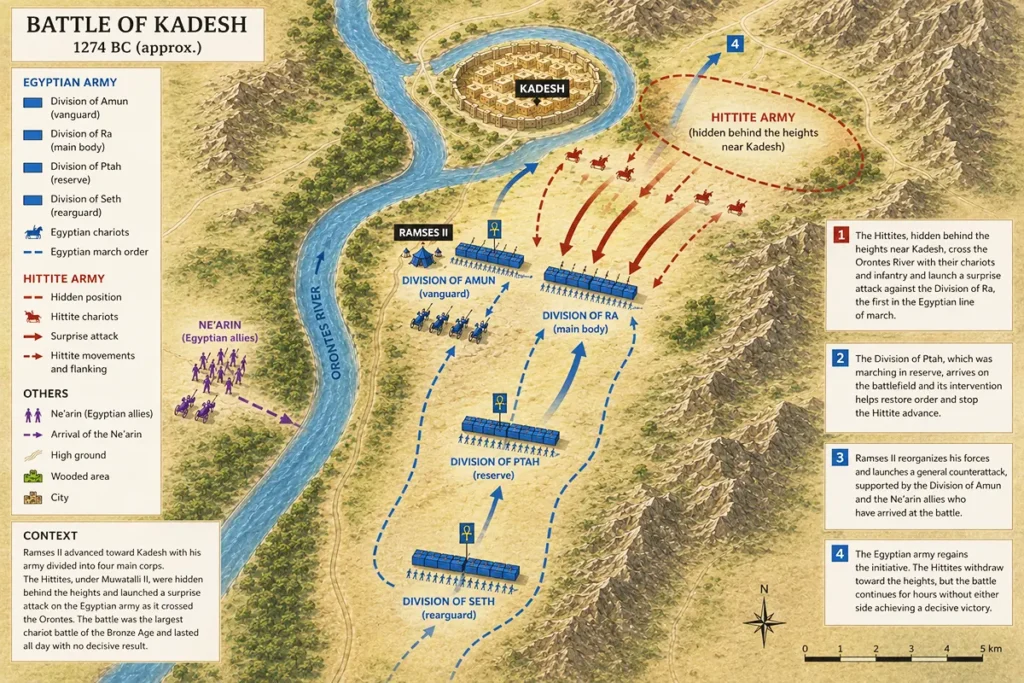
The situation became even more critical when part of the Hittite forces reached Ramses’s camp. For a few hours, an Egyptian defeat seemed a real possibility: had the Hittites managed to completely destroy the pharaoh’s forces at that moment, the campaign would have ended catastrophically for Egypt.
However, the attackers’ initial success eventually became a problem. Many Hittite chariots scattered whilst pursuing the defeated enemies and plundering the Egyptian camp. This loss of cohesion gave Ramses the opportunity he needed to reorganise his men and launch a counter-attack that saved the day.
The pharaoh’s reaction
Egyptian sources present this moment of the battle as a true epic. According to ancient texts, Ramses II fought practically alone against thousands of enemies before leading a brilliant counter-offensive that turned the tide of the battle.
Although modern historians consider these accounts to contain a significant amount of propaganda, they nevertheless acknowledge that the pharaoh must have played a key role in regathering and reorganising his troops at the most critical moment of the battle. Taking advantage of the scattering of the Hittite chariots and the arrival of reinforcements, the Egyptians managed to stabilise their positions and launch several counter-attacks against the Hittites.
The intervention of new units, including contingents known in the sources as the Ne’arin, helped prevent the collapse of the Egyptian army. Shortly afterwards, reinforcements from the Ptah division also arrived, which served to strengthen Ramses’s positions.
Thus, what had begun as a surprise ambush that threw the Egyptian ranks into disarray, ended up becoming a much more evenly matched battle than Muwatalli had anticipated, having based his strategy precisely on the element of surprise of his attack and the shock power of his chariots.
Who really won the battle?
Incredible as it may seem, this question continues to spark debate among specialists even 3,000 years later. Egyptian monuments present Kadesh as a great victory for Ramses II. The reliefs at Abu Simbel, Karnak, Luxor and the Ramesseum show the pharaoh defeating his enemies and forcing them to flee… And for centuries, this was the official version of events, which endured alongside the long-lasting Egyptian kingdom.
However, the reality seems to have been more complex. Although Ramses avoided the destruction of his army and managed to repel the Hittite attack, the truth is that he failed to capture Kadesh or drive the Hittites out of Syria, which were the main objectives for which the pharaoh had gone into battle. In fact, the city remained under Hatti rule following the clash.
For this reason, a majority of historians today consider that, beyond Egyptian propaganda, the actual outcome of the clash was a tactical stalemate, whilst others even maintain that the Hittites gained a slight strategic advantage, as they retained the territories whose defence had motivated the campaign. What seems clear is that neither empire achieved a decisive victory.
From the battlefield to the first major peace treaty
The events following the Battle of Kadesh support this assertion. The rivalry between the Egyptians and the Hittites continued for years, but neither side managed to gain complete dominance over the other, and for years they coexisted in a sort of “cold war”, aware that another major battle like that of Kadesh could spell disaster for both Egypt and Hatti.
Over time, both states realised that cooperation could prove more beneficial than perpetual war. Thus, approximately 16 years after the famous Battle of Kadesh, Ramses II and Hattusili III — successor to Muwatalli I — signed the famous Treaty of Kadesh, considered the oldest international peace treaty in the world to have been preserved in its entirety.
The agreement established commitments to non-aggression, mutual aid against external enemies and diplomatic cooperation. It also regulated matters relating to the extradition of refugees and political fugitives, as well as relations between the two states. What is most remarkable is that both Egyptian and Hittite versions of the document have been preserved, something exceptional for such a remote era. Its historical significance is so crucial that a replica of the treaty, donated by the Turkish government to the United Nations, is on display today at the UN headquarters in New York.
The 3,000-year legacy of the Battle of Kadesh
The significance of the historic Battle of Kadesh goes, as we have seen, far beyond its military outcome. The battle constitutes an exceptional source for understanding warfare in the Bronze Age, the functioning of the first great territorial empires, and the evolution of international diplomacy.
It also offers one of the earliest known examples of large-scale political propaganda: Ramses II turned the conflict and his failure to achieve his stated objectives into a powerful tool for personal legitimisation, spreading his own version of events throughout Egypt via monumental inscriptions.
More than three thousand years later, the great Battle of Kadesh, which pitted Ramses II against the Hittites, continues to fascinate historians, archaeologists and enthusiasts of ancient history. Not only because it was the greatest chariot battle in history and one of the best-documented conflicts of the ancient world, but also because it marked the beginning of a new way of relating between kingdoms and empires, through the signing of agreements seeking cooperation and respect for borders in the interests of peace and stability. Qadesh was also the last great battle of the Bronze Age, and the beginning of the end of an era in which chariots had been the masters of the battlefield.
📚 If you want to learn more about the history of Turkey, we recommend:
🧿 Discover here more recommended products about Turkey
As an Amazon Associate, we earn from qualifying purchases. This comes at no extra cost to you and helps support this website.
VOTE

EDITORIAL TEAM
🧿 About us
.
Edited and reviewed by:

Pablo Gómez is a specialist in Turkey and has been editor-in-chief of Hispanatolia since 2011. He has been analysing current affairs and geopolitics in Turkey and the surrounding region since 2006.
…
📣 Your ADVERTISING on Hispanatolia
.
🤗 HELP US WITH A DONATION:
💗 Paypal