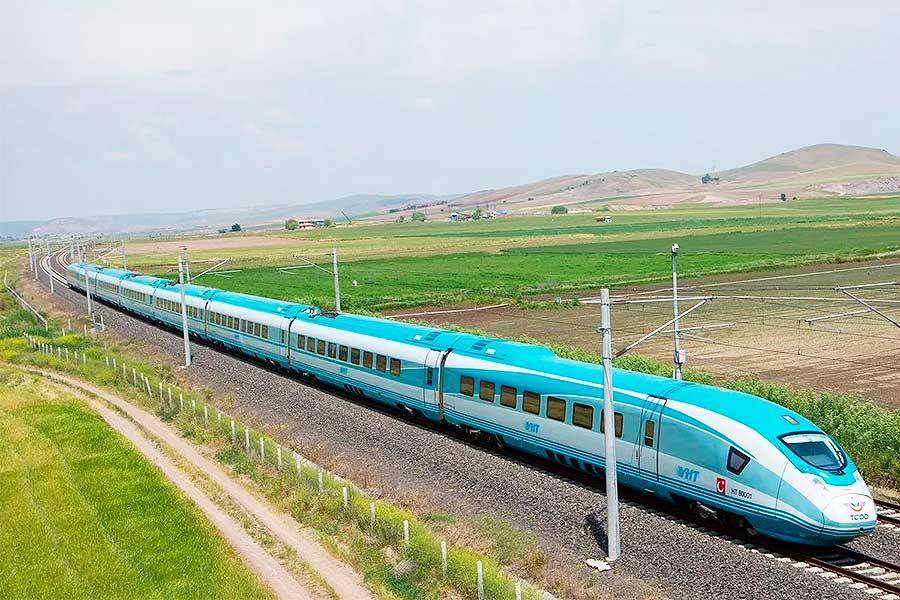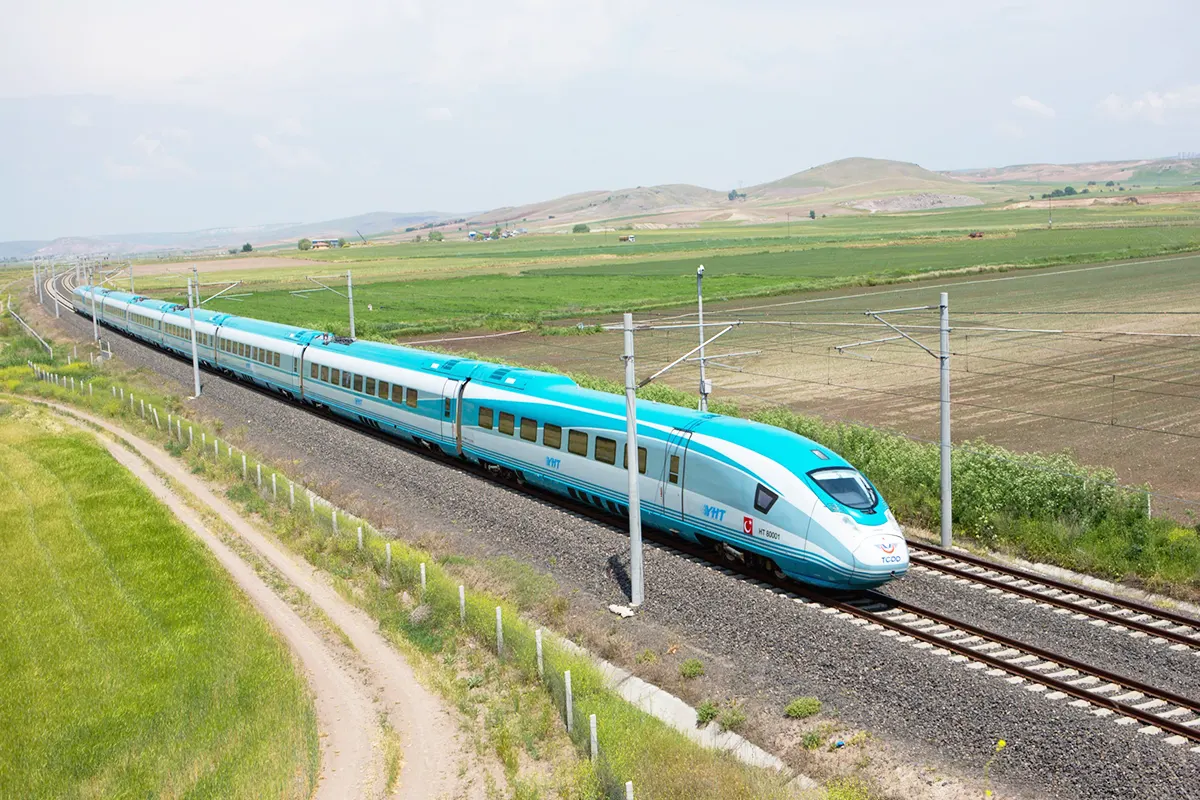
Turkey’s Minister of Transport and Infrastructure, Abdulkadir Uraloğlu, announced that, once the ongoing works on the Ankara-Istanbul high-speed train line are completed, the journey time will be reduced from the current 4 hours and 7 minutes to just 3 hours and 37 minutes.
In a statement released by Turkish media, Uraloğlu explained that there are three critical points causing bottlenecks on the Eskişehir-Istanbul section of the high-speed rail line (in Turkish, Yüksek Hızlı Tren or YHT) between Ankara and Istanbul. “The 12-kilometre Doğançay Ripajı-1 section was brought into service in 2022. Now, upon completion of the T26 tunnel and the Doğançay Ripajı-2 sections, we will completely eliminate the bottlenecks on the Ankara-Istanbul high-speed line”, he stated.
“Once the works we are currently carrying out on the line are completed, the journey time between Ankara and Istanbul, which currently stands at 4 hours and 7 minutes by high-speed train, will be reduced to 3 hours and 37 minutes,” he added.
The works will enable a continuous operating speed of 250 km/h
The minister noted that the T26 tunnel, stretching 8 kilometres, will ensure a continuous railway line suitable for an operational speed of 250 kilometres per hour on the Alifuatpaşa-Arifiye section of the line, located in the province of Sakarya. He also highlighted that this infrastructure will eliminate the current 9.2-kilometre stretch on a conventional line, where – until now – high-speed trains had to travel at an average speed of just 55 kilometres per hour.
“Following the commissioning of the T26 tunnel, journey time on the Bozüyük-Bilecik section (Bilecik province) will be reduced from 11 minutes to 9 minutes. Furthermore, delays caused by train crossings due to the single-track section will be reduced, and operational restrictions for freight trains will be lifted. We have completed the infrastructure works for a 5,587-metre-long tunnel. We are currently continuing with the superstructure, electrification and signalling works,” announced Uraloğlu.
The minister added that, as part of the Doğançay Ripajı-2 project, considered one of the most critical sections of the line, 7,544 metres of tunnels, 3,795 metres of safety tunnels and around 795 metres of viaduct have been constructed. “With the completion of Doğançay Ripajı-2, journey time on this section will be reduced from 23 minutes to just 4 minutes. This will result in a saving of 19 minutes on the Ankara-Istanbul high-speed line,” he said.
Over 2,250 km of high-speed rail, with new projects under construction
Turkey’s high-speed rail network began to take shape at the start of this century. The first section of the line between Ankara and Istanbul, which connected Ankara with Eskişehir, entered service in 2009, whilst the full connection to Istanbul was inaugurated in 2014. Subsequently, in 2019, high-speed services began running to Söğütlüçeşme station on the Asian side of the city.
Turkey currently has approximately 2,251 kilometres of high-speed lines in service. YHT trains provide direct connections between cities such as Ankara, Istanbul, Eskişehir, Konya, Sivas, Bilecik, İzmit, Arifiye, Karaman, Kırıkkale and Yozgat, amongst others, forming one of the most extensive high-speed rail networks in the region. The Ankara-İzmir high-speed line, currently under construction and undergoing testing, is expected to be completed in 2027. There is also a project to connect four major cities in southern Turkey (Mersin, Adana, Osmaniye and Gaziantep) via high-speed train, which is expected to enter service in 2028.
VOTE

EDITORIAL TEAM
🧿 About us
.
Edited and reviewed by:

Pablo Gómez is a specialist in Turkey and has been editor-in-chief of Hispanatolia since 2011. He has been analysing current affairs and geopolitics in Turkey and the surrounding region since 2006.
…
📣 Your ADVERTISING on Hispanatolia
.
🤗 HELP US WITH A DONATION:
💗 Paypal