Turkey does not believe there is an immediate risk of war between the US and Iran and believes the diplomatic track remains viable, Turkish Foreign Minister Hakan Fidan said in a televised interview on 9 February, in which he also discussed Iran’s nuclear programme and described expectations of regime change in Tehran as “an empty dream”.
“No, it would not collapse,” Fidan said during a live interview for CNN Türk when asked about an eventual collapse of the Iranian regime following a military strike aimed at toppling it. “I don’t want to speculate on certain scenarios in Iran, but the regime won’t change through an airstrike or anything else. That’s a pipedream,” the Turkish foreign minister was quoted as saying by the Turkish news agency Anatolia. “What could be is the government weakens, the system weakens, and it becomes unable to provide services to the people. Then, the existing regime might choose to take much more radical decisions and perhaps try to correct the situation. It could transform itself“, he added.
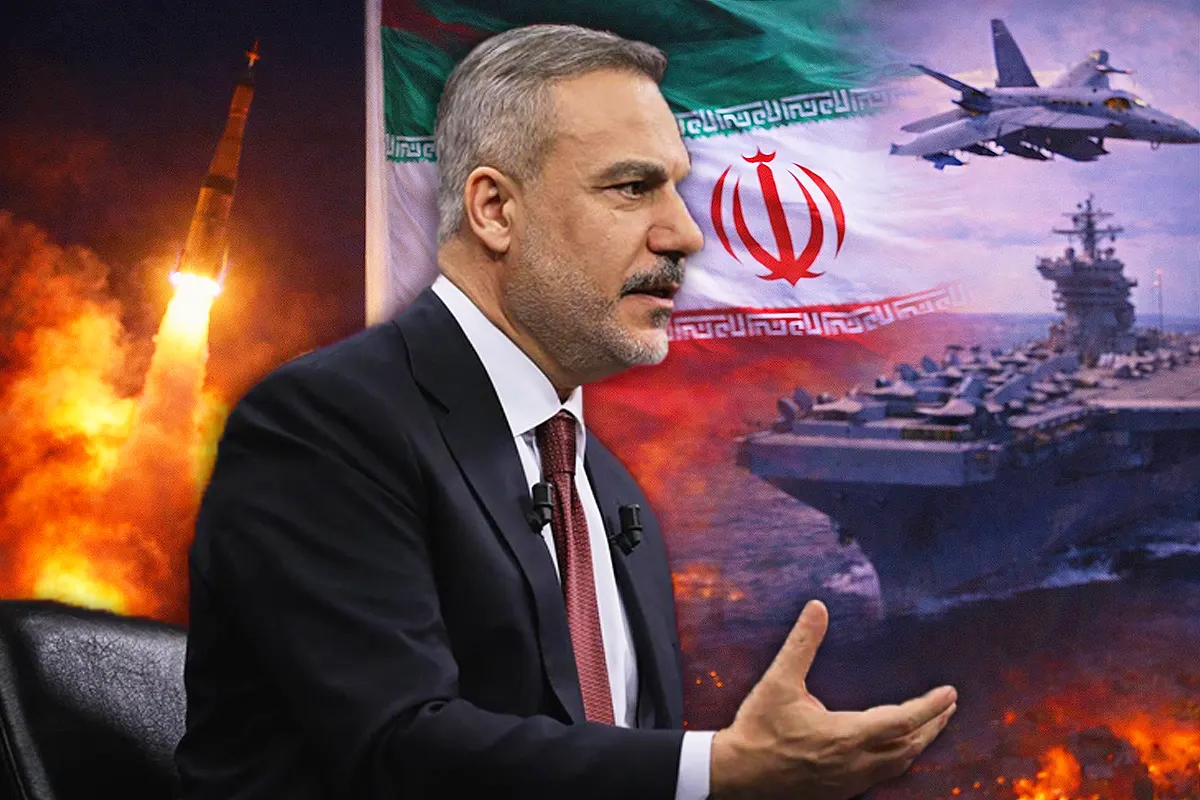
The Turkish chief of diplomacy referred to the US military deployment of large fleets, bombers and other strategic assets, along with Tehran’s announcements about bolstering its missile capabilities, as clear signs that any military confrontation would come at a high cost to both sides. “First, it’s about showing strength; second, it’s about being prepared,” he explained.
Insisting that regimes do not change through bombing campaigns, Fidan reiterated that he does not see regime change in Iran as possible and redefined such an expectation as “an empty dream”. “I do not believe that regime change is possible in Iran,” stressed the Turkish foreign minister, who warned that the region cannot endure another war. In this respect, he assured that the Turkish president, Recep Tayyip Erdogan, is showing “the utmost sensitivity’ on this issue and that Ankara is using all the means at its disposal to avoid a conflict. He also indicated that Iranian Minister Abbas Araghchi informed him about the negotiations during his recent visit to Ankara, and that Turkey is in contact with the US side at the same time.
“At the moment there does not seem to be an immediate threat of war,” Fidan said, explaining that the door to negotiations is now open. In his opinion, the problem is not the Iranian regime itself, but the decisions and policies it adopts, although he acknowledged that separating the two is another matter. He also pointed out during the interview that Iran is not an absolute monarchy, unlike other states in the region that “are much more centralised and totalitarian than Iran” and yet do not face comparable international pressures. Fidan nevertheless admitted that Iran’s supreme leader has “a rare concentration of power“, as the ayatollahs have authority in both political and religious matters.
“Iran does not have nuclear weapons“
Having been Turkey’s governor to the International Atomic Energy Agency (IAEA) before being head of the National Intelligence Organisation (MİT) and foreign minister, Fidan referred to Iran’s controversial nuclear programme by pointing out that Tehran insists on uranium enrichment despite the fact that the ayatollah himself maintains a fatwa (pronouncement on Islamic doctrine) that bans nuclear weapons.
“With that fatwa, the system cannot produce a bomb,” he said, although he acknowledged that the development of near-militarised nuclear capabilities entails sanctions and treating Iran as if it already has a nuclear weapon. However, according to Fidan, Iran has not taken steps to weaponise enriched uranium and does not possess nuclear weapons. “The Iranians do not have atomic bombs and there are no indications that they want to build them,” he said, pointing out that uranium enrichment alone is not enough to build a nuclear weapon.
“On the one hand, you have to enrich uranium. On the other hand, you have to develop nuclear warheads and combine them. For now, Iran has not taken a single step in this direction, towards weaponisation,” the minister reiterated, although he admitted that doubts remain about Iran’s justification for continuing high-level enrichment despite its claim that it has no intention of building nuclear weapons: “If there is no such intention, some argue that enrichment on this scale is not necessary…. Or for there to be such severe sanctions”.
The US and Iran resumed dialogue in Oman on 6 February for the first time since the 12-day war between Iran and Israel last June – in which the US military was briefly involved – after Trump warned the Iranian regime that it “should be very worried” if it dares to rebuild its atomic programme following the US attack on its facilities. At the same time, Israeli Prime Minister Benjamin Netanyahu is scheduled to arrive in Washington today to meet the US president, in what analysts interpret as an attempt to influence talks between Washington and Tehran.
VOTE

EDITORIAL TEAM
🧿 About us
.
Edited and reviewed by:

Pablo Gómez is a specialist in Turkey and has been editor-in-chief of Hispanatolia since 2011. He has been analysing current affairs and geopolitics in Turkey and the surrounding region since 2006.
…
📣 Your ADVERTISING on Hispanatolia
.
🤗 HELP US WITH A DONATION:
💗 Paypal