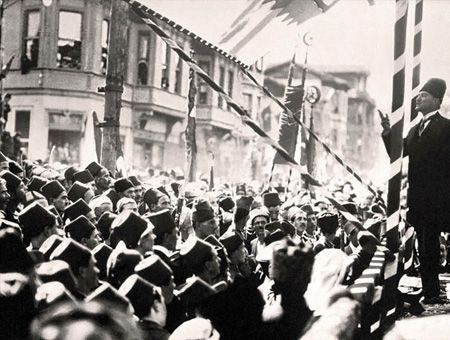
The story of the birth of the Republic of Turkey, proclaimed in 1923 by Atatürk on the remains of the Ottoman Empire, is the story of the Turkish struggle against the foreign occupation of Anatolia.
On 29 October Turkey commemorates its independence as a nation and the birth of a new Republic, founded by Mustafa Kemal Atatürk on the remains of the former Ottoman Empire.
The birth of the Turkish Republic was not, however, an easy path: it was a process that required several years and many battles, not only in the war but also in the political and diplomatic fields, and in which thousands of Turks shed their blood trying to ensure that their country, after the dismemberment of the Ottoman Empire, would not end up divided among the European powers as had happened in the Middle East.
The end of the Ottoman Empire after World War I
 In 1918, World War I – the so-called ‘Great War’ – ended with the defeat of the Central Powers, including the Ottoman Empire, by the Allies, and the Ottoman capital, Istanbul (Constantinople), was occupied by foreigners. Mehmet VI Vahideddin, the last Ottoman sultan who ascended the throne in the last months of the war, became a puppet of the French and British: at the end of 2018 he abolished the parliament and ruled by decree.
Given the weakness of the government, the Allied powers had a free hand to begin occupying the territories still held by the Ottomans; resistance groups were formed throughout Anatolia against this occupation led by former Ottoman generals, one of whom was Mustafa Kemal, hero of Gallipoli and who would later lead the entire Turkish resistance and struggle for independence.
On 15 May 1919 representatives of all the Allied nations that fought in World War I meet in Paris and agree that the Turkish region of İzmir (ancient Smyrna), on the Anatolian coast of the Aegean Sea, is occupied by Greece, which claimed historical rights to these territories.
Only a day later Greek troops landed in İzmir but far from being satisfied, they began the invasion of the whole of Anatolia, capturing the ancient Ottoman capital of Bursa and moving inland, leaving a trail of massacres and ethnic cleansing against the Turkish and Muslim communities, who were defenceless in the face of government inoperativeness and the impassivity of the other countries.
Mustafa Kemal lands in Samsun
That same day, alarmed by news from the western provinces, General Mustafa Kemal (not yet nicknamed ‘Atatürk’, or ‘Father of the Turks’) left Istanbul, ignoring the orders of Sultan Mehmet VI – who had ordered him to suppress the Turkish uprisings – and landed in the port of Samsun on Turkey’s Black Sea coast, in what is considered a turning point in Turkish history.
There, Kemal, rebelling against his own government, decided to send messages from Amasya to prominent people in Istanbul inviting them to abandon the Sultan and join the cause of Turkish independence; this is known as the Amasya Genelgesi (the Amasya Circular), distributed throughout Anatolia on 22 June.
“The integrity of the country and the independence of the nation are in danger. The independence of the nation will be saved by devotion and determination. It has been decided to convene a national congress in Sivas as a matter of urgency”, the famous circular said. Later, not one but two congresses, one in Erzurum and the other in Sivas, would meet in the course of 1919 and draw up a plan to put an end to the foreign occupation of Anatolia.
Independence or death
The Erzurum Congress, which met in this eastern Anatolian city on 23 July 2019 and was chaired by Mustafa Kemal himself, by then an outlaw of the Ottoman government, concluded with a joint declaration saying that “the nation will not accept the status of a mandate as a protectorate (of the allied European powers). The nation will resist foreign occupation.”
One of the most important decisions taken at this congress was precisely to set up a provisional government outside that of Constantinople/Istanbul, which was considered illegitimate and subject to foreigners. Kemal himself would say in Erzurum that “(the government in) Istanbul insists on a mandate from the United States. This will not happen. Turkey will be independent. No, gentlemen, there will be no mandate. Either independence or death“.
Later, on 4 September 1919, the Sivas Congress was held, where the organs of the new government and the independence movement were finalised. Atatürk himself would later say of the Sivas Congress that “It was here that the decisions were taken that prepared the independence of a nation“.
Istanbul under foreign occupation
The following year, with the Ottoman capital – Istanbul – occupied by soldiers from the UK, France and Italy, Mustafa Kemal decided to create the Anatolia news agency to tell the world about the Turks’ struggle for independence.
The Ottoman puppet government of the Sultan, not content with having removed the former war hero of Gallipoli from all his posts, then decided to condemn him to death. Not only that, but Mehmet VI then agreed to sign the Treaty of Sèvres.
This treaty, drawn up at the convenience of the Allied powers, not only dismantled the Ottoman Empire but also divided Anatolia among the Greeks, Italians, French and British. Istanbul and the entire Marmara region in northwest Turkey were placed under international control, and to the east a state was created for the Kurds and a ‘Greater Armenia’, including Trabzon (Trebizond) and Erzurum itself.
What was left for the Turks? In reality, the treaty left them only a region that occupied the centre and northern coast of Anatolia, and in fact encompassed the poorest and least developed provinces of the country. In short, it meant the ‘Balkanisation’ of Anatolia and its division among colonial powers in a similar way to what had been done in the Middle East or Africa itself. The treaty also limited the Ottoman army to a ridiculous 50,000 soldiers and seven military ships, and forbade it to have an air force.
The Turkish War of Independence and the victory over Greece
The Turkish independence movement was quick to react, and began its offensive both on the battlefield and in the diplomatic arena. İsmet İnönü, a former Ottoman military officer born into a Kurdish family, one of Atatürk’s closest associates and eventually the second President of the Republic of Turkey, won several important victories on the Western Front during the Greco-Turkish War (1919-1922), while peace was signed with Russia.
 On 5 August 1920, Mustafa Kemal was appointed Commander-in-Chief of the Turkish rebel armies. On 23 August, the Battle of Sakarya, which took place on the outskirts of Ankara, began. After 20 days of fighting, the Turks succeeded in forcing the Greeks to retreat to Smyrna. King Constantine I of Greece then appealed to the United Kingdom, France and Italy for help, but they refused to intervene and the Treaty of Sèvres began to be called into question.
“There is no line of defence, but a zone to be defended; and that zone is the whole country. Not a single piece of the country will be abandoned until it is soaked with Turkish blood”, Mustafa Kemal would say at the time.
Victories followed, and on 26 August 1922 the decisive Battle of Dumlupınar took place outside Afyon, which was a crushing defeat for the Greeks. On 9 September İzmir was liberated by the Turks, and on 16 September the last Greek soldiers left Anatolia for good.
The new Lausanne Treaty
On 11 September 1922, Turkish independence fighters signed an armistice with the British Empire, France and Italy at Mudanya, which Greece was also forced to sign three days later by the Allies. With the victory in the War of Independence, the new Turkish government was recognised as the only legitimate one, and the last Ottoman Sultan had to flee the country into exile with the help of the British.
Final peace was achieved with the signing of the new Treaty of Lausanne: this replaced the Treaty of Sèvres, with Greece renouncing its territorial claims in Anatolia and withdrewing from the territories of Thrace held by the Ottomans before the war. A controversial exchange of population between the two countries was also agreed, as both governments feared that they might constitute a‘fifth column’ in future conflicts.
The same treaty was to be signed by İnönü, Atatürk’s right-hand man and the new prime minister of the future Republic. The Treaty of Lausanne put a de facto end to the foreign occupation of the Turkish territories that had remained in the hands of the Ottoman Empire after its defeat in World War I, and laid the foundations of the future Turkish state and its present borders (with the exception of Hatay, which was incorporated in 1939).
Atatürk, first president of the new Turkish Republic
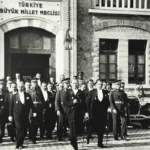
 In November 1922 the new government officially abolished the sultanate and two years later the caliphate. A year later, on the night of 28 October 1923, Mustafa Kemal addressed former comrades-in-arms and members of the Turkish parliament and said “Gentlemen, we should declare the Republic tomorrow“.
And so it was. On 29 October 1923, the Turkish parliament declared the Turkish Republic as the new regime of government and elected Kemal ‘Atatürk’ as its first president, amidst cheers of “Long live the Republic! Long live Mustafa Kemal Pasha!”. İnönü was elected as the country’s prime minister. Thousands of people took to the streets to celebrate the proclamation and the country’s independence.
Thus was the birth of the new Turkish Republic, after a long struggle for the independence of an entire nation. Atatürk would later carry out numerous far-reaching reforms that would transform Turkey, seeking to westernise the new state and bring it closer to Europe: the new constitution, the abolition of Sharia, the adoption of the Latin alphabet and the Gregorian calendar, the secularity of the state, the vote for women… But that is another story.
📚 If you want to learn more about the history of Turkey, we recommend:
🧿 Discover here more recommended products about Turkey
We include affiliate links: if you buy through them, you don’t pay extra money and you help this website.
VOTE

EDITORIAL TEAM
🧿 About us
.
Edited and reviewed by:

Pablo Gómez is a specialist in Turkey and has been editor-in-chief of Hispanatolia since 2011. He has been analysing current affairs and geopolitics in Turkey and the surrounding region since 2006.
…
📣 Your ADVERTISING on Hispanatolia
.
🤗 HELP US WITH A DONATION:
💗 Paypal