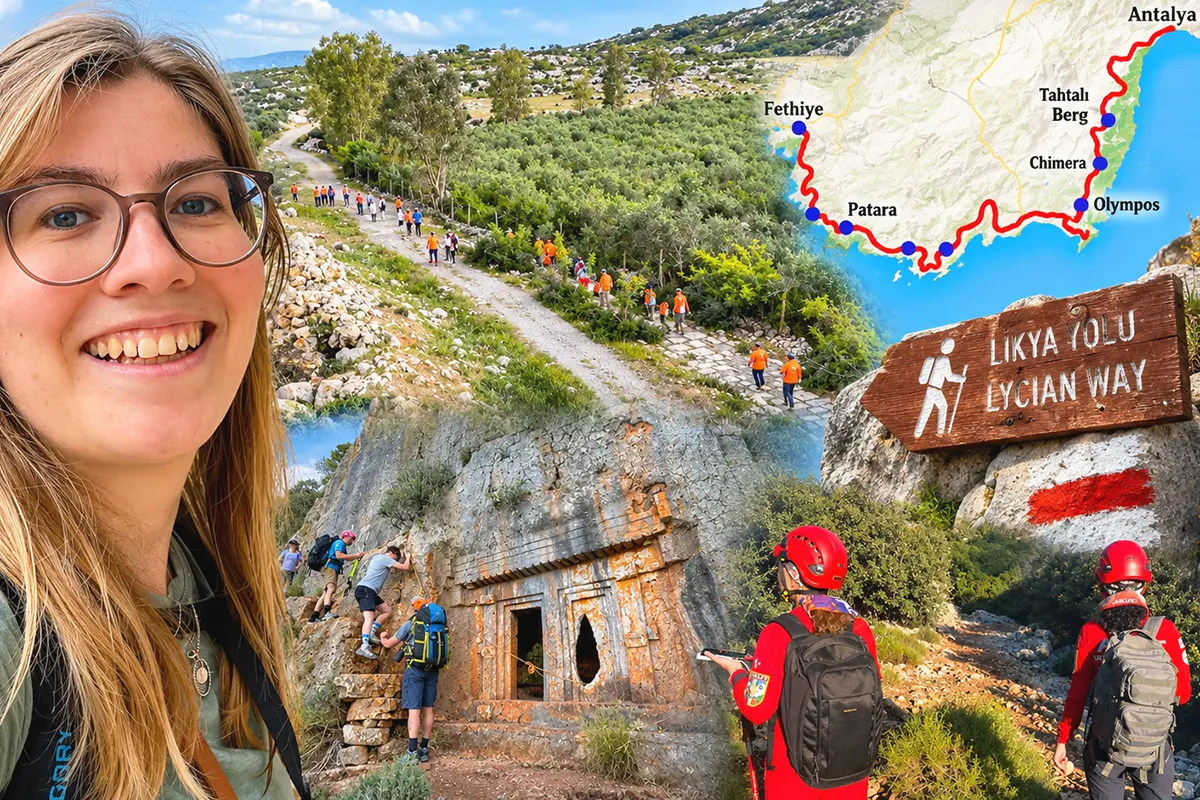
The Turkish authorities recovered during the weekend the body of the German tourist Friederike Elisabeth Newrzella from a rocky ravine near the Lycian Way, a well-known hiking route that runs through the Turkish province of Antalya, following an intensive search and rescue operation that lasted several days. This tragic death has reignited calls to step up safety measures on this popular route that runs along the Mediterranean coast of Turkey.
Newrzella, a 33-year-old German national, had gone missing on 14 October whilst walking the section of the route between the districts of Kaş and Demre, in Antalya. Her family members posted messages on social media asking for help in locating her and, once her disappearance became known, teams from the gendarmerie and AFAD (Disaster and Emergency Management Agency) launched a large-scale search operation in the area.
The woman’s body was finally found on Friday 30 October in a rocky area near Üçağız, in Kaş, some 700–800 metres from the coast and off the route. The governor of the Demre district, Emin Bağlı, confirmed that the documents found alongside the body belonged to Friederike Elisabeth Newrzella and noted that her family had already been informed of the sad news. Bağlı also announced that a judicial investigation has been launched to determine the cause of death, according to the Turkish news website T24.
Initial theories suggest that Newrzella may have strayed from the signposted route of the Lycian Way and followed a different path; a possibility compounded by the fact that there are many arrows and directional signs placed haphazardly in the area by some hotels and restaurants to indicate how to reach their premises, leading to the suspicion that the tourist may have followed these directions and ended up getting lost. Another possibility being considered is that, due to adverse weather conditions, she may have fallen from the rocky terrain, resulting in her death.
Experts condemn the lack of safety and maintenance on the Lycian Way
However, this accident has once again drawn attention to the state of this important tourist route in Turkey, which runs between the coast of Fethiye – in the province of Muğla – and Antalya, passing through numerous archaeological sites and places of tourist interest such as Patara, Myra, Phaselis and Yanartaş.
Local media have in recent days reported on the criticisms and allegations made by Güven İslamoğlu, a well-known television presenter specialising in nature programmes, who has published a book based on his own observations regarding the shortcomings and the hidden dangers of the country’s most famous hiking route. “If the Lycian Way is left to fall into disrepair, it becomes a death trap,” warns İslamoğlu, who harshly criticises its current state and emphasises that this internationally recognised cultural heritage will continue to pose serious risks until urgent measures are taken.
“At present, there is no safety, maintenance, order, logistical support or regulation whatsoever on this trail. Local traders and residents, with the mindset of ‘let the tourists pass through here, let them come to my shop’, have arbitrarily signposted the route with red and white markings, altering the course of the historic trail. Furthermore, there is no price control in the area. They are practically trying to fleece tourists with exorbitant prices. Even if they charge extortionate prices, they should at least show tourists the correct way, maintain the route and repair the signposts!”, denounced the Turkish presenter.
A route originally designed solely for professional hikers
İslamoğlu recalls that in 2004 he himself walked the Lycian Way – which is now Turkey’s most famous long-distance hiking route – alongside its creator, Kate Clow, a British woman with a passion for nature. The presenter emphasised that Clow designed this route from the outset with professional hikers in mind, not tourists and amateurs.
“Kate insisted that the Lycian Way was not safe for tourists and amateurs and that it should not be tackled alone or without a guide. This was due to the lack of safety and logistical support. Over the last 20 years or so, not only have these shortcomings not been addressed, but the current system has completely collapsed. Just as in Cappadocia there is no system in place to monitor the rocks that erode and fall away every year, here too there is a similar succession of disasters and a lack of supervision,” he lamented.
VOTE

EDITORIAL TEAM
🧿 About us
.
Edited and reviewed by:

Pablo Gómez is a specialist in Turkey and has been editor-in-chief of Hispanatolia since 2011. He has been analysing current affairs and geopolitics in Turkey and the surrounding region since 2006.
…
📣 Your ADVERTISING on Hispanatolia
.
🤗 HELP US WITH A DONATION:
💗 Paypal