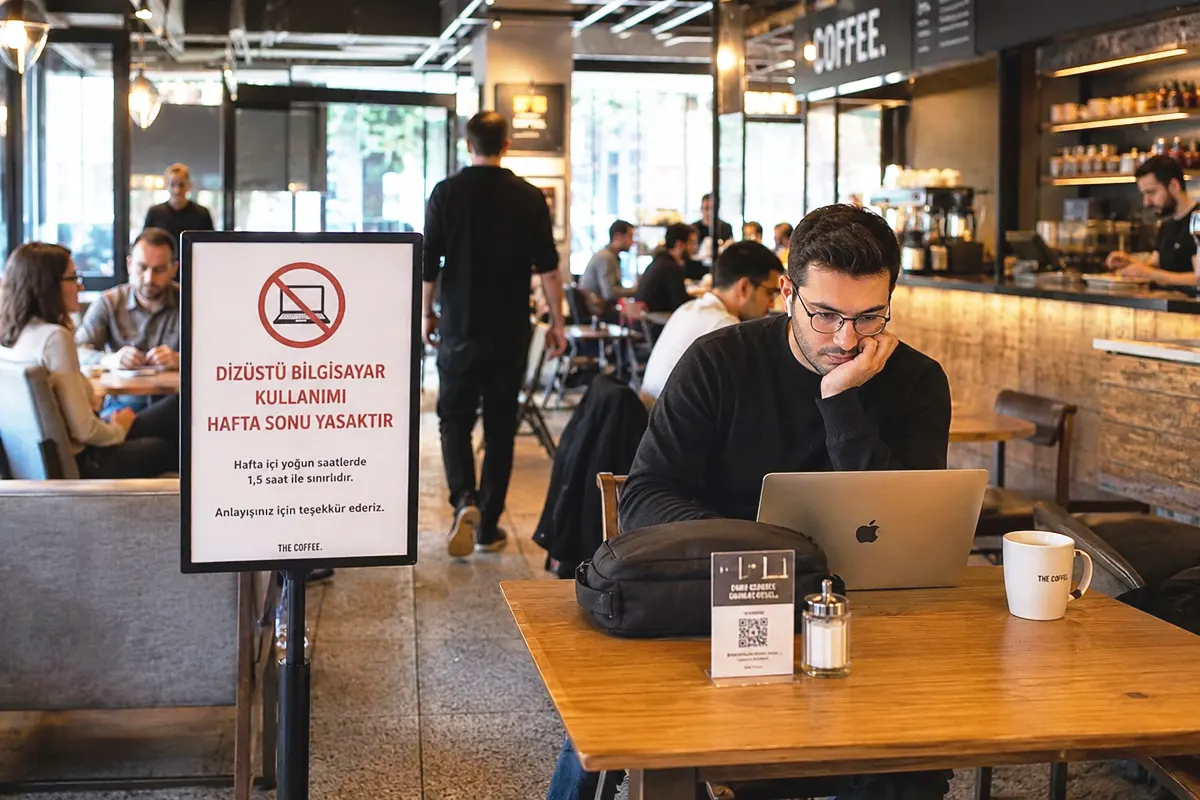
Several cafés in Istanbul have decided to take a stand against remote workers and influencers in the face of what they consider an unsustainable situation, and have begun implementing measures against customers who occupy tables for hours on end with their laptops as if they were in an office, overloading the Wi-Fi connection while barely ordering anything. Some establishments have even gone so far as to ban the use of computers on weekends.
Telework, which became popular during the pandemic and subsequently established itself as a work model alongside the hybrid model and freelancing, has sparked a new debate in restaurants but especially in cafés, which are the most affected by this issue. With the growth of this work culture, cafes, tea shops, and similar establishments face the problem of customers who keep tables occupied for hours with a single order, reducing revenue and jeopardizing the very viability of the businesses: therefore, owners are seeking solutions that, for now, involve implementing various restrictions.
A common sight in Istanbul, especially in cafes located in busy areas such as Beşiktaş, Kadıköy, and Şişli, is seeing customers working on their laptops from first thing in the morning. However, rising rental costs, staff expenses, and energy costs have led many establishments to already display signs prohibiting the use of computers on weekends, while others have also set limits on how long customers can stay at a table, according to reports in the Turkish media.
“The situation is unsustainable,” say restaurant owners
Hakan Ateş, director of an Istanbul-based coffee shop chain, explained to the Turkish press that the current situation is unsustainable for businesses: “Before, a single table was used by an average of five or six different customers throughout the day. Those customers would have their coffee, eat a dessert, and leave after a while. Now, however, a software developer or a student who buys the cheapest coffee at 9:00 a.m. and sits next to an outlet completely occupies that table until 5:00 p.m.”
“During that time, they consume electricity nonstop, clog the WiFi network, and prevent customers who really just want to have a coffee and leave from coming in. We’re not a charity; we pay hundreds of thousands of liras every month in rent, taxes, and salaries. The place looks full, but at the end of the day there’s barely any money in the till. That’s why unplugging devices or limiting WiFi password access times is no longer an option for us, but a necessity for survival,” he added.
Influencers who take up space… but don’t spend money
The complaints from business owners in Istanbul aren’t limited to laptop users. Recently, some visitors who create content for social networks have also caused frustration among cafe owners. These are influencers who arrive without placing orders, take numerous photos and videos in the decorative areas, and leave quickly — and who are considered by many owners to be detrimental to the business’s image and financial viability.
This type of visitor — consisting of influencers with varying numbers of followers who take up space in the establishment without consuming and use the place solely to create content — is also the subject of much criticism from numerous business owners in the sector. For all these reasons and in the face of rising costs, many businesses are turning to new practices.
In some cafes, Internet access is now time-limited, and the WiFi passwords printed on receipts only allow users to connect for an hour and a half: after that time, the system automatically cuts off the connection. Additionally, many establishments have disabled power outlets to prevent prolonged energy consumption by customers.
Other businesses have decided to turn this demand to their advantage and offer device charging services via paid chargers. Furthermore, especially on weekends — when customer traffic is highest — some cafes in Istanbul seeking to increase table turnover are resorting to asking customers who stay too long to order additional drinks: in some cases, establishments even require customers to place a new order every two hours.
The other side of the issue: remote workers
The issue also has another side that is now considered disadvantaged, and even discriminated against: the teleworkers themselves. Many professionals who regularly work from home go to cafes to cut down on their usual expenses for electricity, heating, or internet. This is the case for Burak Tan, a device interface designer who has been working remotely for a software company for nearly three years.
“When I work alone from home, my natural gas bill doubles in the winter, and my electricity bill also doubles in the summer because of the air conditioning and because the computer and monitor are on all day. Plus, being cooped up inside all day seriously affects my mood,” he explained.
“When I go to a café, I see other people and my concentration improves. Yes, it’s true that we order a coffee and then stay for a long time, but we can’t afford to pay the high fees for coworking spaces every day,” says this remote worker.
Burak adds that he finds it very unpleasant that cafes in Istanbul block the outlets or prohibit them from bringing in laptops. “We are consumers too, and, after all, we spend money at those establishments. The solution shouldn’t be to exclude us entirely, but perhaps to create tables and specific areas for customers who use laptops,” he concluded.
VOTE

EDITORIAL TEAM
🧿 About us
.
Edited and reviewed by:

Pablo Gómez is a specialist in Turkey and has been editor-in-chief of Hispanatolia since 2011. He has been analysing current affairs and geopolitics in Turkey and the surrounding region since 2006.
…
📣 Your ADVERTISING on Hispanatolia
.
🤗 HELP US WITH A DONATION:
💗 Paypal