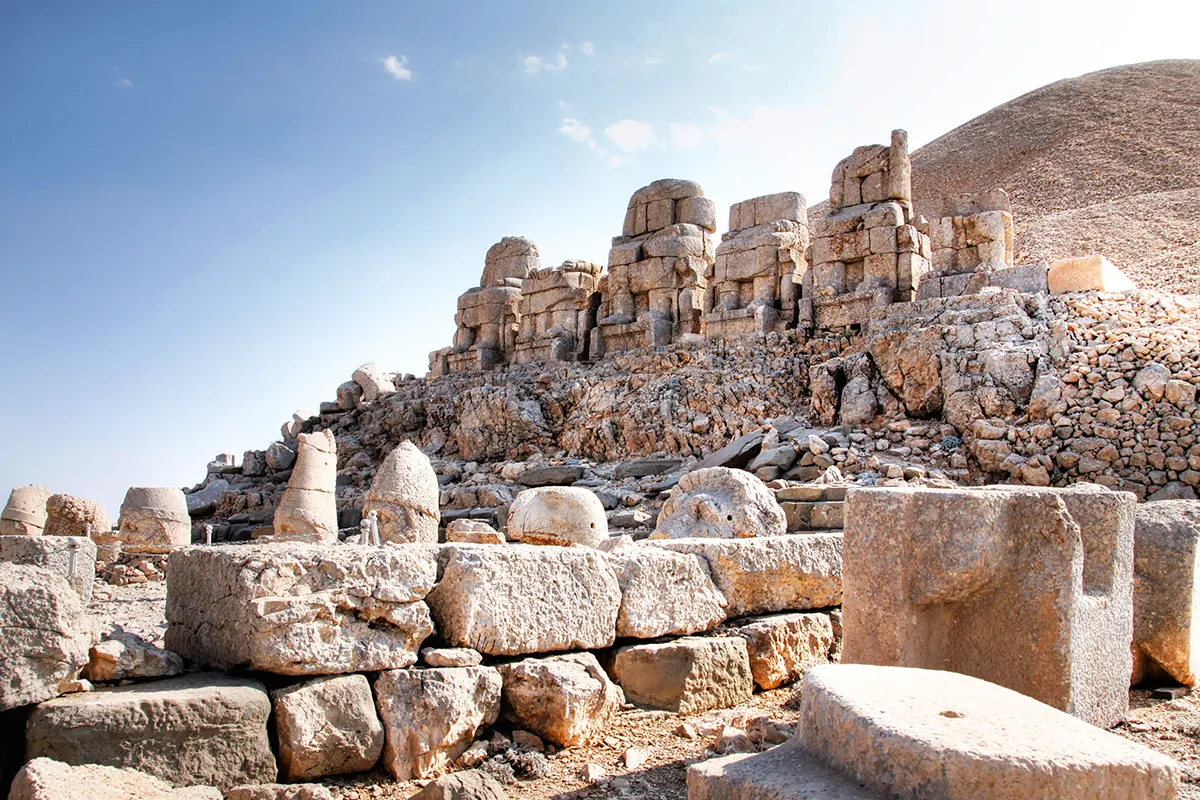
In southeastern Anatolia, far from almost any civilised corner, stands one of the most awe-inspiring and impressive places in the whole region: Turkey’s Mount Nemrut. On its summit, at an altitude of more than 2,100 metres, gigantic heads of gods and kings have been silently watching the sunrise and sunset for more than 2,000 years, as if guarding the gigantic, thousand-year-old tomb of a Hellenistic king who wanted to be equal to the gods themselves.
Declared a World Heritage Site by UNESCO, this enclave is a mixture of ancient history, monumental archaeology and spectacular mountain scenery that leaves an indelible mark on every traveller who visits it. A trip to Mount Nemrut is not just a simple excursion: it is an almost ritualistic experience, designed for those who seek to understand the profound mix of cultures that defined Anatolia in antiquity and for those who wish to discover a more unknown, authentic and fascinating Turkey.
Where is Mount Nemrut?
Mount Nemrut, known in Turkish as Nemrut Dağı, is located in southeastern Türkiye, within the present-day province of Adıyaman. It is part of the ancient historical region of Comagene, a small but influential Hellenistic kingdom that served as a ‘buffer state’ between the dominions of Rome, Parthia, Armenia and Syria.
Geographically, the mountain rises in the Eastern Taurus mountain range and dominates a mountainous and sparsely populated territory, dotted with valleys, dams and small rural villages. Its isolated location explains why, for centuries, this extraordinary sanctuary went largely unnoticed by the Western world.
Key features of the site
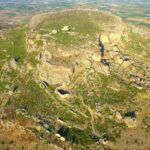
The most striking feature of Turkey’s Mount Nemrut is the monumental burial shrine at its summit. There is a huge artificial limestone mound, some 50 m high and 150 m in diameter, which covers the supposed tomb of the king who ordered its construction.
On either side of the mound are two large ceremonial terraces:
- East Terrace, facing the sunrise
- West Terrace, famous for the sunset.
The colossal statues of various Greco-Persian gods and of the king himself, now decapitated due to earthquakes and the passage of time, are preserved on these terraces. The heads, up to two metres high, lie aligned in front of the bodies, creating one of the most striking archaeological images in Turkey. The figures depicted include Zeus-Oromasdes, Apollo-Mitra, Hercules-Artagnes and the goddess Fortuna-Tyche, a clear reflection of the cultural syncretism that dominated Comagene beliefs.
History of Mount Nemrut
The history of Mount Nemrut is closely linked to the figure of Antiochus I of Comagene, one of the most unique rulers of the Hellenistic world that emerged after the death of Alexander the Great. Antiochus reigned between 70 and 31 BC in the small but strategic kingdom of Comagene, located in a border area between two great powers of antiquity: the Roman Empire and the Parthian Empire, heir to the Achaemenid Persians.
Aware of the political fragility of his kingdom, Antiochus I developed an elaborate ideology based on the divine legitimisation of royal power. He claimed direct descent from both Darius I of Persia and Alexander the Great, a dual heritage he used to justify his authority and to present Comagene as a bridge between East and West.
The sanctuary on Mount Nemrut was conceived as the central element of this political and religious project. It was not just a tomb, but a ceremonial complex designed to perpetuate the memory of the king and to ensure his eternal cult. In the inscriptions preserved at the site, Antiochus left precise instructions on the rituals to be performed on important dates, such as his birthday and the anniversary of his coronation, and asked future generations to venerate him.
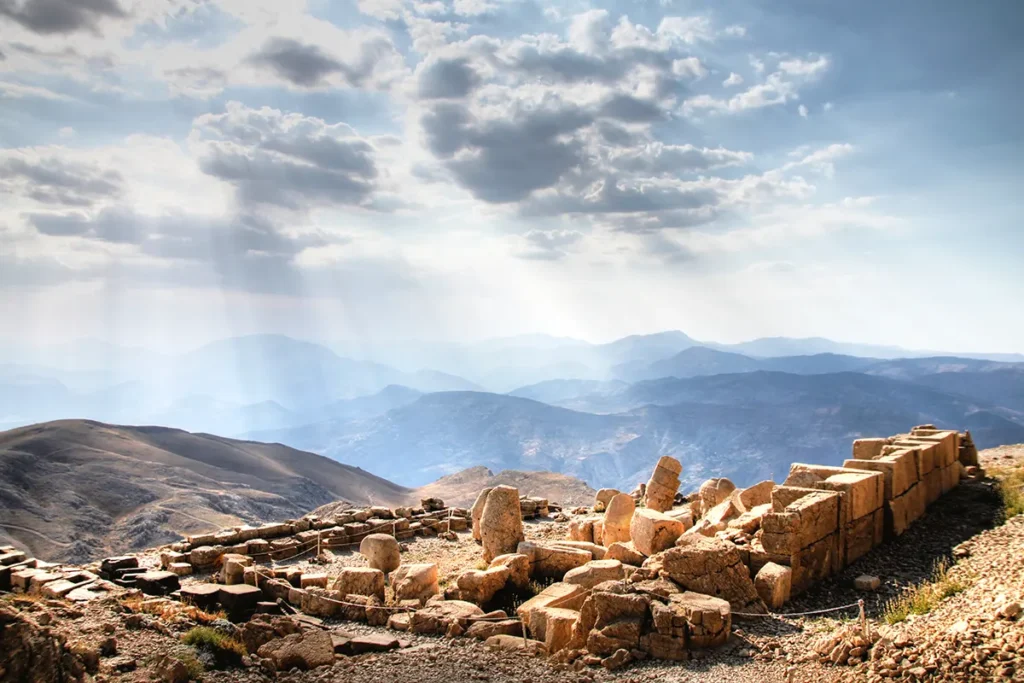
The artificial mound that crowns the mountain is thought by researchers to cover the burial chamber of the king, although to date it has never been located with any certainty. The deliberate accumulation of thousands of tons of loose stone seems designed to prevent any attempt at looting and to symbolically protect the monarch’s eternal rest.
The monumental statues represent an unprecedented religious fusion: Greek gods are associated with Persian divinities under composite names, reflecting the cultural syncretism of Comagene. Antiochus himself is depicted next to them, seated on the same level, a clear affirmation of his semi-divine status.
After the annexation of Comagene by Rome in 72 AD -after its incorporation into the Roman province of Syria- the sanctuary lost its ritual function. Over the centuries, earthquakes and extreme weather conditions caused the statues to collapse, their heads rolling to the ground, creating the fragmented image that we know today and that so characterises this impressive site.
Mount Nemrut gradually fell into oblivion until the end of the 19th century, when it was rediscovered by European explorers. Systematic archaeological excavations began in the 20th century, confirming the exceptional historical and artistic importance of the site.
In 1987, this place was recognised by UNESCO as a World Heritage Site, consolidating its value as one of the most extraordinary testimonies of the late Hellenistic world and as a unique symbol of the political, religious and cultural ambition of a king who wanted to defy time.
How to get to Nemrut Dağı?
Getting to Turkey’s Mount Nemrut requires planning due to its isolated location from major urban centres. The most common base town for visitors to the site is Adıyaman, located about 70 kilometres away and connected by domestic flights to Istanbul and Ankara. From Adıyaman you can travel by road to the town of Kahta, and from there continue north, either by car or with an organised tour to Mount Nemrut National Park.
Be aware that the last stretch of road up the mountain is particularly steep and winding. From the final car park, it is a 15-20 minute walk – a distance of approximately 500 metres – to reach the foot of the artificial mound that forms the king’s tomb. Many travellers choose to make the hike at sunrise or especially at sunset, when the light transforms the statues and the impressive landscape that can be seen from the summit – over 2,000 metres high – takes on an almost mystical character.
Opening times, prices and tips for visiting Nemrut
There is no set timetable for entry to Mount Nemrut: in principle, access to the site is usually open from early morning until sunset, although opening hours may vary depending on the season and weather conditions, especially in winter, when access to the site may be closed due to several metres of snow. Therefore, the best time to visit Nemrut is between May and October.
The entrance fee is around 10 euros, although it is free for Turkish citizens with a museum card. More information about the visit is available on this official website. It is possible to hire an organised excursion from nearby to go to the mountain, at a cost of between 1,000 and 3,000 liras (between 20 and 60 euros).
Tips for your visit:
- Wear warm clothes, even in summer: the wind at the top can be strong and the cold is intense there, especially before sunrise and after sunset.
- Wear comfortable, non-slip footwear.
- Don’t forget to bring water and sun protection.
- Arrive with enough time to enjoy the sunrise or sunset without rushing.
- It is advisable to bring cash, as cards are not always accepted in the area.
Other places of interest in the surrounding area
A visit to Mount Nemrut can be combined with other interesting historical sites in the region:
- Arsameia, the ancient summer capital of Comagene, located next to the route up Mount Nemrut.
- Cendere Bridge or Severan Bridge, an impressive Roman bridge built 1800 years ago by the Legio XVI, still standing today and still in use. Until 2003, it was the only bridge that allowed the crossing of the region by car.
- Karakuş Tumulus, a burial monument dedicated to the women of the royal family, also located on the route to the Nemrut.
To visit Turkey’s Mount Nemrut is to enter the lesser-known and more mysterious part of Anatolia: a region where history merges with landscape and silence. This is a must-see destination for curious travellers, archaeology lovers and those looking for something more than the usual tourist circuits. Here, among stone gods and an infinite sky, is where Turkey reveals one of its most fascinating and unforgettable corners… This is attested to by those who have had the good fortune to visit it. Would you like to be one of them?
📚 If you want to learn more about the history of Turkey, we recommend:
🧿 Discover here more recommended products about Turkey
We include affiliate links: if you buy through them, you don’t pay extra money and you help this website.
🧿 TOP TOURS IN TURKEY
VOTE

EDITORIAL TEAM
🧿 About us
.
Edited and reviewed by:

Pablo Gómez is a specialist in Turkey and has been editor-in-chief of Hispanatolia since 2011. He has been analysing current affairs and geopolitics in Turkey and the surrounding region since 2006.
…
📣 Your ADVERTISING on Hispanatolia
.
🤗 HELP US WITH A DONATION:
💗 Paypal