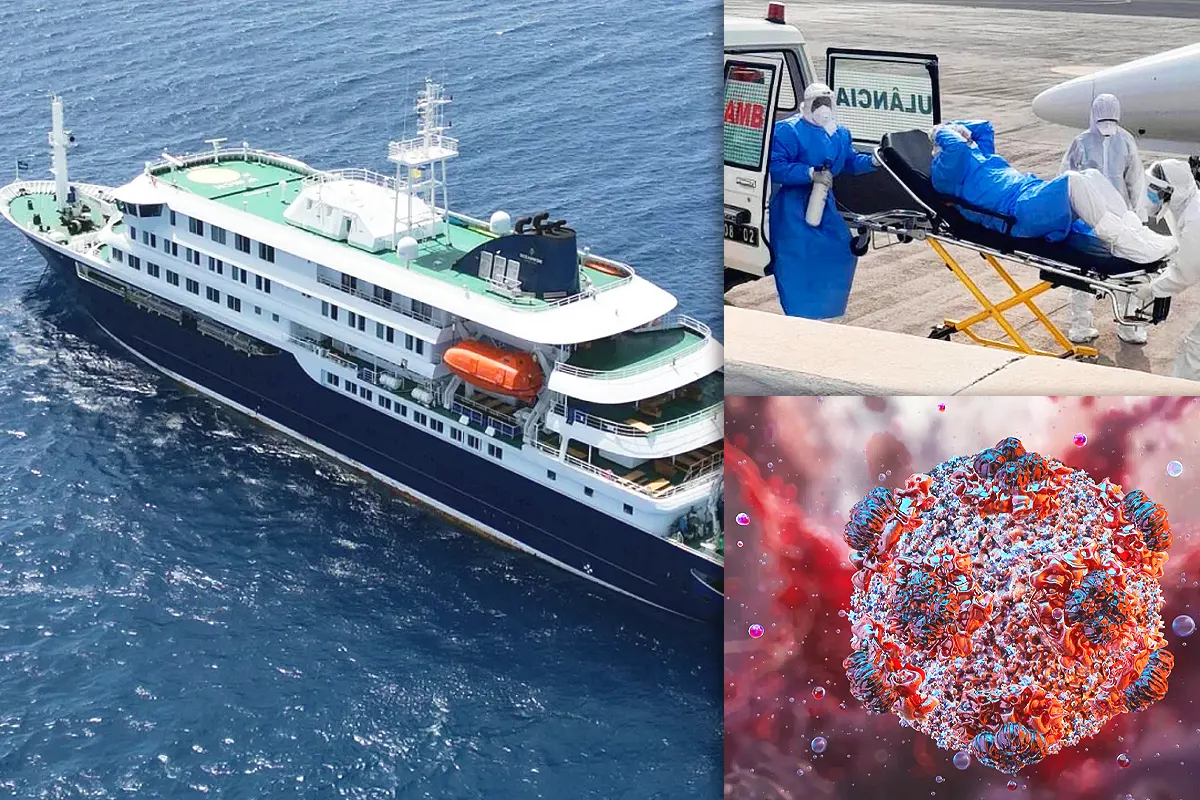
The deaths of three people on board the “Hondius” cruise ship, which was crossing the Atlantic Ocean from Argentina, due to an outbreak of hantavirus, has once again raised the question of whether a new pandemic could emerge. Whilst the World Health Organisation (WHO) has reported an increase in cases on the ship, experts are attempting to reassure the public by stating that this virus does not spread as quickly as COVID-19, although it can pose a serious risk in certain circumstances. Meanwhile, several passengers from Turkey, where the virus was first detected in 1997, have recounted their experience following the detection of the outbreak on board and have criticised the ship’s crew’s response.
The WHO has so far confirmed seven cases of hantavirus among the 147 people travelling on the cruise ship: three people have died, one remains in a critical condition in a South African hospital and three others are showing mild symptoms. Two of the deceased and one of the sick left the ship during a stopover on the cruise, including a woman who, on 26 April, flew to Johannesburg before dying, following the earlier death of her husband… Authorities are now tracing dozens of potential contacts who were on the flight with her.
The passengers and crew have remained isolated on board after the authorities in Cape Verde prohibited the cruise ship MV Hondius from docking in port, so it was eventually diverted to the Port of Granadilla, in the south of the Spanish island of Tenerife, in the Canary Islands, where it is scheduled to arrive on 9 May. Although the initial plan was for the ship to dock in the port and for passengers to disembark to be transferred to their home countries, fierce opposition from the Canary Islands government has meant that the MV Hondius will not dock after all, but will simply anchor in the Tenerife port without going ashore, in an attempt to reduce the risk of infection.
The ship’s crew did not take the necessary precautions
The Turkish YouTuber Ruhi Çenet is one of the two Turkish citizens who were travelling on the MV Hondius cruise ship where the outbreak was detected. “When one of the passengers died, I thought it was due to the sea conditions. However, the situation was much worse than we had imagined. I disembarked on the 24th and the cruise continued for another 11 days to its final destination. Just one day after I left, the deceased’s wife and another person also died, and it was discovered that the cause was the hantavirus, transmitted by rodents and for which no treatment was available on board,” he explained in a video, according to the Turkish newspaper Hürriyet.
Çenet, who said he was in good health after undergoing blood tests, criticised the cruise ship management’s handling of the situation and the crew’s initial reaction to the problem: “The ship’s management did not take seriously the possibility that this situation was caused by an infectious disease following the first death, and issued a statement saying that ‘there is no risk of an epidemic’. However, they should have imposed a quarantine from that moment (following the first death). But that did not happen. People continued to gather, group activities were held and meals were shared.”
“We’re fine. We’re sailing towards the Canary Islands”
Birdwatcher and wildlife expert Emin Yoğurtçuoğlu is another of the Turkish passengers on the cruise ship, who remains on board today: “We’re fine, everyone’s fine. Right now nobody is ill, there are no new cases or quarantine. We’re not afraid. Everyone on the ship is looking out for one another; everything is fine. Much of what is said about this virus is an exaggeration. Right now we’re heading towards the Canary Islands. I hope that in a few days’ time, when we disembark safe and sound from this ship, I’ll be able to tell you more. Please keep us in your prayers,” he said in a message posted on social media.
In his message, Yoğurtçuoğlu also explained that he first learnt what a hantavirus was last February, when the Oscar-winning actor Gene Hackman and his wife Betsy Arakawa died. He was referring to the death of Arakawa, aged 65, who died from respiratory failure linked to the virus, whilst Hackman died a week later from heart failure due to a lack of care – he was suffering from Alzheimer‘s in an advanced stage – and medication. Rat nests and several dead rodents were found in the couple’s mansion, which may have transmitted the virus to them.
Is the virus dangerous?
Based on the latest data released by the WHO, and following the monitoring of the situation of passengers on board the ship, millions of people around the world have begun to wonder what the risk of the virus spreading is and whether we are facing a possible new global pandemic.
The Turkish virologist Semih Tareen, known on social media as #virusphantom, dismisses this scenario, however: “There is no need to panic. A new pandemic is not on the way. Türkiye does not face an extraordinary risk. The cases on the ship are caused by the Andes virus, a sub-variant of the hantavirus. It is the only type of hantavirus that can be transmitted between people, although this is rare. I find this interesting as a virologist precisely because it is a very unusual case, but there is no reason to be afraid. It is not like COVID-19. Furthermore, the risk of hantavirus infection already exists in Turkey,” he noted.
As Tareen explained, the hantavirus is one of the deadliest viruses in existence; it is transmitted through bites or scratches from infected rodents, or through particles present in urine, faeces or saliva that become airborne and are inhaled.
“Imagine you’re cleaning out a barn or a garden and there are dried mouse droppings on the floor, and you sweep them up: it’s possible for the virus to come into contact with the dust that gets kicked up into the air (and for you to breathe it in). It’s more common in wooded areas, farmland, vineyards and gardens than in cities. Therefore, there is already a risk in our country. Forest workers, those involved in agriculture or livestock farming, and those living in villages… are at-risk groups. It is not a new virus. It is estimated that there are around 200,000 infections a year. The mortality rate is 60%, and, unfortunately, there is no specific treatment,” added the expert.
“The incubation period of the virus is usually between 2 and 4 weeks, but can last up to 8 weeks. The 1996 outbreak in Argentina was the first documented case of transmission of this virus between humans. In fact, it owes its name to the Andes mountain range in that country. It is a common disease in South America, and this ship also set sail from Argentina. The passengers took part in nature and wildlife watching activities. It is not yet known for certain, but it is possible that they came into contact with rodent habitats. Identifying infected people is relatively easy: the virus can be easily detected with a blood test. From a global public health perspective, the risk of an epidemic is quite low,” he concluded.
“It would be a mistake to believe that it cannot spread as rapidly as COVID”
Experts in the field highlight two key aspects of the current situation: the first is that the hantavirus is not considered to have the spreadability of SARS-CoV-2, the virus that caused the COVID-19 pandemic. The WHO states that, for the time being, there is no situation that justifies declaring a global pandemic alert. However, infectious disease experts point out that, although rare, human-to-human transmission can occur, particularly with pulmonary variants of the virus, such as the one that appears to have spread on the cruise ship in question, and that, therefore, the risk should not be considered zero.
This is the view of infectious disease specialist Dr Sıla Akhan from Turkey, who, in comments reported by Turkish media, explained that the hantavirus is mainly transmitted by inhaling air contaminated with rodent urine, faeces or saliva. Some variants affect the kidneys, whilst those detected in the Americas can cause severe lung damage.
Akhan has emphasised that this is an infection that has been known for many years, and that although it has a low transmission rate, the risk should not be underestimated: “It is not a new virus that spreads as quickly as COVID. However, it would be a mistake to completely ignore its potential”.
History of hantavirus infections and deaths in Turkey
Turkey recorded its first hantavirus infections in 1997, when cases were identified in people admitted for kidney failure in the Aegean region, specifically in the province of İzmir, according to some studies. In subsequent years, a limited number of infections were recorded, mainly in the Black Sea region (in the provinces of Bartin and Zonguldak), where the virus reappeared in 2009, infecting a dozen people.
According to reports, the outbreak that began in February 2009 caused at least one death in Turkey: this was a 22-year-old male patient who was admitted to Silivri Public Hospital in Istanbul in March 2010 with symptoms of fatigue, diffuse pain, nausea and vomiting. Approximately two hours after admission, petechial rashes – spots on the skin’s surface caused by burst blood vessels – appeared on his upper limbs, eventually spreading to other areas. The young man’s condition rapidly deteriorated and he died two days after being admitted to the ICU, where he was barely able to speak upon arrival. However, there is no record of him having travelled or having been exposed to rodents.
Although international health authorities are currently avoiding talk of a “new pandemic” like that of the coronavirus, the case involving infected passengers on board the cruise ship “Hondius” has once again placed the global spotlight on the hantavirus, its high mortality rate and the risk of its spread, particularly following revelations of the lack of adequate protocols on board the ship after the first death occurred, and the fact that some thirty people from the cruise ship disembarked on 24 April on the island of Saint Helena, including two Dutch nationals who subsequently died from the virus. The coming days will therefore be crucial in determining whether new cases emerge in other parts of the world and to what extent we are facing a new threat to global health.
VOTE

EDITORIAL TEAM
🧿 About us
.
Edited and reviewed by:

Pablo Gómez is a specialist in Turkey and has been editor-in-chief of Hispanatolia since 2011. He has been analysing current affairs and geopolitics in Turkey and the surrounding region since 2006.
…
📣 Your ADVERTISING on Hispanatolia
.
🤗 HELP US WITH A DONATION:
💗 Paypal