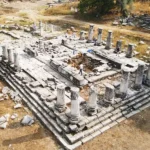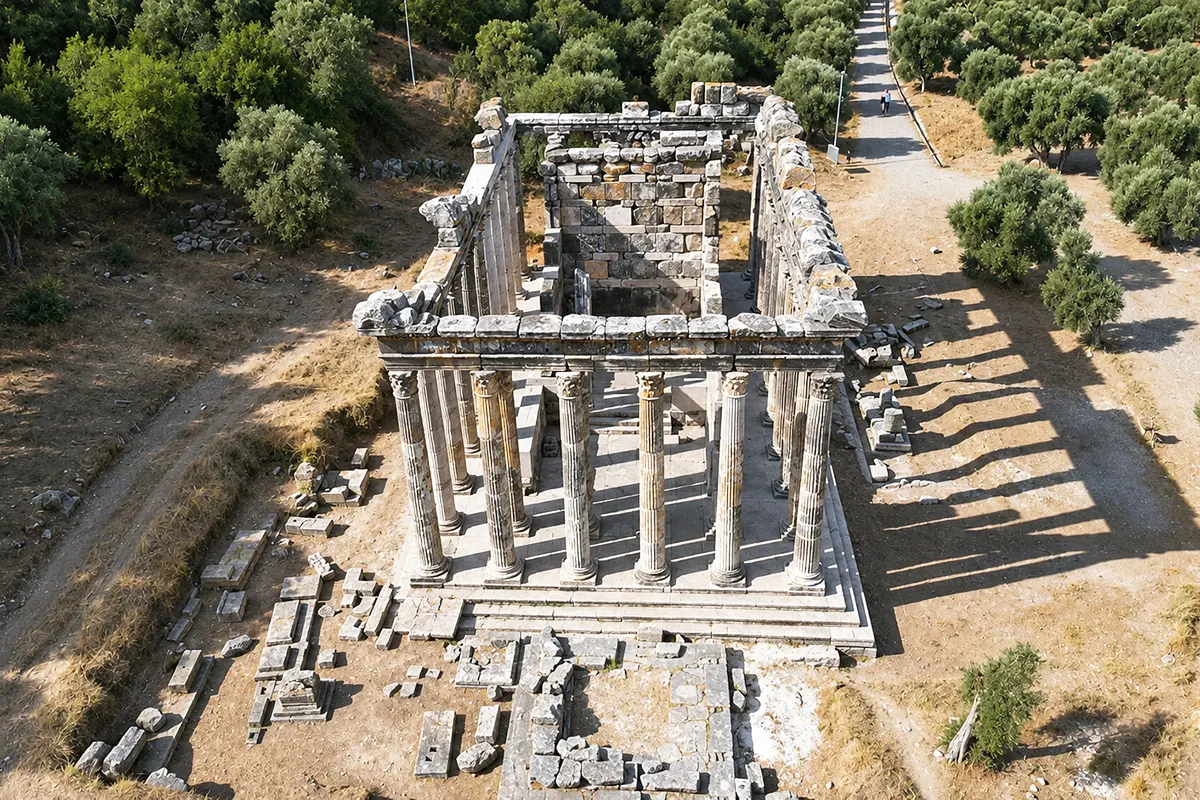
The Temple of Zeus Lepsynos, built in the 2nd century AD and forming part of the ruins of the ancient city of Euromus, situated in what is now the Milas district of the Turkish province of Muğla, has been restored and has regained its former splendour, becoming a new attraction for cultural tourism in Turkey.
Restoration work on the monument, which was built during the Roman Empire’s rule over the region, began in 2015 with the architectural survey, numbering and cataloguing of the blocks that made up the structure.
As part of the project, around 900 architectural blocks were examined individually; approximately 70% of these pieces were returned to their original positions as they stood when this temple in honour of Zeus was erected in antiquity, whilst elements that could not be reused were replaced with new blocks sourced from marble quarries in the region, according to the Turkish news agency Anatolia.
The main objective of the restoration project undertaken has been to conserve this historic monument, parts of which are still standing, and to ensure its preservation for future generations. Efforts have also been made to help promote the ancient city of Euromus and to encourage the development of cultural tourism in Milas.
Euromus: one of the major cities of ancient Caria
The ruins of ancient Euromus are situated some 12 kilometres north of the Turkish town of Milas, within the boundaries of the Selimiye neighbourhood.
The city has been known by various names throughout its history, but it underwent significant development particularly during the Roman Empire, a period in which it established itself as a major centre in the west of Asia Minor, being one of the most important settlements in the ancient region of Caria. In 2019, archaeologists discovered evidence here that brain surgery was already being performed 2,200 years ago.
It is believed that the Temple of Zeus was built during the reign of Emperor Hadrian, in the 2nd century AD. Prior to its restoration, 16 standing columns remained of the temple, bearing inscriptions from the citizens who helped to fund its construction, which took place during the city’s golden age.
A plague helped to preserve the original Temple of Zeus
However, by the end of the 2nd century, the city was virtually deserted – probably due to the so-called Antonine Plague which ravaged the Empire during the reign of Emperor Marcus Aurelius – so the temple fell into disuse and, unlike other similar structures, was not converted into a church with the arrival of Christianity.
This explains why the Temple of Zeus Lepsynos is today one of the best-preserved ancient temples in the whole of Anatolia. The archaeological site of Euromus also preserves the remains of an agora, a theatre, thermal baths, city walls, a necropolis and a chapel.
VOTE

EDITORIAL TEAM
🧿 About us
.
Edited and reviewed by:

Pablo Gómez is a specialist in Turkey and has been editor-in-chief of Hispanatolia since 2011. He has been analysing current affairs and geopolitics in Turkey and the surrounding region since 2006.
…
📣 Your ADVERTISING on Hispanatolia
.
🤗 HELP US WITH A DONATION:
💗 Paypal