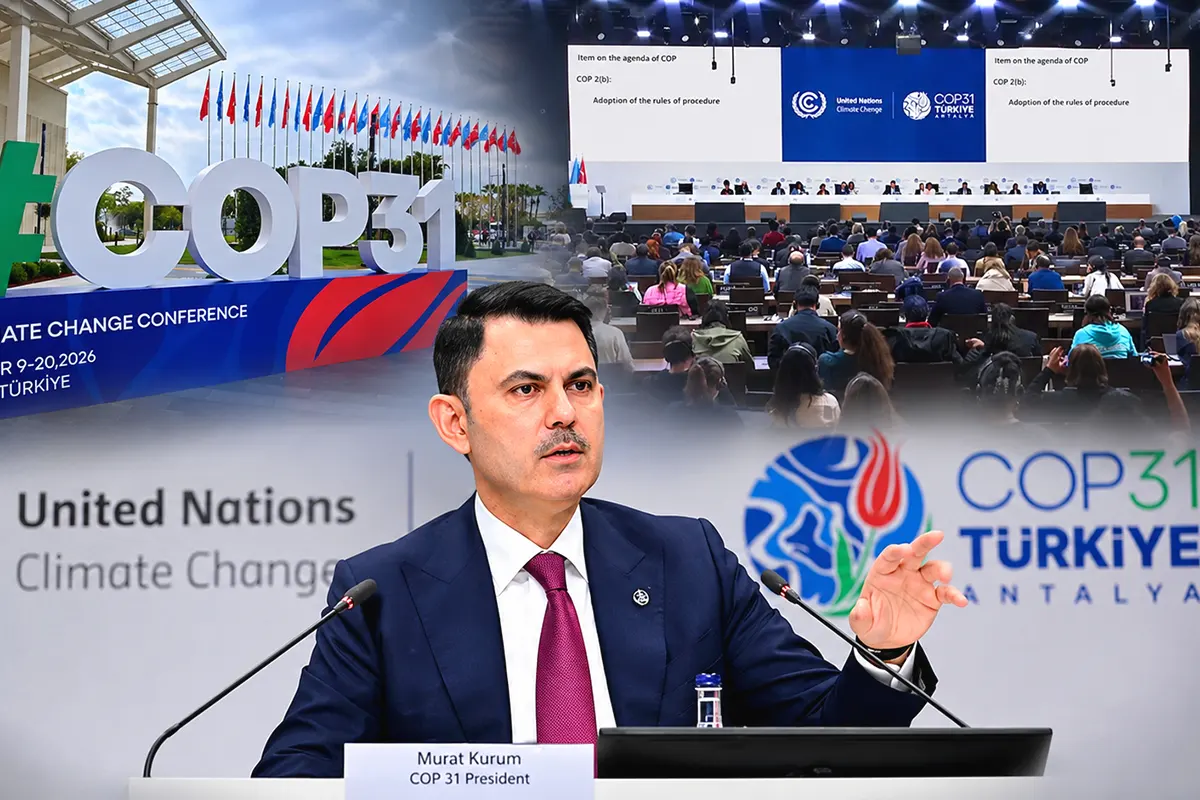
The Environment, Urbanisation and Climate Change Minister of Turkey, Murat Kurum, has responded to the comments made by Özgür Özel, leader of the main opposition party in the Turkish parliament, regarding the COP31 climate summit – which took place over the last few days in Antalya – ending without an agreement, whilst accusing the EU and other countries of preventing a consensus from being reached “over a few words”.
In a post shared on social media, the minister addressed Özel, saying: “As you do not know what the national interest and a country’s stance mean, we do not expect you to understand. We’re not going to waste our words trying to explain it to you.” Arguing that Turkey had not budged from its positions during the negotiations, Kurum added: “Türkiye is not a country that will give up its stance in the face of ‘pressure’! Don’t expect us to be pawns for others, like you. We haven’t been and we never will be.”
The minister responded in this way after the opposition leader described the failure to reach a joint agreement following COP31 as “a serious failure and a complete fiasco in our diplomatic history”, criticising the fact that Turkey had not achieved its objective of acting as a bridge between developed and developing countries, as well as the absence of any reference to fossil fuels in the draft agreement, according to reports in the Turkish press.
Kurum accuses several countries of blocking the negotiations
The 31st Conference of the Parties to the United Nations Framework Convention on Climate Change (COP31), held for the first time in Turkey and organised in Antalya, concluded without reaching an agreement on the so-called Antalya Pact. According to Kurum, this happened because some countries hindered the progress of the negotiations.
“Some countries got bogged down over a single word or phrase and, regrettably, hindered the progress of the process by raising other issues that were unrelated to climate change. We did everything in our power; the decision rests with 196 countries,” the minister stated, as quoted by Turkish media.
Kurum had already ruled out on Saturday 22 November the possibility of presenting a new draft agreement after the participating countries failed to reach a consensus on the main text due to emerge from the summit.
The Antalya Pact fails to secure consensus
Although the conference ended two days later than planned – the summit, which was initially due to close on Friday, was extended until the afternoon of Sunday 22 November, making it the longest climate summit in history — the European Union and several other delegations opposed the proposed Antalya Pact, allegedly because it did not include an explicit reference to fossil fuels, and ended up walking out of the meeting.
Even after extending the summit by a further two days, it proved impossible to reach the consensus required to adopt the so-called Antalya Pact, drawn up under the co-chairmanship of Turkey and Australia. Despite this, the summit organisers defended themselves by stating that the document had not been imposed on any of the participating delegations.
“We did everything in our power. Ultimately, we did not impose this text on anyone, nor did we issue any ultimatum along the lines of ‘take it or leave it’. It is clear that some parties oppose the text. We recognise that there is no consensus on this document. Therefore, these decisions were not adopted,” they said.
The proposed agreement urged countries to electrify their economies and called on the wealthiest nations to provide funding to help countries with fewer resources adapt to the effects of the climate crisis. It also called for the 1.5 °C threshold – relative to pre-industrial levels (1850–1900) – established in the Paris Agreement to be exceeded as little as possible.
It also incorporated a proposal from Turkey to increase the share of electricity in global final energy consumption to 35% by 2035 and envisaged at least tripling the funding allocated to help the least developed countries adapt to climate change by 2035.
Discontent arose because this proposed document did not include the phrase “phase out fossil fuels”, a measure called for by more than 130 participating countries and which many believed failed to gain traction due to pressure from the oil lobbies.
It also included controversial provisions on carbon capture and storage technologies, which – according to their critics – leave the door open to the continued use of fossil fuels.
Turkey responds to EU criticism over fossil fuels
In response to criticism from the European Union and other countries calling for an explicit mention of fossil fuels in the Antalya text, Kurum pointed out that the document retained a reference to the agreement reached in Dubai in 2023 (COP28), which had already included, for the first time, a commitment to advance an orderly and just transition towards phasing out fossil fuels.
“A system based on holding meetings and failing to take decisions in the negotiating rooms benefits no one,” stated Turkey’s Environment Minister, defending the role played by Ankara in attempting to reach an agreement during COP31 in Antalya. Kurum also warned of the consequences of the continuing deadlock in climate negotiations and the impact this may have on the worsening of climate change and its consequences.
VOTE

EDITORIAL TEAM
🧿 About us
.
Edited and reviewed by:

Pablo Gómez is a specialist in Turkey and has been editor-in-chief of Hispanatolia since 2011. He has been analysing current affairs and geopolitics in Turkey and the surrounding region since 2006.
…
📣 Your ADVERTISING on Hispanatolia
.
🤗 HELP US WITH A DONATION:
💗 Paypal