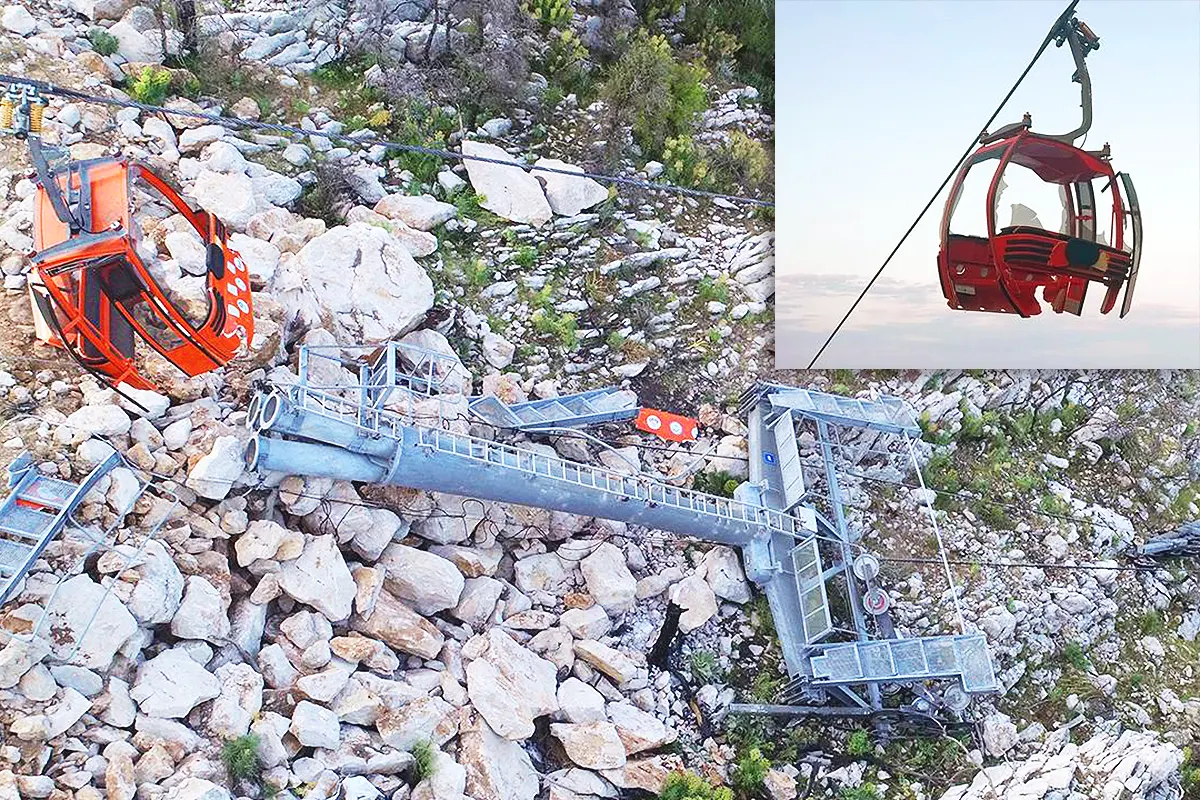
On 20 April, a court in southern Turkey handed down prison sentences to 8 people accused in connection with a fatal cable car accident in Antalya in 2024, which resulted in the death of one passenger and left several others injured.
The accident occurred on 12 April 2024, when one of the cable car cabins, situated at a height of 600 metres, struck a support pole after one of the anchors holding the cable snapped, causing the cabin floor to break, so that all its occupants fell into the void and struck the rocks below. The cable car was taken out of service and 174 people were left stranded in the cabins at a great height — some for almost 23 hours — until they could be rescued with the help of seven helicopters and hundreds of members of specialist rescue teams.
The Sarısu cable car, owned by Antalya Metropolitan Municipality, is a major tourist attraction in the region, as it connects the famous Konyaaltı beach with a restaurant and a viewpoint situated at the summit of Mount Tünektepe, at an altitude of 618 metres. The accident in Antalya took place during the festival of Eid al-Fitr, which marks the end of the Muslim holy month of Ramadan, a time when hundreds of people use this tourist attraction.
A mayor among the accused
The incident ultimately resulted in one death and seven injuries. The 36-page indictment lists 150 complainants, including relatives of Memiş Gümüş, the fatal victim. Although initially as many as 14 people were arrested, finally twelve individuals were ultimately charged, for whom the prosecution sought sentences of up to 27 years’ imprisonment for negligence resulting in death and injury.
Most of the defendants in the investigation opened by the prosecution following the accident were employees of ANET, a subsidiary of Antalya Metropolitan Municipality responsible for operating the facility; among them were the cable car operator and also Mesut Kocagöz, former chairman of the ANET board and current mayor of the Kepez district.
“If the operator hadn’t pressed that button, the accident wouldn’t have happened”
Kocagöz, in previous statements, had pointed the finger at the operator for pressing the system reset button once the cable car had stopped after detecting a fault in the infrastructure; according to the mayor, by “forcing” the main system to operate a second time instead of allowing the system to remain stationary and proceeding with the safe evacuation of the passengers using the auxiliary motor – in accordance with protocols for such cases – the strain was what ultimately broke the anchors and caused the cabin to collide with the support pillar. “If he hadn’t pressed the button a second time, the accident wouldn’t have happened,” the mayor stated.
During the trial, as reported by the Turkish news agency DHA, the cable car operator Serkan Y. defended himself by saying that he had been assigned to a position of responsibility for which he did not have the necessary training, and claimed that he pressed the button because he received a fire alert and thought that by restarting the system he would move the passengers away from danger: “I restarted it to evacuate the people. A fire alarm went off and I wanted to prevent them from burning to death by restarting it to prevent damage.”
Another of the defendants, Okan E., who was in charge of supervising the line, pointed out that the cable car had been recording reports of constant faults for years: “I was hired in 2022 for this facility, which was established in 2017. It is claimed that I did not pass on the reports of technical faults to my superiors; however, those reports of problems had existed since 2017. I cannot be held responsible for faults detected before my arrival,” he told the court.
After the defendants’ defence arguments had been presented, all of them pleaded for acquittal in their closing statements. Finally, the court in Turkey hearing the case regarding the 2024 Antalya cable car accident handed down a verdict acquitting Mayor Mesut Kocagöz and three other defendants of all charges, whilst eight others received prison sentences ranging from 3 years and 4 months to 7 years and 5 months for “causing death and injury through negligence”.
VOTE

EDITORIAL TEAM
🧿 About us
.
Edited and reviewed by:

Pablo Gómez is a specialist in Turkey and has been editor-in-chief of Hispanatolia since 2011. He has been analysing current affairs and geopolitics in Turkey and the surrounding region since 2006.
…
📣 Your ADVERTISING on Hispanatolia
.
🤗 HELP US WITH A DONATION:
💗 Paypal