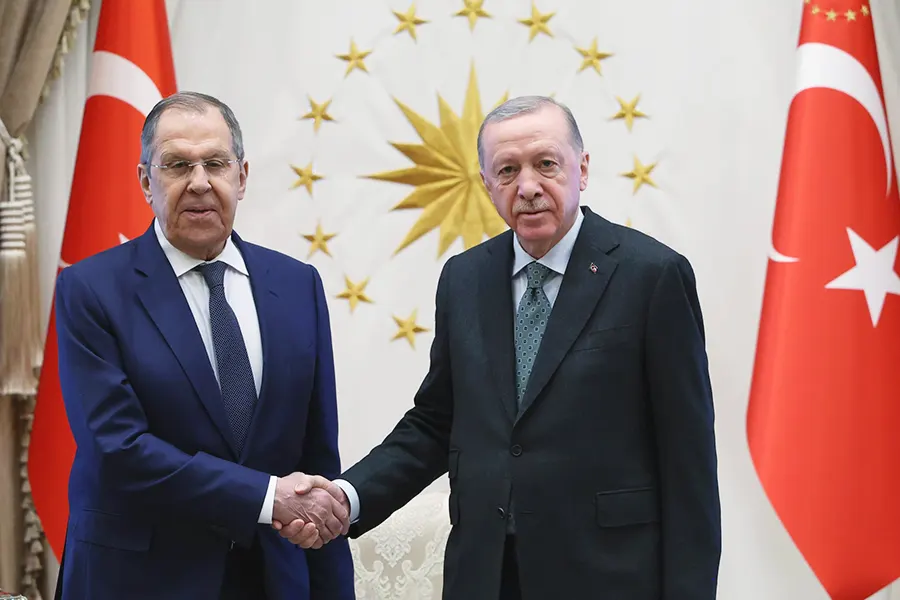
Russian foreign minister, Sergei Lavrov has confirmed that the delegations from the USA and Russia will meet again tomorrow to continue negotiations and that the chosen venue will be the city of Istanbul, Turkey, after the Turkish government insisted only a few days ago on its offer to mediate in the conflict between Kiev and Moscow.
‘Such a meeting will take place tomorrow in Istanbul. I think that its results will show how quickly and effectively we can move forward,’ Lavrov said in a statement made today during a visit to Qatar – a close ally of Turkey – quoted by various media outlets and agencies.
The news was later confirmed by a spokesman for the Turkish Foreign Ministry, who emphasised that ‘as we have repeatedly stated, Türkiye is ready to provide all kinds of support to peace efforts, including hosting future talks’. However, Ankara maintains that Ukraine should also be present at these negotiations, since Turkish government has close relations with Kiev and supports its territorial integrity.
For the moment, it is not known who will participate in tomorrow’s meeting in Istanbul, nor the exact time and place of the meeting. Lavrov and the US Secretary of State Marco Rubio met on 18 February in Riyadh, the capital of Saudi Arabia, coinciding with a visit by Zelenskyy to Turkey, in which the Ukrainian president harshly criticised the meeting with representatives from Moscow, accusing Washington of wanting to negotiate peace behind Ukraine’s back and of helping Putin to emerge from his international isolation.
However, the US has not corrected its position and insists on negotiating with Russia without the participation of Ukraine, even showing tacit support for the Kremlin’s positions on the war; on Monday, the United States sided with Russia in up to two votes at the United Nations and tried to prevent a resolution condemning Moscow for the invasion of Ukraine, while President Donald Trump has called Zelenskyy a ‘dictator’, accusing him of being to blame for the conflict.
VOTE

EDITORIAL TEAM
🧿 About us
.
Edited and reviewed by:

Pablo Gómez is a specialist in Turkey and has been editor-in-chief of Hispanatolia since 2011. He has been analysing current affairs and geopolitics in Turkey and the surrounding region since 2006.
…
📣 Your ADVERTISING on Hispanatolia
.
🤗 HELP US WITH A DONATION:
💗 Paypal