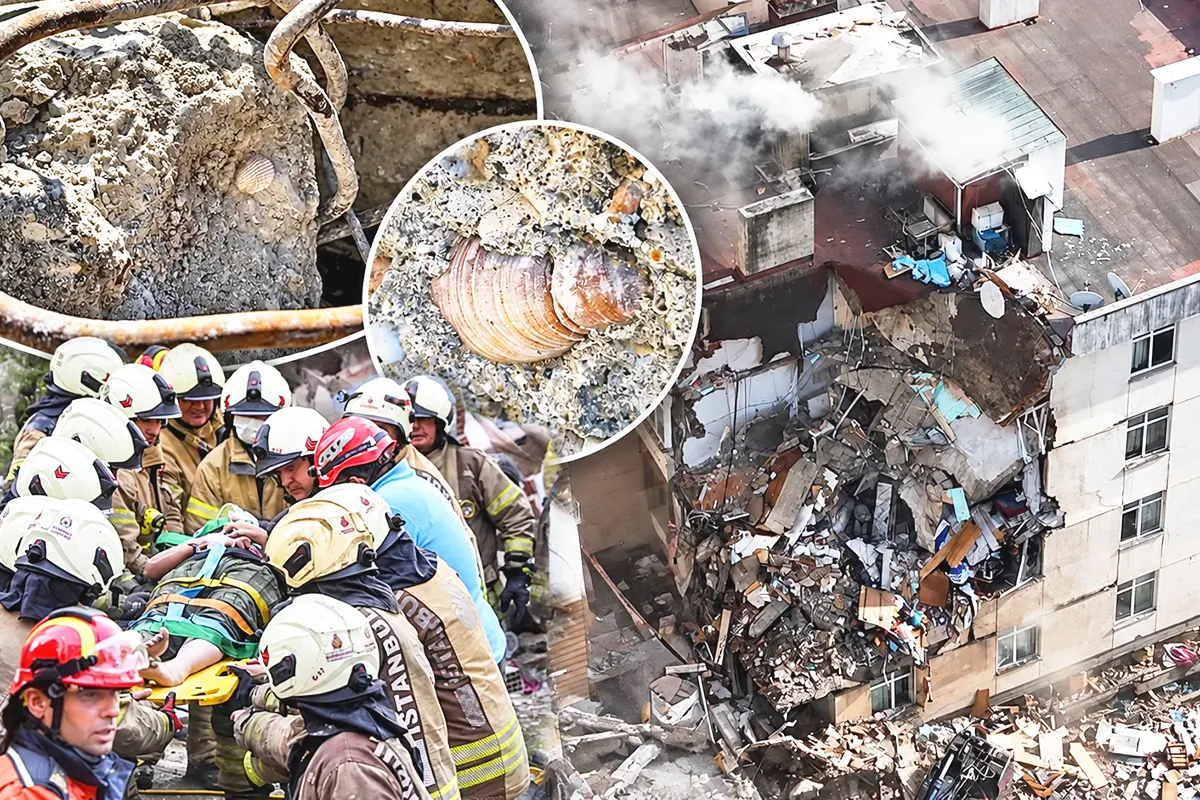
Emergency services concluded their search and rescue operations this morning in the district of Maltepe, on the Asian side of Istanbul, after recovering the bodies of the three people who had remained missing in the rubble following the collapse of a seven-storey building in the early hours of yesterday morning. The final death toll from the disaster therefore stands at five, following the collapse of the building’s three lower floors, whilst teams who have begun investigating possible construction defects have found traces of shells that could indicate that sea sand was used to make the cement for the building’s pillars.
Rescue operations at the building on Doğu Street, in the Istanbul neighbourhood of Cevizli, concluded early this morning at 06:15, approximately 24 hours after the emergency services arrived at the scene, according to the Istanbul Governor’s Office, following the recovery of the body of the last person still trapped under the rubble.
The building was demolished in a controlled manner to locate the missing persons
Whilst work continued to locate the three people who remained missing and were suspected to be under the building’s ruins, rescue teams carried out a controlled demolition using a technique of progressively removing material, starting from the upper floors of the building, according to reports in the Turkish media.
Once this operation was complete, the teams began clearing the rubble, pausing periodically to listen for any signs of life. As a result of the operations coordinated by AFAD, Turkey’s Disaster and Emergency Management Agency, the bodies of a further three people were recovered, bringing the total number of casualties to five; four of them died at the scene of the incident and a fifth died in hospital.
Three more buildings at risk evacuated in Istanbul
The governor of Istanbul announced that orders had been given for the evacuation of three buildings and a total of 55 people. Of these, 44 who required accommodation were transferred to hotels, where psychosocial support was also provided to those affected.
Furthermore, psychological support was provided to the victims admitted to hospital, and food was distributed to the personnel deployed and to the evacuated citizens. A total of 774 personnel, two drones, 237 vehicles and ten dogs from the K9 unit took part in the search and rescue operation.
Seashells found in concrete samples
Whilst demolition and rubble clearance work continued this afternoon, the discovery of seashells in the concrete of the collapsed building has raised questions about the quality of the materials used in its construction, according to reports by local media.
As part of the investigation into the tragedy, teams began collecting concrete samples from the rubble of the collapsed building, and during this process, they found seashells amongst the fragments analysed: images that have caught the attention of members of the public and experts alike.
This is because seasand contains salts that can easily corrode the steel elements in the concrete; furthermore, the presence of organic matter can weaken the mixture, and its fine grain size reduces the structure’s strength. For these and other reasons, the use of sea sand as a building material is not only strongly discouraged, but is prohibited in many countries, including Türkiye, where its use contravenes building regulations designed to protect against earthquakes.
It is hoped that the analysis of these samples will shed light on the causes of the building’s collapse in Istanbul – a story that has dominated the news and newspapers in Turkey over the last 24 hours – and clarify whether there were indeed construction defects in a building to which, as the mayor of Maltepe revealed yesterday, two upper floors had been added illegally.
VOTE

EDITORIAL TEAM
🧿 About us
.
Edited and reviewed by:

Pablo Gómez is a specialist in Turkey and has been editor-in-chief of Hispanatolia since 2011. He has been analysing current affairs and geopolitics in Turkey and the surrounding region since 2006.
…
📣 Your ADVERTISING on Hispanatolia
.
🤗 HELP US WITH A DONATION:
💗 Paypal