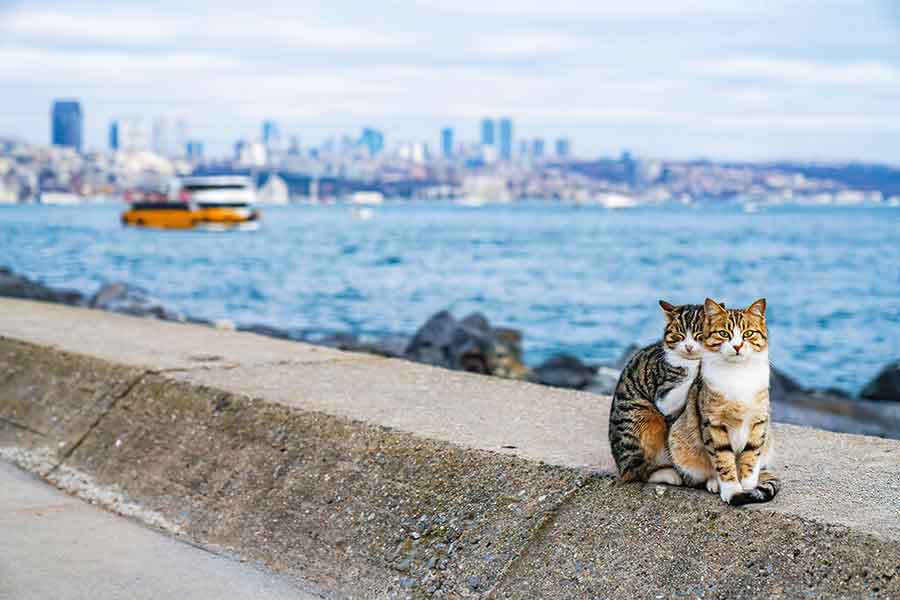
A rare disease caused by a feline coronavirus is killing hundreds of cats in Istanbul. Mortality rate is 100%, and there is no cure.
Istanbul is famous for its monuments and also for its cats: the population of stray cats in the Turkish metropolis is estimated at more than 700,000 felines, and some like “Tombili” became so famous that they have their own dedicated statue. However, there is something that seems to be killing the cats of the city, and that worries animal lovers tremendously.
The problem for now seems centered on Büyükada, the largest of the so-called “Princes’ Islands”, located off the coast of the Asian side of Istanbul; there, the Turkish press assures that, according to official records, only in the last 4 months some 700 cats have died from the so-called feline infectious peritonitis (FIP), a rare disease caused by the so-called feline coronavirus.
Volunteers from the Büyükada Animal Rescue Society, an association for the protection of animals on the island, say death rates have skyrocketed. “I used to take care of 210 cats, and now there are only 50 left,” says activist Neslihan Sipahioğlu, speaking of the effects of FIP, a systemic disease caused by a mutation of the feline coronavirus (FCoV), on the island’s cat population. The disease spreads rapidly among young or immunosuppressed cats.
Another volunteer, Metin Türkmenoğlu, assures that “7 out of 10 cats on the island are dying of FIP”. “Every year, between 450 and 500 cats die in Büyükada. But during the first five months of this year, the number of dead cats exceeds 700”, says Türkmenoğlu: that is, almost 3 times more than the normal number of deaths for the whole year in the area.
Once the cat gets sick, mortality rate is 100%
Faced with this worrying situation, associations such as the aforementioned Büyükada Animal Rescue Society are trying to contain the spread of the pandemic by creating a kind of “quarantine rooms” where cats that fall ill with FIP are isolated and cared for. The problem is money: although there are vaccines and tests for the feline coronavirus, they are tremendously expensive.
“I gave 3 of my cats the vaccine, but I had to pay a fortune. We are very desperate… People are looking for ways to be able to pay for the medicines: many, including myself, have had to ask for a loan from the bank (to be able to pay for them)”, says Sipahioğlu. Some cat owners on the island have even had to “sell their second residencies” in order to save their cats, she adds.
The problem with this disease caused by the feline coronavirus is that, once the cat is infected, “death occurs in 100% of cases,” says Celal Karabulut, a veterinarian on the island. This is mainly because the disease acts fast, and there is no 100% effective cure. “Once the disease affects the cat, the damage is done,” he explains.
When asked if there is a possibility that infected cats infect humans, he answers with a blunt “No”; actually, feline coronavirus exclusively affects cats, and no other species. Infections occur mainly in areas where cats gather, either to eat or to defecate: it is estimated that 1 in 3 infected cats shed the virus in their faeces.
Delving into the characteristics of this virus that seems to be killing hundreds of cats in Istanbul, the veterinarian indicates that the virus is quite fragile and does not survive outside for more than 24 or 36 hours, although low temperatures can help it survive even for months in winter. As with the coronavirus that has affected humans in the last two years of the pandemic, the feline coronavirus can be transmitted by contact with infected clothing or objects, but it does not survive more than a few hours on them.
VOTE

As a history lover, Pablo Gómez was captivated by Turkey from the first day he visited it in 2006: he got married there, has a house there… and has since become an expert on Turkey’s current affairs. With a long experience in media, he has been at the helm of hispanatolia.com since 2011.