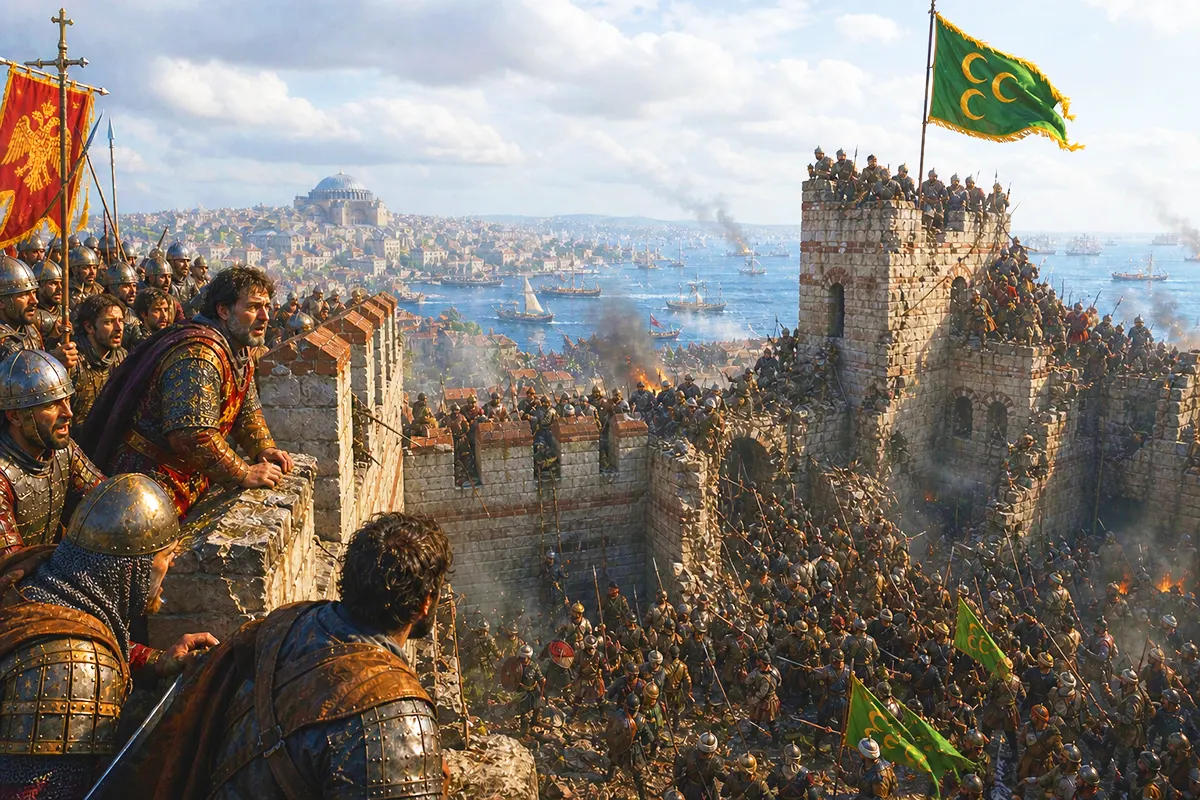
The siege of Constantinople in 1453 was not merely a battle; it was the final crash of a world collapsing as another, young and ambitious, emerged from the smoke of the gunpowder from the cannons. But for centuries, a story has captivated the imagination of writers and readers alike: the idea that the fall of Constantinople was due to an anonymous soldier forgetting to bolt a small postern gate known as Kerkoporta; the Ottomans, realising the oversight, breached the walls and the city’s fate was sealed.
This narrative suggests that the fall of the Byzantine capital and the end of the Middle Ages hinged on a simple human oversight, a stroke of bad luck that allowed the Janissaries of Mehmet II to infiltrate the heart of the last Roman capital. But did it really happen that way? What do historians say about it?
Stefan Zweig and the literary construction of the ‘forgotten gate’
Although this account was considered true for centuries, modern historiography has begun to question this episode, which many today regard as poetic licence rather than a documented fact. The notion of the ‘forgotten gate’ was masterfully popularised by the Austrian author Stefan Zweig in his work ‘Decisive Moments in History’. Zweig, with his dramatic pen, described how this small error changed the course of history. But what do modern sources say about the event?
Historians such as the Turkish professor Fahameddin Basar have rejected the historicity of the account, pointing out that most eyewitnesses, as well as the Byzantine and Latin chroniclers of the time, make no mention of such an incident. The myth appears to have sprung from the pen of a single later historian, Doukas, whose chronicles often sought almost supernatural or tragic explanations to justify a defeat that, militarily speaking, was almost inevitable in the case of Constantinople; Doukas describes how some fifty Ottoman soldiers discovered the gate open near the imperial palace of Constantine (Blachernae), climbed the walls and hoisted their banner, causing panic amongst the defenders, who began to shout “The city has fallen!”… But no one else mentions this detail.
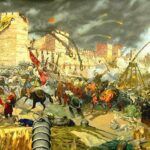
To understand whether the legendary Kerkoporta was truly the key that sealed the city’s fate, we must examine the state of the Byzantine defences in May of that year, when the siege that would lead to its fall took place. Constantinople was exhausted after 54 days of uninterrupted bombardment. The Ottoman sultan did not rely on luck, but on the most advanced technology of his time: the bronze cannons of colossal proportions designed by the Hungarian engineer Orbán, among which the Great Bombard (or Basilica) stood out, measuring 8 metres in length and firing granite balls weighing some 700 kilos.
These devices had been pounding the Theodosian walls for weeks, opening huge breaches that the Byzantines could barely manage to patch up hastily during the night. The fall of the city, therefore, was the result of overwhelming military pressure exerted by an army that outnumbered the defenders by a ratio of more than 10 to 1, with some 5,000 Byzantines recruited by the emperor Constantine XI Palaiologos and some 2,000 foreign volunteers — mainly Genoese led by Giovanni Giustiniani — attempting to hold back between 80,000 and 100,000 Ottomans, including Janissaries, regular infantry and auxiliary troops.
The legend of the Kerkoporta during the siege of 1453
“It is completely false. All eyewitnesses and almost all Byzantine sources — except Dukas — as well as the Latin accounts, recorded the events of the 54-day siege,” Professor Basar states categorically, dismissing any credibility of the story about the Kerkoporta. According to his analysis, the true turning point of the siege was not that a gate was left open, but the coordinated mass assault launched by Mehmed II after the Ottomans managed to transport several ships overland to the Golden Horn.
This unique strategic manoeuvre forced the Byzantines to divide their already meagre forces to also defend the sea walls, weakening the landward section of the Theodosian Walls, which was where the main fighting was taking place. The resistance led by Emperor Constantine XI and the Genoese commander Giovanni Giustiniani Longo was heroic… But the wall of men and fire facing them was, quite simply, unstoppable.

The account of the Kerkoporta would thus serve a psychological function: the need to find an external or fortuitous cause for what was seen by the Christian world as a tragedy and the end of an era. For the Byzantines, accepting that their sacred city had been taken by brute force was more painful than believing that the disaster was the result of a fatal error which, had it not occurred, might have changed history. The legend was fuelled by the idea that ‘God willed the gate to be opened’, as recorded in some popular Greek texts that sought to give a mystical meaning to the disaster. But it is illogical to think that – after weeks of brutal fighting – everything was decided simply by an unlocked gate, let alone that anyone could have been so careless.
In any case, it does seem more plausible that someone from within might have decided to open a gate in the wall to end the terrible siege, just as – indeed – had already happened during the Visigothic siege of Rome in 410. Some studies suggest that the preservation of many Byzantine churches in the city following the conquest may have been a reward from Mehmed II – who offered the emperor to surrender the city peacefully on three separate occasions – for the individual surrender of several districts of Constantinople, which simply accepted the fact that the Ottomans were now the new rulers.
Even in the case that a handful of Ottoman soldiers had managed to enter through a secondary postern gate, the definitive breach occurred several kilometres further south, in the Lycus Valley: a depression in the central and weakest part of the walls of Theodosius II. There, heavy artillery had reduced the wall to a heap of rubble; and when Commander Giustiniani was wounded and had to be evacuated, the Genoese soldiers abandoned the battle and the morale of the few remaining defenders collapsed completely. It was in that moment of chaos, and not through a forgotten gate, that the Sultan’s elite troops managed to breach the final barricades. The conquest of what we now know as Istanbul was an incredible military operation which – without massive and decisive aid from the European powers, which never arrived – had only one possible outcome.
What do eyewitnesses say about the breach in the wall?
The impact of this legend continues to resonate in today’s culture because it strikes a chord: the vulnerability of civilisations, however great they may become. But historical research is clear on this point. The evidence suggests that the story of the gate was inserted into later chronicles to add drama to the fall of the Eastern Roman Empire.
A review of the diaries of figures from the period, such as Nicolò Barbaro, a Venetian surgeon who experienced the siege of Constantinople first-hand, describes a fierce struggle for every metre of stone, with no mention whatsoever of a triumphant entry through an unguarded gate. Barbaro, who notes that the Ottoman army numbered some 160,000 fighters and possessed formidable cannons, blames Giustiniani for the fall of the city, claiming that he abandoned his post out of cowardice rather than because he was wounded, whilst regarding Emperor Constantine XI, he notes that some claimed he had died in battle and others that he had taken his own life by hanging, thus confirming the uncertainty that persists to this day regarding how the last Roman emperor died, whose body was never found.
Today, archaeology, history and the study of original texts allow us to reconstruct that 29 May 1453 with greater objectivity. Constantinople did not fall because of an open gate; it fell because the world had changed. The massive use of gunpowder by the Ottomans, the superior logistics of their army and the determination of a young and resolute 21-year-old sultan were the true battering rams behind the fall of a city which, by then, was no longer even a shadow of the fabulous capital it had been a thousand years earlier.
The true military factors behind the Ottoman victory and the fall of Constantinople
The prestigious Turkish historian Halil İnalcık (1916–2016), a world-renowned author of numerous studies on the Ottoman Empire, is known for having accurately described Constantinople in 1453 as a “dead city” due to its state of extreme economic, social and demographic decline. According to some of his studies, the city conquered by Mehmed II was no longer the splendid metropolis of the past, but a mere “shadow” that barely had 50,000 inhabitants (having once exceeded 500,000) following centuries of civil wars, sieges and, especially, the devastation caused by the Fourth Crusade in 1204.
By then, Constantinople was merely “a cluster of villages separated by cultivated fields, ruins and empty spaces” within the ancient walls, according to chroniclers of the time. Furthermore, the former Byzantine Empire had been reduced practically to the city itself and its surroundings, as well as the Peloponnese peninsula (Despotate of Morea) and a handful of islands in the Aegean, having lost its trade routes and main sources of income to the Italian powers and the emerging Ottoman power.
For İnalcık and other experts in Byzantine and Ottoman history, Sultan Mehmed II’s true achievement was not merely the military conquest, but his subsequent policy of reconstruction and repopulation of Constantinople, which — in fact — saved and transformed what was a ‘dead city’ into the vibrant cosmopolitan centre of the empire we now know as Istanbul. The Kerkoporta is thus relegated to the realm of literary mythology, and discovering this allows us to see that the fall of Constantinople and Byzantium was inevitable: the logical consequence of the end of an era and of a world that lay in ruins and could no longer hold back the Ottoman advance. Because civilisations do not fall due to a single oversight, but rather through an accumulation of circumstances that, inexorably, lead to their demise.
📚 If you want to learn more about the history of Turkey, we recommend:
🧿 Discover here more recommended products about Turkey
As an Amazon Associate, we earn from qualifying purchases. This comes at no extra cost to you and helps support this website.
VOTE

EDITORIAL TEAM
🧿 About us
.
Edited and reviewed by:

Pablo Gómez is a specialist in Turkey and has been editor-in-chief of Hispanatolia since 2011. He has been analysing current affairs and geopolitics in Turkey and the surrounding region since 2006.
…
📣 Your ADVERTISING on Hispanatolia
.
🤗 HELP US WITH A DONATION:
💗 Paypal