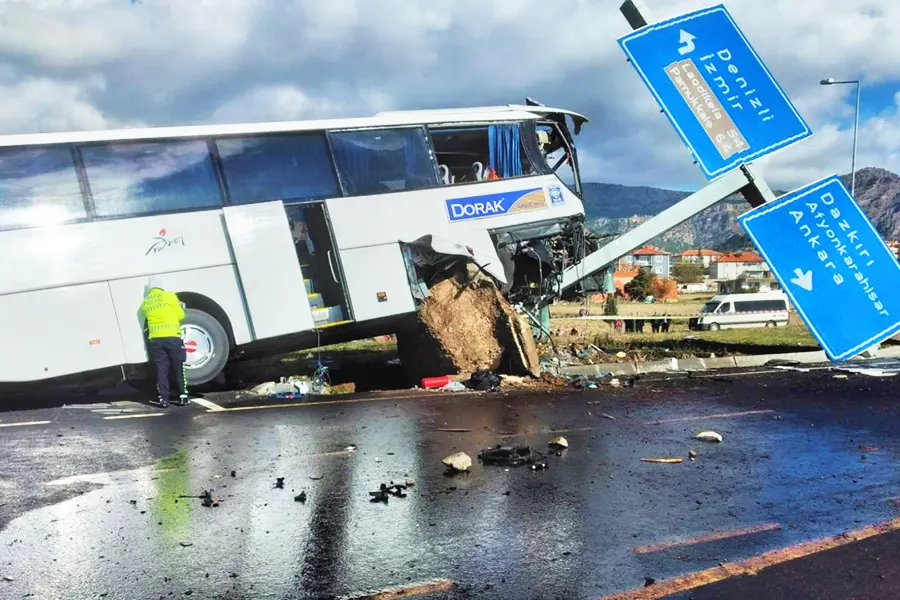
Alarm is growing among citizens and associations in Turkey about the increasing number of fatal bus accidents, with many casualties recorded in August alone, confirming an upward trend that has been observed for several years now, and forcing reflection on what measures the authorities, transport companies and even passengers should take to reduce the number of accidents on the roads.
According to information published by the Turkish daily Hürriyet, 1,347 accidents with fatalities and injuries involving buses on intercity routes have been recorded in the last five years. To cite a few examples this month alone, on 9 August a bus collided with a truck in Düzce injuring 25 people, and on the same day another bus travelling from Ağrı to Izmir crashed into a bridge in Ankara killing 9 people. On 13 August, a bus collided with a construction vehicle travelling on a motorway in Aydın in an accident that injured 8 people, and the following day a bus overturned in Malatya injuring 22 people.
According to data provided by the Turkish Gendarmerie General Command, intercity bus accidents with casualties increased from 218 in 2020 to 252 in 2021, 333 in 2022 and 364 in 2023 (an increase of 167% between 2020 and 2023). So far in 2024, there have already been nearly 190. Given these figures, the media and authorities seem to have focused on the bus companies operating in the country, agreeing on the need to increase inspections and safety measures.
Speaking to the newspaper, Alpay Lök, vice-president of the Association for the Prevention of Traffic Accidents, pointed to the practice of disabling the speed limiters on these vehicles as one of the main causes of these accidents; it is common for drivers or companies to manipulate these devices – which limit the speed of buses to 100 km/h – to allow speeds of 150 or even 170 km/h: a practice that Lök believes should be punished with heavier fines, as no intercity bus is designed to operate safely at speeds above 100 km/h, he said.
Poor working conditions for drivers
While acknowledging the need for increased inspections of companies and vehicles, Lök also denounced the working conditions endured by many drivers, with long working hours of 9 or 10 hours with only one rest day per week. An additional problem is the common practice in the industry of travelling with replacement drivers who sleep in the vehicle itself and do not get adequate rest. ‘This is not real sleep. You are going to travel a long distance, and you need a good sleep. As long as this situation continues, there will be a risk of accidents,’ he said.
‘When a person works eight hours a day, their performance does not become full again until they rest,’ he said, citing a study in Germany. ‘In Turkey, drivers sometimes work more than 10 hours with only one day off, and sometimes even that day is cancelled, which raises the question of whether that person is getting adequate rest,’ Lök said.
But in order to avoid bus accidents in Turkey, it is not only the companies or the drivers who are to blame. According to Lök, passengers should also be made aware of the importance of wearing seat belts: a basic safety practice that is not even common in private cars, let alone buses. ‘How many passengers were wearing seat belts in the bus accident in which 9 people lost their lives? Unfortunately, we do not wear seat belts either in private cars or during intercity bus journeys. We need to educate our citizens more about the importance of seat belts,’ he warned.
VOTE

EDITORIAL TEAM
🧿 About us
.
Edited and reviewed by:

Pablo Gómez is a specialist in Turkey and has been editor-in-chief of Hispanatolia since 2011. He has been analysing current affairs and geopolitics in Turkey and the surrounding region since 2006.
…
📣 Your ADVERTISING on Hispanatolia
.
🤗 HELP US WITH A DONATION:
💗 Paypal