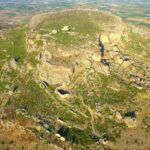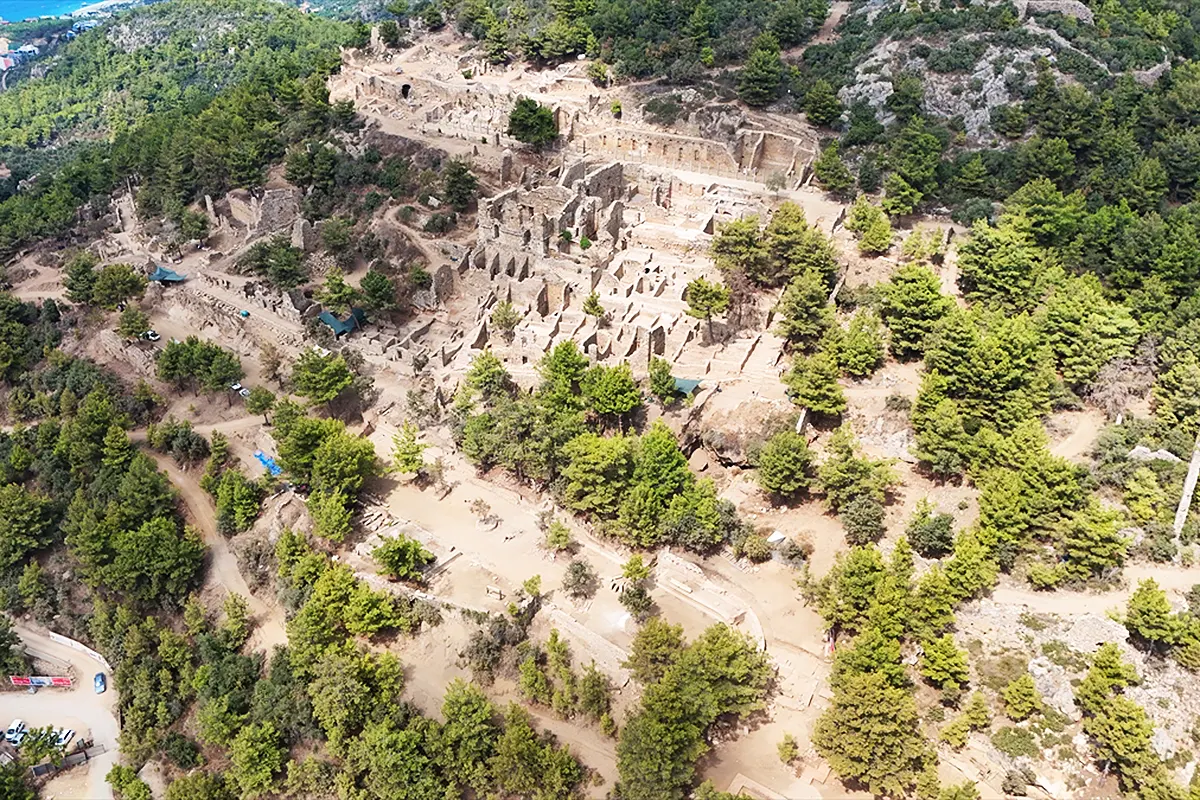
Archaeological excavations at the ruins of the ancient city of Syedra, located in the Alanya district of Antalya province on Turkey’s Mediterranean coast, have revealed what archaeologists have identified as the remains of an ancient Roman stadium some 1,800 years old and capable of holding up to 3,000 spectators.
Syedra is a city in the ancient region of Cilicia that was founded in the 7th century BC and abandoned around the 13th century AD, and was home to remains of Hellenistic, Roman, Byzantine and Seljuk civilisations. It was once an important seaport, and it is said that this is where Pompey the Great held his last meeting with his generals before travelling to Egypt, where he would be assassinated.
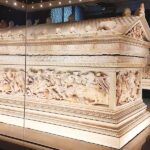
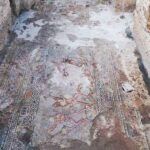
The archaeological excavations, supported by the Turkish Ministry of Culture and Tourism, have provided a deeper insight into the history of Syedra, where one can still see its colonnaded street, a baptismal cave, its baths, an assembly building, the cisterns and its entire hydraulic infrastructure, mosaics depicting the Twelve Labours of Hercules and several statues depicting the goddess Nike.
This year’s excavations focused on the southern part of the city, where archaeologists were able to identify the remains of an ancient Roman stadium, as Ertuğ Ergürer, head of the archaeological work in the area, told Anatolia news agency: “We knew about the existence of the rows of seats, but we had not found the structure because of the steep terrain, which is 340 metres high. Finally, we discovered a stadium about 200 metres long and 16 metres wide,” he said.
The stadium hosted games and festivals during the Roman Empire
Ergürer noted that inscriptions referring to sports such as wrestling and boxing are found in the ruins of the city, suggesting that the stadium hosted athletic games, religious festivals and imperial celebrations during the Roman Empire. “The existence of a stadium here shows that Syedra was a developed and prosperous city with a distinguished status in the region,” he said.
Archaeologists working on the ruins at the site estimate that the Roman stadium at Syedra had the capacity to hold between 2,000 and 3,000 spectators, and that it was dug directly into the bedrock. While the northern section is well preserved, the southern part was damaged by the later construction of the city’s fortification walls. Still, excavations have revealed rows of seats, stairs and finely hewn stone blocks, although Ergürer believes that the structure may have combined stone and wooden seats, as was the case in the city’s theatre.
VOTE

EDITORIAL TEAM
🧿 About us
.
Edited and reviewed by:

Pablo Gómez is a specialist in Turkey and has been editor-in-chief of Hispanatolia since 2011. He has been analysing current affairs and geopolitics in Turkey and the surrounding region since 2006.
…
📣 Your ADVERTISING on Hispanatolia
.
🤗 HELP US WITH A DONATION:
💗 Paypal