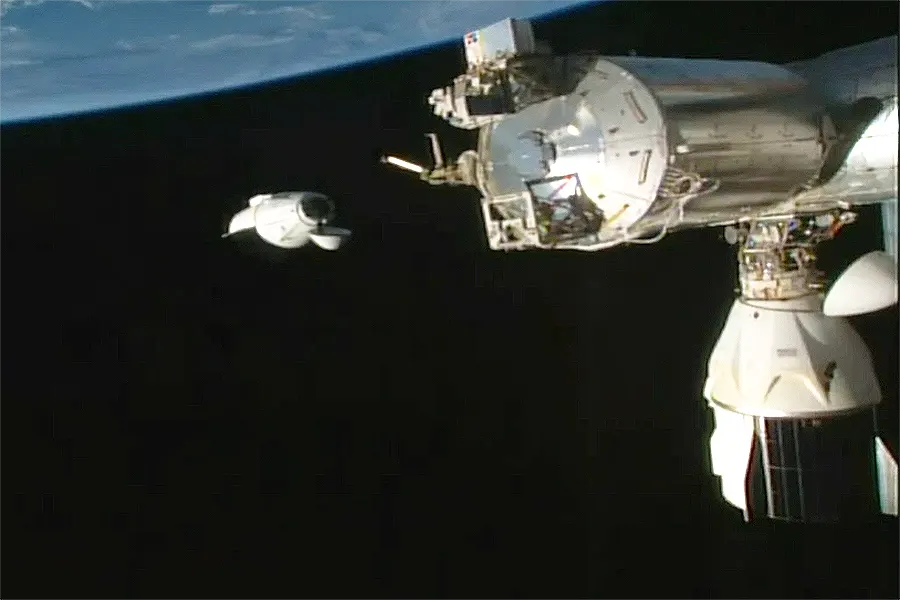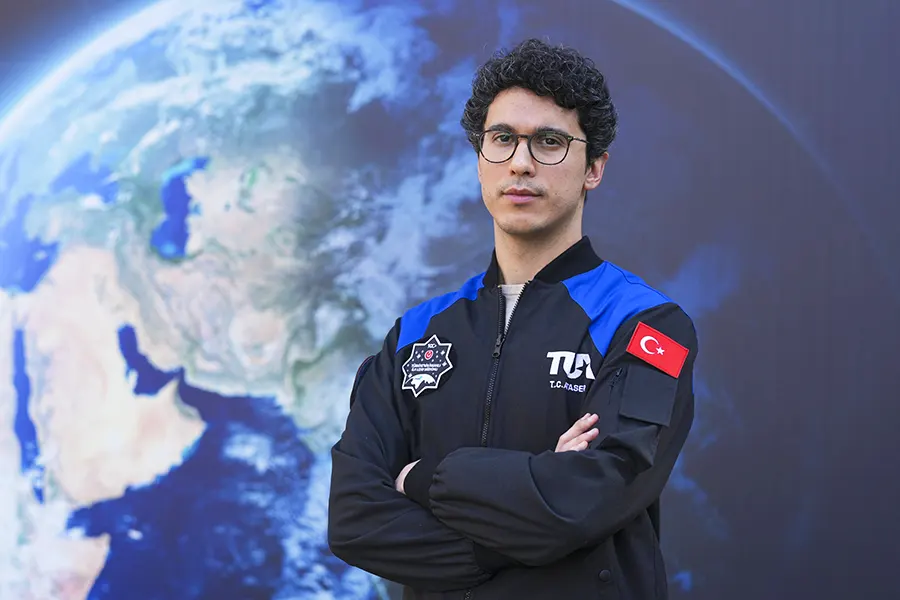
Tuva Cihangir Atasever, the second Turkish astronaut in history to travel into space, is preparing for his mission tomorrow aboard a Virgin Galactic rocket, which comes less than five months after the first Turkish astronaut travelled with a SpaceX Falcon 9 rocket to the International Space Station (ISS).
Atasever, who has announced that during his mission he will carry not only the Turkish flag but also the Azerbaijan’s flag on his suit because ‘just as these two nations are together on Earth, so will they be together during my journey into space’, made a statement to the Turkish state channel TRT Haber in which he spoke about his experience and his expectations just a few hours before the historic mission he will carry out tomorrow, 8 June.
‘If I had to describe this whole process in three sentences, they would be enormous excitement, unforgettable adventure, and indescribable pride,’ said the astronaut, who will carry out a total of seven scientific experiments during the mission for which he has been training for the past few months. ‘I am confident that the experiments we are going to conduct during this flight will make a significant contribution to space studies and research in our country,’ he said.
Speaking about the development of the space flight itself, Atasever explained that a Virgin Galatic VSS suborbital aircraft will fly to an altitude of approximately 14 km carried by a propulsion vehicle: at that point it will be released and its hybrid engines will be activated, taking it to an altitude of 90 km in just one minute, which will expose its occupants to an acceleration force of 4.5 G, reaching 3 times the speed of sound. The engines will then be shut down and the manned vehicle will enter a free-fall phase towards Earth: it is at this point that microgravity conditions will be reached for several minutes, and the experiments will begin.
“The purpose of space travel is to improve life on Earth”
“Three of the experiments will be carried out in a specially designed flight suit. After the start of the free-fall phase, which lasts about 3 minutes, our spacecraft will re-enter the Earth’s atmosphere. Since the rocket engine will have run out of fuel and there is no other propulsion system, we will land with a parachute,’ explained Atasever. “At this time the pilots have a great responsibility. The most important safety precautions during flight are those taken with parachutes. We have also received training for any emergency scenarios that may occur,’ he said.
“Our purpose for going into space, for working in space, is to improve life on Earth through science. This is the goal we are working towards. We are doing this to find new solutions and develop new technologies for many diseases, technological problems and other challenges of our age, and that people in our country and around the world are facing. Knowing that there is a possibility to make a contribution both to my country and to the world gives me enormous moral satisfaction,’ said the Turkish astronaut.
VOTE

EDITORIAL TEAM
🧿 About us
.
Edited and reviewed by:

Pablo Gómez is a specialist in Turkey and has been editor-in-chief of Hispanatolia since 2011. He has been analysing current affairs and geopolitics in Turkey and the surrounding region since 2006.
…
📣 Your ADVERTISING on Hispanatolia
.
🤗 HELP US WITH A DONATION:
💗 Paypal